Intermediate Python Mastery and Software Design
Advanced Data Structures
Beyond Lists and Dictionaries
You've likely used Python lists and dictionaries to solve a wide range of problems. They're the workhorses of Python data structures. But when applications grow in scale and complexity, relying only on these basic types can lead to slower, less readable, and less memory-efficient code.
Professional development often requires choosing the right tool for the job. Python offers a powerful built-in toolkit for this called the collections module. It provides specialized container types that are optimized for specific tasks, bridging the gap between general-purpose lists and custom-built classes.
Readable Data with NamedTuple
Imagine you're working with 2D coordinates. You might store a point as a tuple, like p = (10, 20). Accessing the data means using indices like p[0] and p[1]. This works, but it's not very expressive. What does index 0 represent? If you switch to a dictionary, p = {'x': 10, 'y': 20}, it's more readable but uses more memory and is slower.
A namedtuple offers the best of both worlds. It lets you create simple, immutable data structures that have named fields, just like an object, but with the memory footprint and speed of a regular tuple.
from collections import namedtuple

# Define the structure
Point = namedtuple('Point', ['x', 'y'])

# Create an instance
p1 = Point(10, 20)

# Access data by name or index
print(f"Access by name: {p1.x}, {p1.y}")
print(f"Access by index: {p1[0]}, {p1[1]}")
This code is instantly more readable. Anyone seeing p1.x immediately understands its meaning without needing to remember index positions. For creating simple, lightweight, and immutable data objects, namedtuple is an excellent choice. It's a stepping stone toward more complex structures like dataclasses, which offer more features like mutability and type hints.
Efficient Queues with Deque
A common task in programming is managing a queue, where items are added to one end and removed from the other (First-In, First-Out). You might try to use a Python list for this. Adding an item to the end with list.append() is fast. However, removing an item from the beginning with list.pop(0) is incredibly slow.
Why? Because a list is stored in a contiguous block of memory. When you remove the first element, every other element in the list must be shifted one position to the left. For a list with a million items, this means a million shifts, which is a major performance bottleneck.
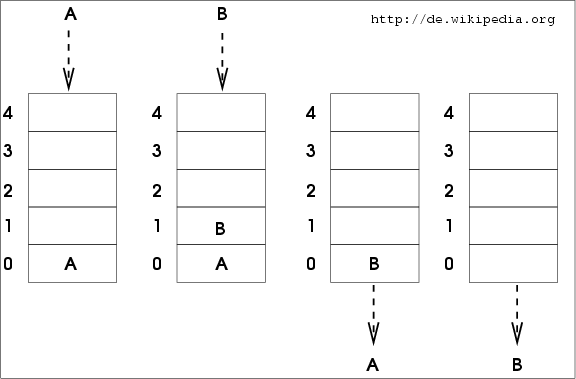
The collections module provides a solution: the deque (pronounced "deck"), which stands for double-ended queue. It's specifically designed for fast appends and pops from both ends. Internally, it's not a simple array but a doubly-linked list, which allows it to add or remove elements from either side in constant time, or complexity.
from collections import deque

# Create a deque
printer_queue = deque(['job1.pdf', 'job2.docx', 'job3.png'])

# Add a new job to the end of the queue
printer_queue.append('job4.txt')

# Process the first job in the queue
processed_job = printer_queue.popleft()

print(f"Processed: {processed_job}")
print(f"Remaining queue: {printer_queue}")
Using popleft() is the key here. It's just as fast as append(), making deque the ideal choice for implementing queues or any logic that requires efficient addition and removal from both ends of a sequence.
Smarter Dictionaries
Standard dictionaries are fantastic, but they have one common annoyance: KeyError. If you try to access or modify a key that doesn't exist, your program crashes. This often forces you to write extra code to check for a key's existence before using it.
Consider counting word frequencies in a text. The typical approach with a normal dictionary involves a conditional check for every single word.
# Standard dictionary approach
word_counts = {}
text = "this is a test this is only a test"

for word in text.split():
  if word in word_counts:
    word_counts[word] += 1
  else:
    word_counts[word] = 1

print(word_counts)
The defaultdict from the collections module cleans this up beautifully. When you create it, you provide a function (like int, list, or set) that will be used to generate a default value for any key that hasn't been seen before. The int() function, when called with no arguments, returns 0.
from collections import defaultdict

# defaultdict approach
word_counts = defaultdict(int)
text = "this is a test this is only a test"

for word in text.split():
  word_counts[word] += 1

print(word_counts)
The if/else block is gone. When the loop encounters a word for the first time, defaultdict automatically creates an entry for it with a value of 0 and then performs the addition. It’s cleaner and more efficient.
For the specific task of counting, Python provides an even more specialized tool: Counter. It's a dictionary subclass built for tallying hashable objects.
from collections import Counter

text = "this is a test this is only a test"

# The Counter does all the work
word_counts = Counter(text.split())

print(word_counts)
# Counter({'this': 2, 'is': 2, 'a': 2, 'test': 2, 'only': 1})
How Hashing Works
The incredible speed of dictionaries, sets, and their collections counterparts comes from a core computer science concept: .
When you add a key-value pair to a dictionary, Python doesn't search through all existing keys. Instead, it runs the key through a hash function, which converts the key (no matter its size) into a fixed-size integer called a hash value. This hash value is then used to calculate an index in the dictionary's underlying memory array where the value should be stored.
When you look up a key, Python performs the exact same process: it hashes the key, calculates the index, and retrieves the value directly from that memory location. This is why dictionary lookups are, on average, an operation. It takes roughly the same amount of time whether the dictionary has 10 items or 10 million.
Choosing the right data structure is a matter of understanding these trade-offs. A list is great for ordered sequences, but slow for searching. A dict or set offers near-instant lookups, but uses more memory and doesn't preserve insertion order (in older Python versions). A deque excels at queue operations. Knowing when to use each is a hallmark of an effective Python programmer.
Time to check your understanding of these specialized containers.
What is the primary advantage of using collections.namedtuple over a standard tuple for storing data like a 2D point?
Why is collections.deque the recommended data structure for implementing a FIFO (First-In, First-Out) queue in Python?
By moving beyond basic lists and dictionaries, you can write code that is not only faster and more memory-efficient but also clearer and easier to maintain.