Intermediate Calisthenics Mastery
Mastering Leverage Mechanics
Beyond More Reps
At a certain point, just adding more push-ups or pull-ups stops building maximum strength. You can do 50 push-ups in a set, but that builds endurance, not the raw power needed for advanced skills. To get stronger, you need to make the exercise itself harder. In weightlifting, you add more plates to the bar. In calisthenics, you change your body's leverage.
Instead of adding external weight, we manipulate internal physics.
This is the core of intermediate and advanced bodyweight training. It's not about how many reps you can do, but how much neurological demand and muscular force you can generate by altering your body's position. This is progressive overload achieved through mechanics, not mass.
Your Body as a Lever
Every exercise involves a force (your muscles contracting) and a lever (your bones). The difficulty of an exercise is determined by torque, which is the rotational force your muscles must overcome. The key variable you can control is the —the distance from the pivot point (like your shoulder or hips) to where the force is applied (your hands, feet, or center of mass).
Think about holding a heavy grocery bag. Holding it with your arm bent and the bag close to your body is easy. Holding it with your arm straight out to the side is much harder. The bag's weight hasn't changed, but by extending your arm, you've lengthened the moment arm, increasing the torque your shoulder has to work against.
This principle is how we create progressions. We start with a short moment arm and gradually lengthen it. This systematic increase in difficulty is what tells your muscles and nervous system to adapt and get stronger.
The most common leverage progressions are:
- Tuck: Knees are pulled into the chest. This keeps your center of mass very close to the pivot point, creating the shortest possible moment arm.
- Advanced Tuck: Your back is flat and parallel to the floor, with your thighs perpendicular to your torso. It's a stepping stone to extending the hips.
- Straddle: You extend your legs out to the sides. This lengthens the moment arm significantly but is still easier than the full version because the separated legs bring the average position of your center of mass closer to the pivot.
- Full: Legs are straight and together. This creates the longest possible moment arm and represents the peak difficulty for the movement.
The Scapula's Role
As leverage increases, the load on your entire body intensifies, especially on your shoulder girdle. Your scapulae (shoulder blades) must be strong and stable. Two key movements are critical: protraction and retraction.
is the act of pushing your shoulder blades forward and apart, like when you reach for something in front of you. In pushing movements like the planche or a push-up, active protraction creates a stable base and engages the serratus anterior muscles, which are crucial for shoulder health and strength.
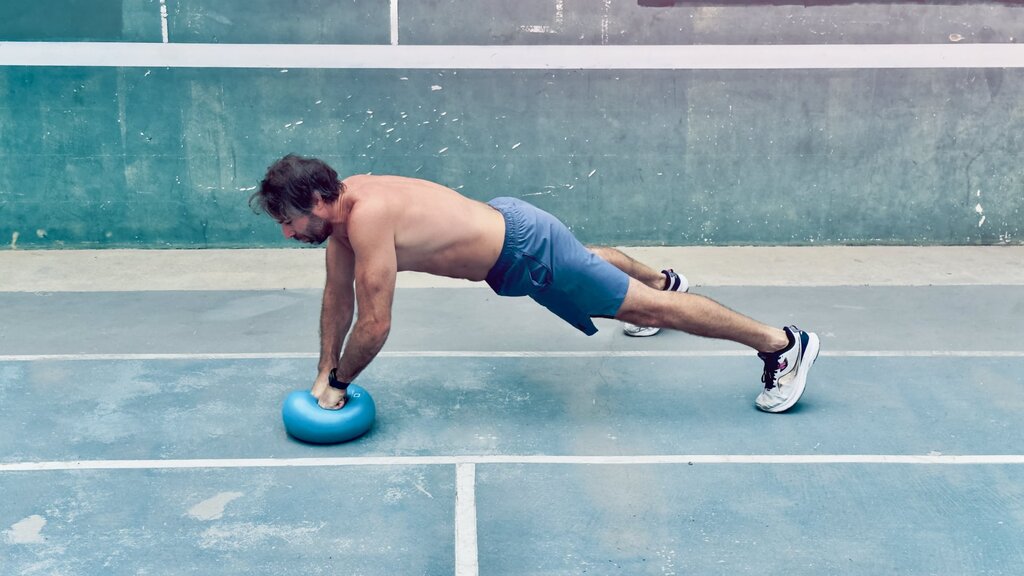
Retraction is the opposite: squeezing your shoulder blades together. In pulling movements like the front lever or rows, strong retraction is non-negotiable. It keeps your shoulders in a safe, powerful position and fully engages the muscles of your upper back, including the rhomboids and trapezius.
Mastering the ability to hold strong protraction or retraction under the immense torque of a long-lever exercise is a skill in itself. It’s what separates solid, safe technique from a high risk of injury.
With calisthenics, you achieve progressive overload by manipulating leverage, stability, and volume.
Ready to test your understanding of these principles?
In calisthenics, what is the primary method for achieving progressive overload to build maximum strength, rather than endurance?
What is the correct order of body positions for a leverage progression, starting from the easiest and moving to the hardest?
By focusing on these mechanical details, you shift your training from counting reps to mastering control. This is the path to unlocking high-level skills.