Intermediate Acoustic Guitar Mastery
Advanced Strumming Patterns
Syncopation: Playing Off the Beat
You've mastered the basic down-up strum. Your arm moves like a steady pendulum, keeping time. Now it's time to add groove. The secret is syncopation: intentionally playing on the off-beats to create rhythmic tension and interest.
Think of a standard count in music: 1 & 2 & 3 & 4 &. The numbers are the downbeats, the moments your foot would naturally tap. The '&'s are the upbeats. Syncopation happens when you emphasize these upbeats or skip the expected downbeats.
Syncopation is what makes a rhythm feel less like a march and more like a dance. It's the shuffle in blues and the bounce in funk.
A great syncopated pattern to start with is Down, Down-Up, (miss), Up, Down-Up. It’s counted like this:
1, 2 &, 3 &, 4 &
Notice the strum you don't play on beat 3. This is a "ghost strum" or a miss. Your hand should continue its downward motion, but you intentionally miss the strings. This keeps your timing solid while creating the syncopated feel. This pattern is a workhorse in countless pop and rock songs. Practice it slowly with a metronome until the rhythm feels natural.
Percussion and Muting
Once you're comfortable with syncopation, you can add texture. Percussive strumming and muting turn your guitar into a rhythm machine, adding sharp, punchy sounds that mimic a drum kit.
Percussive Strumming: This involves hitting the strings to create a snare-like slap. On a downstroke, instead of picking the notes, you lightly slap the strings with the fleshy part of your palm near your thumb. The goal is a clean, muted thwack without much ringing pitch. It’s often used on beats 2 and 4 to simulate a snare drum.
Palm Muting: This is a more subtle technique used to deaden the strings and create a tight, chunky sound common in rock and funk. Rest the edge of your strumming hand gently on the strings, right where they come out of the bridge. Don't press too hard, or you'll mute the notes completely. You want to dampen the sustain, not kill it. This gives your rhythm playing a focused, punchy quality.
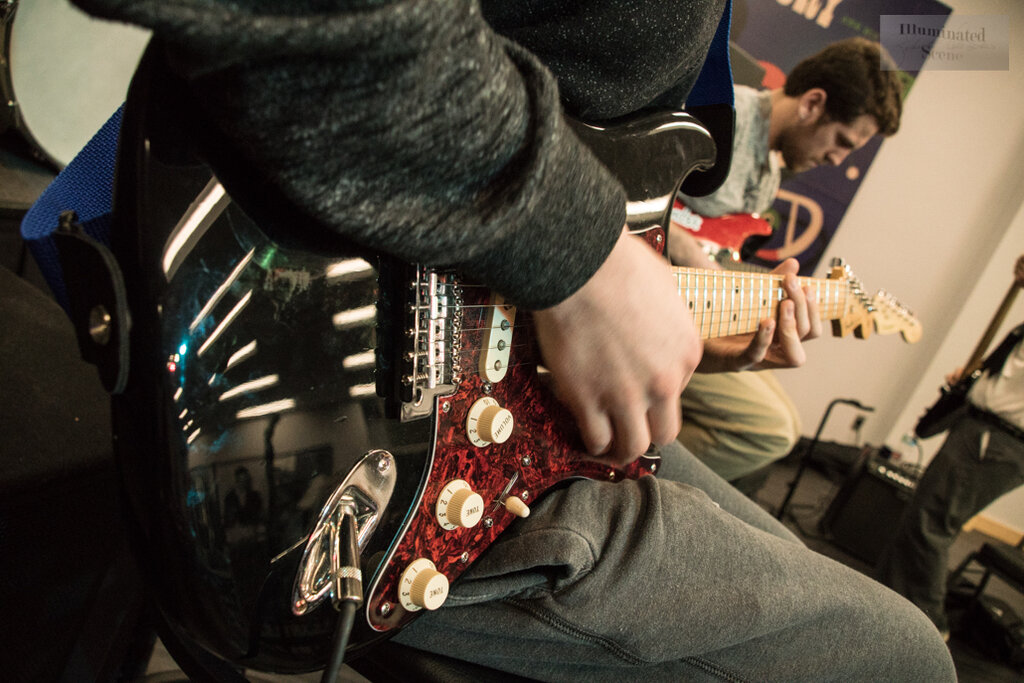
Let's combine these. Try this funk-inspired pattern using palm muting throughout:
Down-(slap), Up, Down, Up-(slap)
Here, you'd play a muted downstroke on beat 1, a percussive slap on beat 2, and then a few more muted strums. Experiment with where you place the slap. This combination of muted notes and percussive hits is the foundation of many funk and R&B guitar parts.
Building Speed and Consistency
Applying these techniques requires a solid rhythmic foundation. Speed is a byproduct of accuracy, not the other way around. Trying to play fast before you can play cleanly and in time only builds bad habits.
Use a metronome. Always. Start at a tempo where you can play a pattern perfectly, with no mistakes. We're talking painfully slow, like 60 beats per minute (BPM). Play the pattern over and over. When it feels effortless, increase the tempo by just 4-5 BPM. Stay there until it's perfect again. This gradual process builds muscle memory correctly.
Keep your strumming hand moving like a pendulum — even on the “rests” or when skipping a hit.
The key is to keep your arm relaxed. Tension is the enemy of speed and stamina. If you feel your wrist or forearm tightening up, stop. Shake it out and start again at a slower tempo. Your motion should come from your elbow and a slight rotation of your forearm, not just your wrist. This larger motion is more efficient and less likely to cause fatigue.
Practice these patterns with chord changes you already know well. This lets you focus all your attention on your strumming hand. Once the rhythm is locked in, you can apply it to learning new songs.
Ready to test your understanding of these rhythmic concepts?
What is the primary goal of syncopation in a guitar strumming pattern?
In the strumming pattern counted 1, 2 &, (miss), 4 &, what should your strumming hand be doing on beat 3?
Mastering these techniques will add a new level of expression and professionalism to your playing. They transform simple chord progressions into compelling musical statements.