Image Diffusion Models Explained
Introduction to Diffusion Models
From Noise to Art
Imagine a sculptor who works backward. Instead of starting with a block of marble and chipping away, they start with a cloud of dust and magically guide each particle into place to form a statue. This is the core idea behind diffusion models, a powerful type of AI that creates new data, like images, from pure randomness.
Diffusion models are a class of generative models. While some AIs are trained to recognize things (like telling a cat from a dog) or predict outcomes, generative models are designed to create. They learn the underlying patterns in a set of data so well that they can produce brand new examples that look just like the real thing.
The Two-Step Process
The genius of diffusion models lies in a two-part process: one that destroys an image and one that learns to rebuild it.
- The Forward Process: Take a perfectly clear image and slowly add a little bit of random noise, step by step. Repeat this until the original image is completely lost in a sea of static. This seems destructive, but it creates a perfect set of training examples for the AI, showing it exactly how an image can dissolve into noise at every stage.
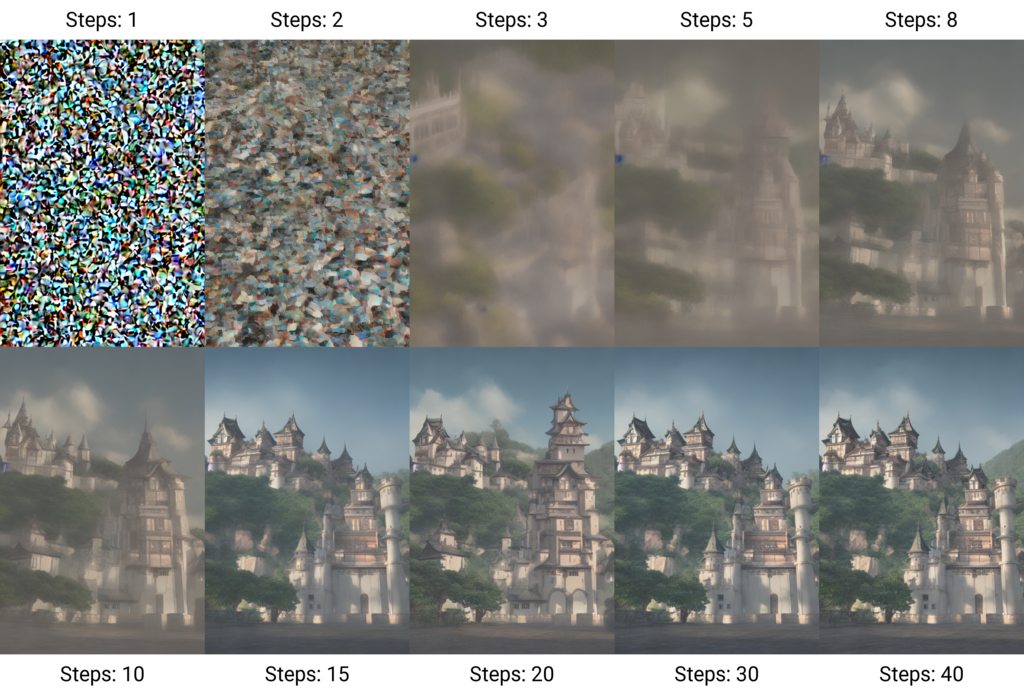
- The Reverse Process: This is where the learning happens. The model is trained to reverse the damage. It looks at a noisy image and learns to predict what the slightly less noisy version of it was. It does this over and over again for all the images in its training data.
After enough training, the model becomes an expert at denoising. It can start with a completely random pattern of static—something it has never seen before—and apply its knowledge in reverse. Step-by-step, it removes the noise, uncovering a coherent, detailed, and completely new image.
Why Diffusion Models Stand Out
Before diffusion models became popular, two other types of generative models were common: Generative Adversarial Networks (GANs) and Variational Autoencoders (VAEs).
GAN
noun
A generative model that pits two neural networks against each other: a generator that creates images and a discriminator that tries to spot the fakes.
GANs can produce sharp images, but training them is notoriously difficult. The two competing networks have to be perfectly balanced, and if they aren't, the training can fail. VAEs are more stable but often produce blurrier, less detailed results.
Diffusion models hit a sweet spot. Their training process is stable and they can generate images with stunning quality and diversity, often surpassing what was possible with GANs. This breakthrough has made them a leading technology for AI image generation, powering many of the text-to-image tools we see today.
Now, let's test your understanding of these core concepts.
What is the primary function of a diffusion model?
The training of a diffusion model is described as a two-part process. What are these two parts?
By learning to reverse a process of gradual decay, diffusion models have learned a powerful new way to create.