How do touchscreens work?
Touchscreens are incredible pieces of everyday magic, and I would love to break down how they work for you! To make sure I tailor this explanation perfectly to your style, let's start with a quick question about what you're hoping to get out of our session.
Are you more interested in a high-level conceptual overview of how they work, or would you like to dive straight into the finer technical details, like the electrical components involved?
I want to dive into the technical details

- Capacitive touchscreens (found in your smartphone, which rely on the electrical charge in your own body)
- Resistive touchscreens (found in ATMs, which rely on physical pressure pushing two flexible layers together)
Make me a diagram comparing capacitive and resistive layouts
You got it! Let's lay out these two technologies side-by-side so you can see exactly how their internal architectures differ physically and mechanically.

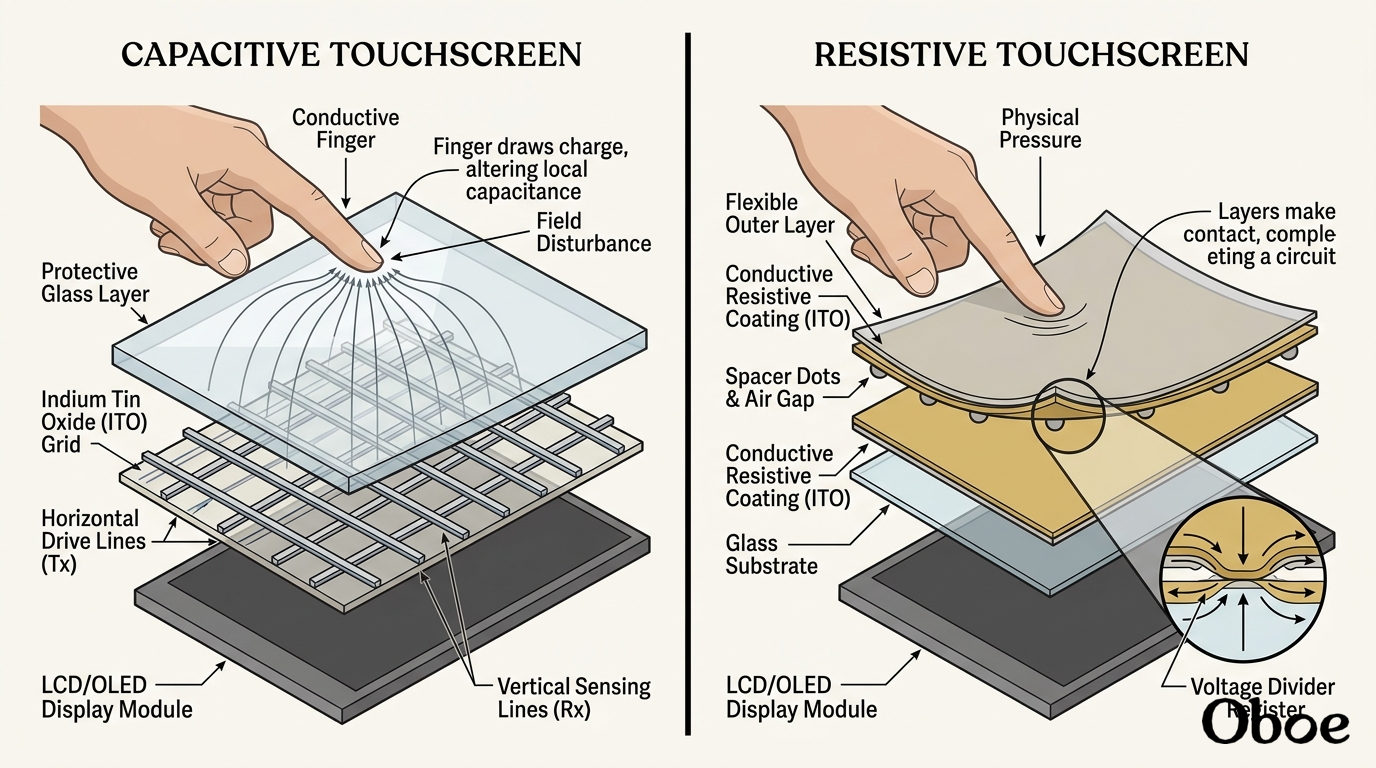
This diagram showcases the fundamental difference in how they detect your input.
On the left, the is entirely solid-state and relies on a continuous electrostatic grid. Because it reacts to electrical changes, it doesn't need to physically move to register a touch.
On the right, the acts like a physical switch. It requires actual mechanical pressure to bend the top layer so that it physically touches the bottom layer, completing a localized circuit.
Now that you have the visual layout down, shall we dive into the specific physics of how that capacitive electrical grid senses your finger?
Why can't capacitive screens work with standard gloves?
Explain how the capacitor grid itself works
- Drive lines: Horizontal rows of electrodes that continuously transmit an alternating electrical current.
- Sensing lines: Vertical columns of electrodes that constantly monitor and receive that current.
A touch-sensor grid of horizontal blue drive lines and vertical orange sensing lines, with electrostatic field bubbles at each intersection, showing one bubble shrunken at the point of fingertip contact.