No history yet

diagram of a canal lock for year 4 class following UK Curriculum

The Water Staircase

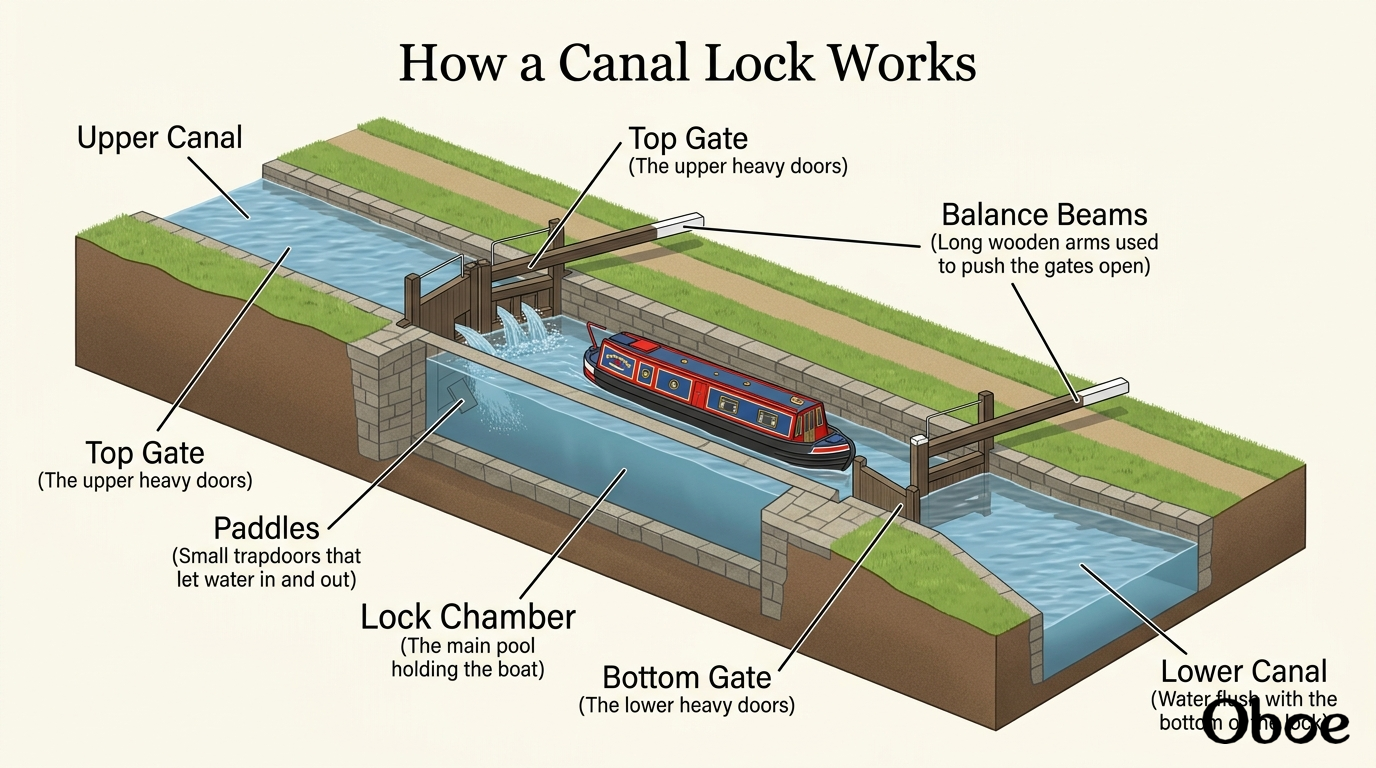
Canals are like watery roads, but there's a big problem: water likes to stay completely flat, while the countryside has lots of hills! To help boats travel up and down these hills, engineers built . Think of a canal lock as a giant, clever water staircase. Instead of a boat trying to climb a steep slope, it steps into a special chamber that works just like an elevator powered entirely by gravity and water pressure.
DIAG
Diagram
Generated course diagram
I've started generating a colorful diagram to show you exactly what these locks look like. Before we look at how the water moves, let's make sure we know the main parts of our water elevator. The main box where the boat parks is called the chamber. It has heavy doors at each end called gates, and tiny secret trapdoors inside them called paddles that let the water sneak in and out.

Who invented canal locks?

That is a brilliant question! Modern canal locks are actually a team effort across history, but the famous inventor is the genius who perfected the design we still use on canals today in the UK.
Before Leonardo and other Renaissance engineers came along, traveling over hills was a total nightmare. Let's look at why canal locks were such a game-changing invention in the first place.

The Tough Way: Dragging and Slopes

Imagine you are a canal merchant from hundreds of years ago. You have a massive wooden boat loaded with heavy bags of coal or fresh food. Suddenly, you reach a steep hill. Before locks existed, there were only two options, and both of them were exhausting:
  1. Unload everything: You would have to carry every single heavy box up the hill by hand, pull the empty boat up, and reload it at the top.
  2. The slipway drag: Teams of people, horses, or oxen had to use ropes and pure muscle power to drag the incredibly heavy, loaded boat up wet, slippery wooden slopes called or slipways.
This was not only painfully slow, but if a rope snapped, the boat would hurtle backward, destroying the cargo and endangering the workers.
Leonardo's clever lock chamber solved all of this. Instead of fighting the hill, engineers used gravity and water to let the boat lift itself. It turned a dangerous, exhausting day of manual labor into a smooth, peaceful 10-minute float.

How heavy are those wooden lock gates?

Those wooden lock gates are absolutely massive! On UK canals, a single lock gate can easily weigh between two and four tonnes—which is about the same weight as a fully grown female !
Because they are so incredibly heavy and spend all their lives dunked in wet, muddy water, they have to be made from extremely tough, solid wood. Traditionally, British canal locks are handcrafted from massive logs of oak or elm. If you tried to push a four-tonne gate open normally, it wouldn't budge at all. That is where the long, heavy wooden arms stretching out from the gates come in. These are called balance beams, and they use the magic of leverage to make pushing them open surprisingly easy.

A top-down structural schematic of a canal lock gate pivoting on a hinge, with a long balance beam extending outward to show leverage positions.

Think of it like a playground seesaw. If you try to lift someone by pushing right next to the middle pivot, it's really hard. But if you stand right at the very end of the seesaw, it's a breeze! The long balance beam lets you stand far away from the heavy hinge, giving you the extra leverage you need to swing the gate open with your feet firmly planted on the ground.

Show me a diagram of leverage on a gate

You've got it! To help us see exactly how physics makes opening these massive gates possible, let's look at a diagram of a lock gate from above. This shows how a long acts as a powerful lever.

A top-down diagram of a lock gate lever system showing mechanical advantage.

Look at how much longer the balance beam is compared to the gate itself! This distance is the secret to . By pushing at the very end of the long beam, you are traveling a longer distance in a wide circle, but it requires only a fraction of the force to swing the gate open.

Continue to the step-by-step process of moving uphill

Going Uphill: Filling the Chamber

Now we are ready to see the real magic of the canal lock! Let's pretend we are driving a narrowboat and we want to go uphill. Right now, our boat is sitting in the lower canal, and we are looking up at a high stone wall with the top lock gates shut tight. Before we can float our boat into the , we have to make sure the water inside it is at the exact same level as the water our boat is currently floating on.

Step 1 of 3 for going uphill through a canal lock, showing a narrowboat waiting outside the closed bottom gate while the chamber is filled with high water.

To get our boat inside, we first need to empty the chamber so the water level drops to meet us. We do this by winding open the bottom to let the water drain out into the lower canal. Once the chamber is empty and the water inside is flat and level with our boat, we can easily swing the heavy bottom gates open and steer our boat right inside the stone chamber.