Git and GitHub Essentials
Introduction to Version Control
What Is Version Control?
Have you ever worked on a document and saved multiple copies? You might have files named report_draft, report_v2, and report_FINAL_I_swear_this_is_it.docx. It's a messy way to track changes. Now imagine ten people trying to edit that same document at once. Someone's changes will inevitably get lost or overwritten.
This is a common problem in software development, where teams of programmers collaborate on the same codebase. Version control systems (VCS) were created to solve this chaos. They are software tools that help a team manage changes to a set of files over time.
version control
noun
A system that records changes to a file or set of files over time so that you can recall specific versions later.
Instead of saving dozens of file copies, a VCS stores a history of every change. It acts like a time machine for your project, allowing you to see who changed what, when they changed it, and why. If a new change breaks the software, you can easily revert to a previous, working version.
The diagram shows the difference clearly. Without version control, collaboration leads to confusion. With it, every contribution is tracked in an orderly history.
The Benefits
Using a version control system is a fundamental practice in modern software development. It offers several key advantages.
Collaboration: Multiple developers can work on the same project simultaneously without interfering with each other's work. The VCS helps merge these different changes together.
Think of it like a shared document where everyone can write on their own transparent overlay. Later, you can merge these overlays together, resolving any spots where two people wrote in the same place.
History and Auditing: A VCS maintains a complete history of every change made to the project. You can see who made a change, what the change was, and why it was made (via commit messages). This is invaluable for debugging and understanding how the project has evolved.
This historical log is a safety net. If a feature that used to work suddenly breaks, you can look back through the history to pinpoint exactly which change caused the problem.
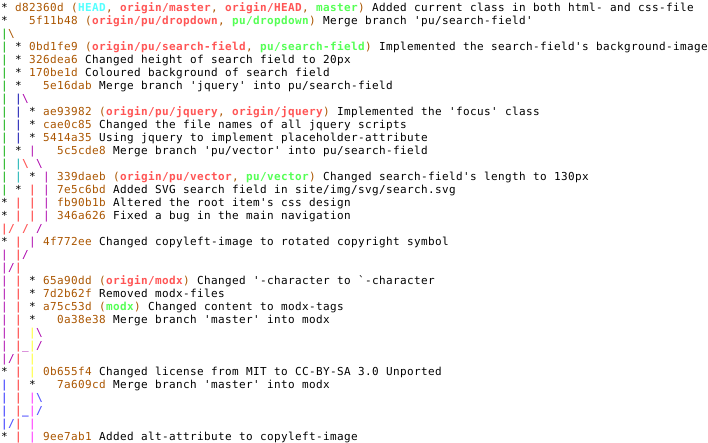
Branching: Developers can create independent branches to work on new features or fix bugs without affecting the main, stable version of the project. Once the work is complete and tested, the branch can be merged back into the main line.
This lets you experiment freely. If an idea for a new feature doesn't work out, you can simply discard the branch, and the main project remains untouched and stable.
Types of Systems
Version control systems generally fall into two categories: centralized and distributed.
In a Centralized Version Control System (CVCS), there is a single central server that contains all the versioned files, and a number of clients that check out files from that central place. For many years, this was the standard. Subversion (SVN) and Perforce are examples of centralized systems.
The main drawback is the single point of failure. If that central server goes down, nobody can collaborate or save versioned changes. If the central database is corrupted, you lose the entire history of the project.
In a Distributed Version Control System (DVCS), clients don’t just check out the latest snapshot of the files; they fully mirror the repository, including its full history. Every clone is a full backup of all the data. Git and Mercurial are popular examples.
This approach is more robust. If any server dies, any of the client repositories can be copied back up to the server to restore it. Every checkout is a full backup of the project's history.
Git is an open-source distributed version control system that helps developers manage and track changes to their code over time.
Because of its flexibility and resilience, the distributed model, particularly Git, has become the dominant approach for version control today. It provides a powerful framework for tracking changes, collaborating with others, and managing code history efficiently.
Now, let's test your understanding of these core concepts.
What is the primary problem that a Version Control System (VCS) is designed to solve?
What is a key disadvantage of a Centralized Version Control System (CVCS)?
Understanding version control is the first step toward more organized and collaborative software development. It's a foundational skill that helps teams build better software, faster.