Getting Started with Quantum Computing Languages
Introduction to Quantum Computing
Beyond Bits and Bytes
Classical computers, from your smartphone to the most powerful supercomputers, are built on a simple foundation: the bit. A bit is a switch that can be in one of two states, either 0 or 1. All the amazing things classical computers do boil down to manipulating billions of these tiny on-or-off switches.
Quantum computing operates on a completely different principle. Instead of bits, it uses quantum bits, or qubits.
Qubit
noun
The basic unit of quantum information. Unlike a classical bit, a qubit can represent a 0, a 1, or both values at the same time.
How can a qubit be both 0 and 1 simultaneously? It leverages a core principle of quantum mechanics called superposition. Think of a spinning coin. While it's in the air, it’s neither heads nor tails. It's in a combination of both states. Only when it lands and you measure it does it settle into a definite outcome.
A qubit is like that spinning coin. It exists in a superposition of both 0 and 1, holding a certain probability for each. When measured, its superposition collapses, and it randomly settles into one of the two definite states.
Mathematically, we can describe the state of a qubit, written as (pronounced "ket psi"), like this:
A Spooky Connection
The other mind-bending principle that gives quantum computers their power is entanglement. This is a special connection between two or more qubits. When qubits are entangled, their fates are linked, no matter how far apart they are.
Imagine you have two entangled qubits. If you measure one and find it in the state , you instantly know the other qubit is in a corresponding state. This happens even if the second qubit is on the other side of the galaxy. The information about the first qubit's state seems to be communicated to the second one faster than the speed of light.
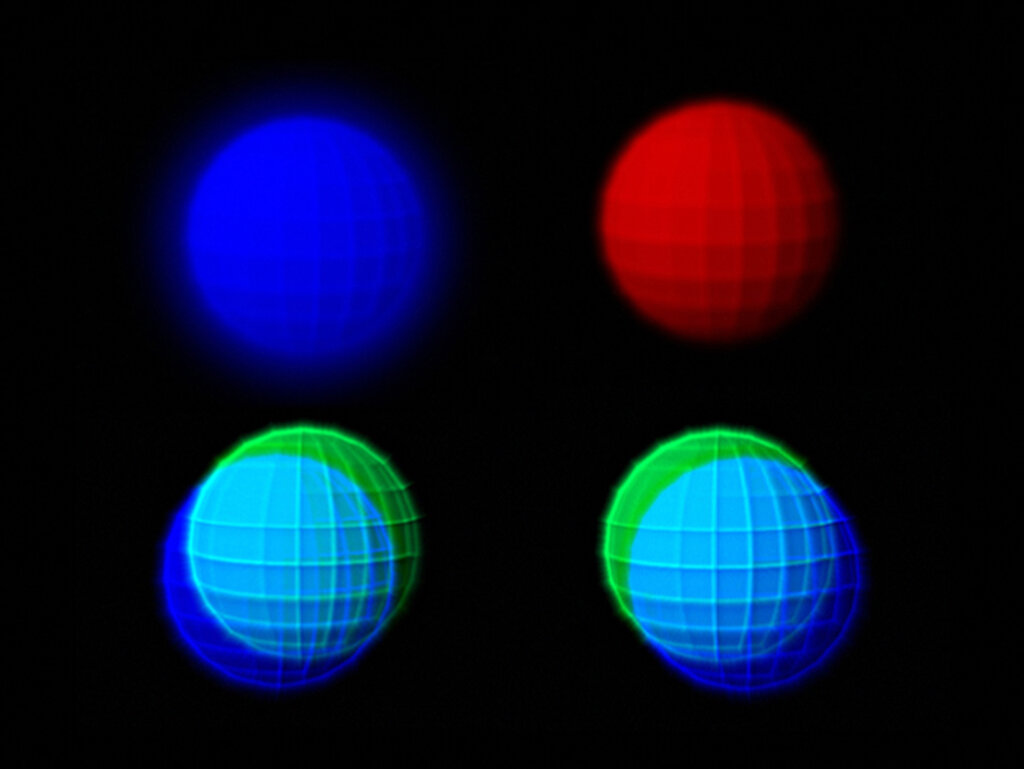
This linked behavior allows for powerful computational tricks. By manipulating one qubit in an entangled pair, you can indirectly control the other, leading to highly coordinated calculations that are impossible in classical computing.
Quantum vs. Classical
Superposition and entanglement are the key differentiators between classical and quantum computing. They allow quantum computers to explore a vast number of possibilities simultaneously.
| Feature | Classical Computing | Quantum Computing |
|---|---|---|
| Basic Unit | Bit (0 or 1) | Qubit (0, 1, or both) |
| State | Definite (either 0 or 1) | Probabilistic (superposition) |
| Key Principles | Logic gates | Superposition & Entanglement |
| Scalability | Linear (N bits store N values) | Exponential (N qubits store 2^N values) |
A classical computer with 4 bits can only represent one of 16 ($2^4$) possible combinations at any given time. But a quantum computer with 4 qubits can represent all 16 combinations at once thanks to superposition. As you add more qubits, this computational power grows exponentially.
This doesn't mean quantum computers will replace your laptop. They are specialized machines designed to solve certain types of complex problems that are intractable for even the most powerful classical supercomputers, like simulating molecules for drug discovery or breaking complex cryptographic codes.
The power of a quantum computer comes from its ability to process information in a fundamentally different way, exploring many paths at once instead of one at a time.
Time to check your understanding of these foundational ideas.
What is the fundamental unit of information in a quantum computer?
The principle that allows a qubit to represent both 0 and 1 at the same time is called:
With these concepts of qubits, superposition, and entanglement, you now have the building blocks to understand how quantum computation works.