Geometric Constructions Essentials
Introduction to Geometric Tools
The Basic Toolkit
Geometry is a lot like building. To construct shapes and prove ideas, you need a specific set of tools. For centuries, geometers have relied on three simple instruments: the straightedge, the compass, and the protractor. Each has a precise job, and learning to use them correctly is the first step toward mastering geometric construction.
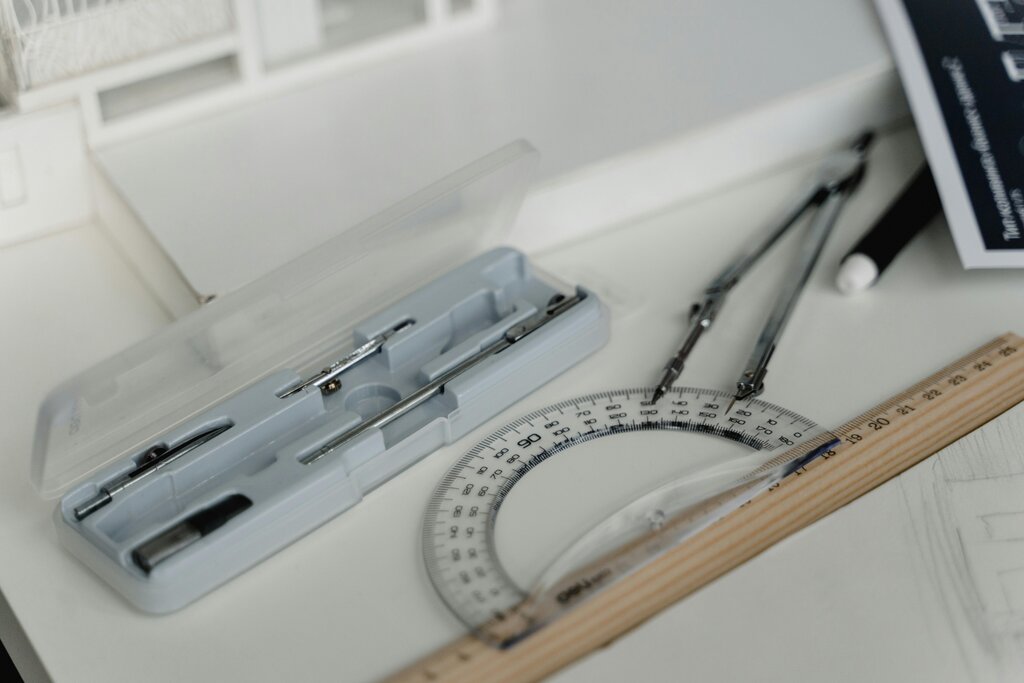
The Straightedge for Lines
The most basic tool is the straightedge. Its only purpose is to draw a straight line. You can use it to connect two points or extend a line segment indefinitely in either direction. Think of it as a guide for your pencil.
In pure, classical geometry—often called Euclidean geometry—we use an idealized version of this tool. A true straightedge has no markings. It can’t measure length. It only draws straight lines. The rulers we use in school are straightedges with measurement marks added. For most constructions, we'll use our ruler as a straightedge, but it's important to remember this distinction. The challenge of classical geometry was to build everything using only an unmarked straightedge and a compass.
Straightedge
noun
A tool used to draw, or check the straightness of, lines. In idealized geometry, it has no measurement markings.
To get the best results from your straightedge or ruler, always press it firmly against the paper so it doesn't slip. Keep its edge clean and free of nicks, as any imperfection can transfer to the lines you draw.
The Compass for Circles
Next is the compass, the tool for drawing perfect circles and arcs. A compass has two legs connected by a hinge. One leg has a sharp point that you place at the center of your circle, and the other holds a pencil to draw the curve.
The distance between the point and the pencil tip is the circle's radius. By keeping this distance constant as you rotate the compass, you ensure every point on the curve is exactly the same distance from the center.
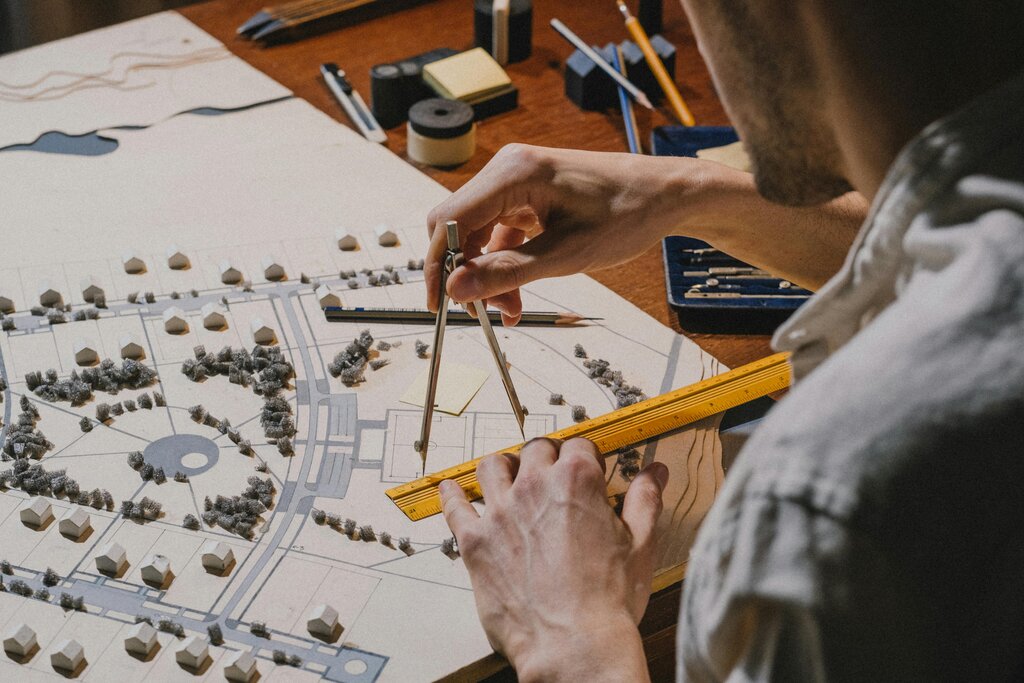
The compass used in ancient Greece was imagined as a "collapsing" tool. Once you lifted it from the paper, it would spring shut, losing the radius you had set. Modern compasses are rigid and hold their setting, which makes it easy to transfer distances from one part of a drawing to another. Luckily, mathematicians have proven that anything possible with a modern compass can also be achieved with a collapsing one, so we can use ours with confidence.
When using a compass, hold it by the top handle and lean it slightly in the direction you're drawing. Apply gentle, steady pressure to create a clean line without digging into the paper.
The Protractor for Angles
While the straightedge and compass are the only tools allowed in classical Euclidean constructions, a third tool is essential for measurement: the protractor. Its job is to measure and draw angles.
Protractor
noun
A tool, typically a semicircle marked with degrees from 0 to 180, used for measuring or drawing angles.
Most protractors are semicircles marked with degrees from 0° to 180°. To measure an angle, you place the protractor's center hole over the angle's vertex and align the 0° line with one side of the angle. Where the other side of the angle crosses the scale, you can read its measurement in degrees.
Protractors often have two scales, one running clockwise and the other counterclockwise. This lets you measure angles starting from either the right or the left. Just be sure to read from the correct scale—the one that starts at 0° on the first side of your angle.
In classical Euclidean geometry, what is the sole purpose of a straightedge?
The distance between the compass point and the pencil tip determines the circle's __________.
With these three tools, you have everything you need to begin exploring the world of geometry. Proper care and precise use will make your constructions accurate and your discoveries clear.