
Oboe
No history yet

geology on mars

Welcome! I'm really excited to explore Mars with you. Before we launch into the Red Planet's fascinating history, I'd love to know a bit about you to help tailor our journey.

What is your background in science or geology, and is there anything specific about Martian geology that caught your eye?

I'm really interested in the history of water on Mars and the search for ancient life.

It's wonderful to have you on board! Since your main interest is the history of water and the search for ancient microbial life, we'll make sure to highlight how Mars's rocks act as a physical archive for those ancient, wet environments.

Your path
Major Surface Features
Water and Climate History
Current Exploration and Discoveries

What is Martian Geology?

To understand where water used to flow, we first have to look at the overall planetary canvas. Planetary scientists actually have a specialized name for the study of Martian geology: . This term combines the Greek god of war, Ares, with the study of rocks, giving us a dedicated framework for looking at how Mars's crust and interior evolved.
At its core, areology helps us map the planet's history by studying its solid structures. Because Mars does not have active plate tectonics recycling its crust like Earth does, its surface acts as a giant time capsule. Some of the rocks we see on Mars today are over 4 billion years old, offering a pristine window into the early solar system—and the exact eras when liquid water was active on its surface.

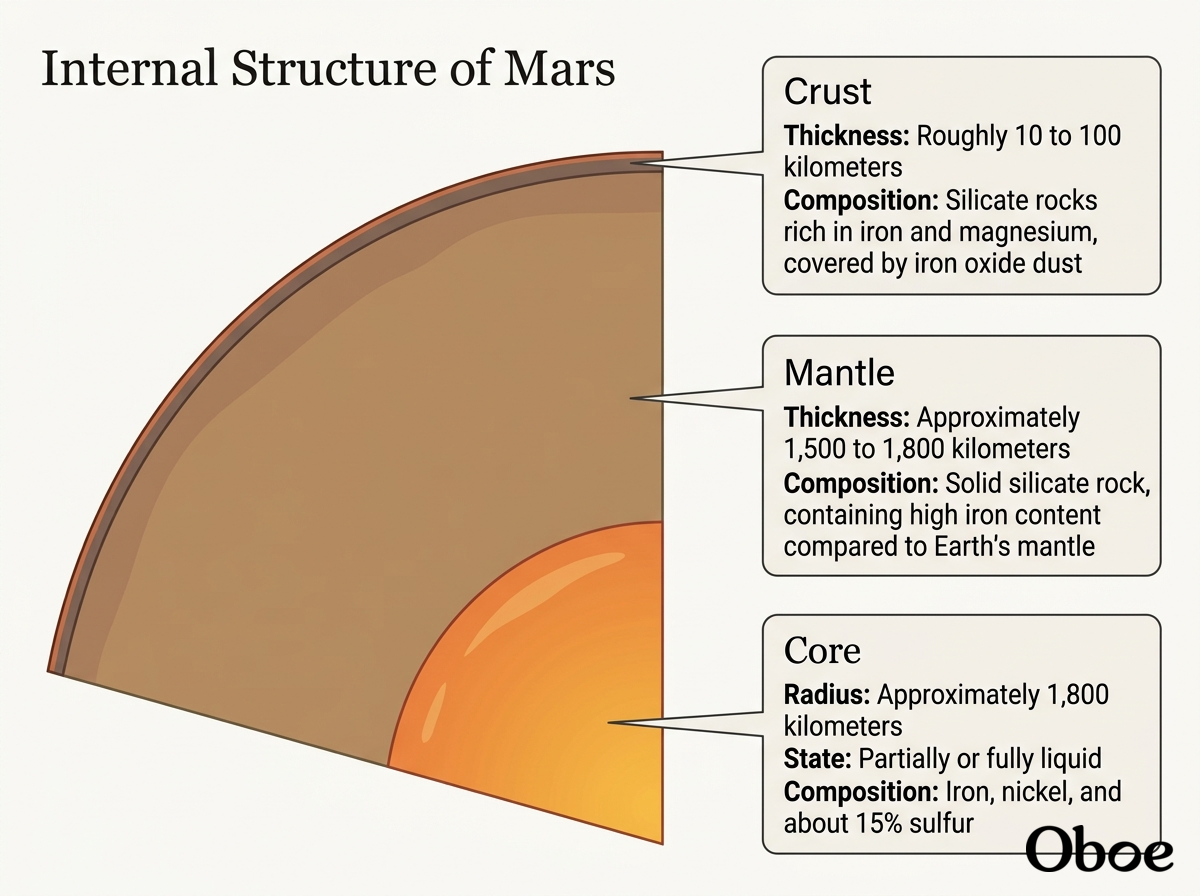
Make a diagram of Mars's internal layers

I would be happy to show you how Mars is put together! Let's take a look inside the planet to see what layers make up its interior.

DIAG
Diagram
Generated diagram
I've started generating that diagram of Mars's internal layers for you. While it processes, we can look at what makes this interior structure so unique compared to Earth. Just like Earth, Mars is divided into a crust, a mantle, and a core. However, because Mars is smaller, it cooled down much faster after its formation. This rapid cooling caused its outer layer, the , to freeze into a single, thick, unbroken shell. On Earth, our lithosphere is broken into moving puzzle pieces called tectonic plates. Because Mars lacks this plate movement, there are no subduction zones to recycle its crust. As a result, its surface remains incredibly ancient, preserving billions of years of history.