Full Stack Architecture and Deployment
Modern Architecture
From Monoliths to Microservices
Early web applications were often built as monoliths. Imagine a single, massive building that houses every department of a company: sales, marketing, engineering, and customer support. All the code for the user interface, business logic, and data access was tightly coupled in one large codebase. If the marketing department needed an update, the entire building had to be renovated and temporarily closed. This made updates slow, risky, and difficult to manage as the company grew.
Modern applications have shifted towards distributed systems, often using a microservices architecture. Instead of one giant building, the company now has a campus of smaller, specialized buildings. Sales has its own office, marketing has its own, and so on. Each building, or service, is independent. It has its own team, its own data, and can be updated without disturbing the others. They communicate with each other through well-defined pathways, or APIs.
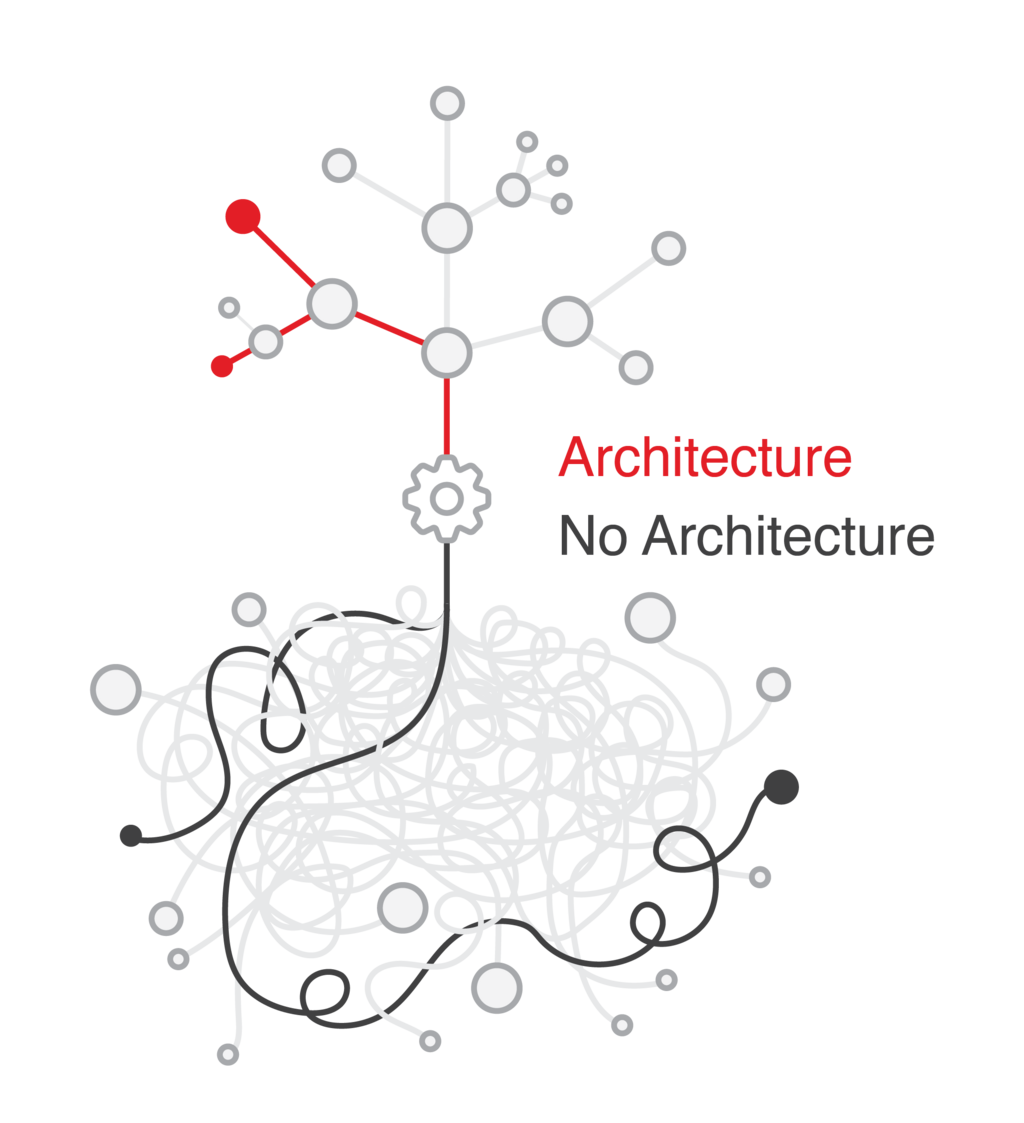
This approach allows teams to work in parallel, use different technologies best suited for their specific task, and scale individual services as needed. If the sales app gets a surge in traffic, you can add more resources just for that service, rather than scaling the entire monolithic application. This separation is a core principle of modern development.
Where Code Runs
A key decision in modern architecture is where to render the user interface. This choice has huge implications for performance, user experience, and SEO. The main strategies are Client-Side Rendering (CSR), Server-Side Rendering (SSR), and Static Site Generation (SSG).
Modern frameworks like Next.js and Remix don't force you to pick just one. They operate on the boundary between the client and the server, allowing you to choose the best rendering strategy on a page-by-page basis. A marketing landing page might be statically generated (SSG) for maximum speed, while a user dashboard with real-time data would be server-rendered (SSR) or even client-rendered (CSR).
This flexibility has led to hybrid approaches like Incremental Static Regeneration (ISR), where a static page can be rebuilt automatically in the background after a certain amount of time, giving you the speed of static with the freshness of dynamic content.
Keeping It Clean
Regardless of how you render your app, a clean architecture is vital for scalability. A common and time-tested pattern is the three-tier architecture. It separates an application into three logical layers:
| Tier | Responsibility | Example |
|---|---|---|
| Presentation Tier | The user interface. This is what the user sees and interacts with. | React components, HTML, CSS. |
| Logic Tier | The brains of the operation. It handles business rules, processes data, and coordinates tasks. | API endpoints, server-side functions. |
| Data Tier | Responsible for storing and retrieving data. | Databases (like PostgreSQL or MongoDB), file storage. |
By keeping these concerns separate, you can modify one tier without breaking the others. You could completely redesign your user interface (Presentation Tier) without touching the business logic. Or you could switch your database (Data Tier) as long as the Logic Tier can still communicate with it. This separation makes the application easier to maintain, test, and scale over time.
Building scalable applications with React Js is not just about writing components it’s about designing an architecture that grows with your project, adapts to new features, and remains easy to maintain for years.
Closer to the User
In a global application, latency is a killer. If your server is in Virginia, a user in Tokyo will have a slower experience than a user in New York, simply because of the physical distance data has to travel. Modern architecture solves this with the Edge network.
CDN
noun
A Content Delivery Network (CDN) is a geographically distributed group of servers that work together to provide fast delivery of Internet content. They cache content like images, CSS, and even entire static pages in locations close to users.
The "Edge" takes this a step further. Instead of just caching static files, edge networks can run code. This means you can run server-side logic in a data center in Tokyo, just for the user in Tokyo. This drastically reduces latency for dynamic, personalized content, not just static assets. It brings the compute power closer to the user, making the entire web feel faster and more responsive, no matter where you are.
Now, let's test your understanding of these architectural concepts.
What is the primary advantage of a microservices architecture compared to a monolithic one?
Why would a modern framework like Next.js support different rendering strategies (CSR, SSR, SSG) on a page-by-page basis?
Understanding these architectural patterns is the first step in building robust, professional-grade applications that can stand the test of time and scale.