i want to learn physic
Welcome! I'm absolutely thrilled to help you explore the universe through physics. It's one of the most rewarding journeys you can take.
To make sure we set just the right pace and depth for our sessions, could you tell me a little bit about what brings you here? For instance, are you studying for a class, or are you just curious about how the world works?
Also, how do you feel about algebra and basic math?
I'm learning for fun! I'm pretty comfortable with algebra.
Learning for pure curiosity is the absolute best way to do it—you get all of the mind-expanding concepts without any of the exam stress! Since you are comfortable with algebra, we can dive straight into the actual math that physicists use to describe reality, rather than just talking in vague metaphors.

What is Physics?
Think of the universe as a giant, cosmic clock. Other sciences like chemistry or biology study the intricate patterns made by the moving gears, but physics is interested in the metal, the spring, and the fundamental laws of motion that make the gears turn in the first place.
To start exploring this clockwork, we should look at how physicists decide what is true. Shall we see how the scientific method acts as our ultimate reality check?
Give me a mind map of physics subfields
I would love to help you visualize how all these different areas of physics fit together. Creating a birds-eye map of the subject is a fantastic way to keep your bearings as we journey through our sessions.

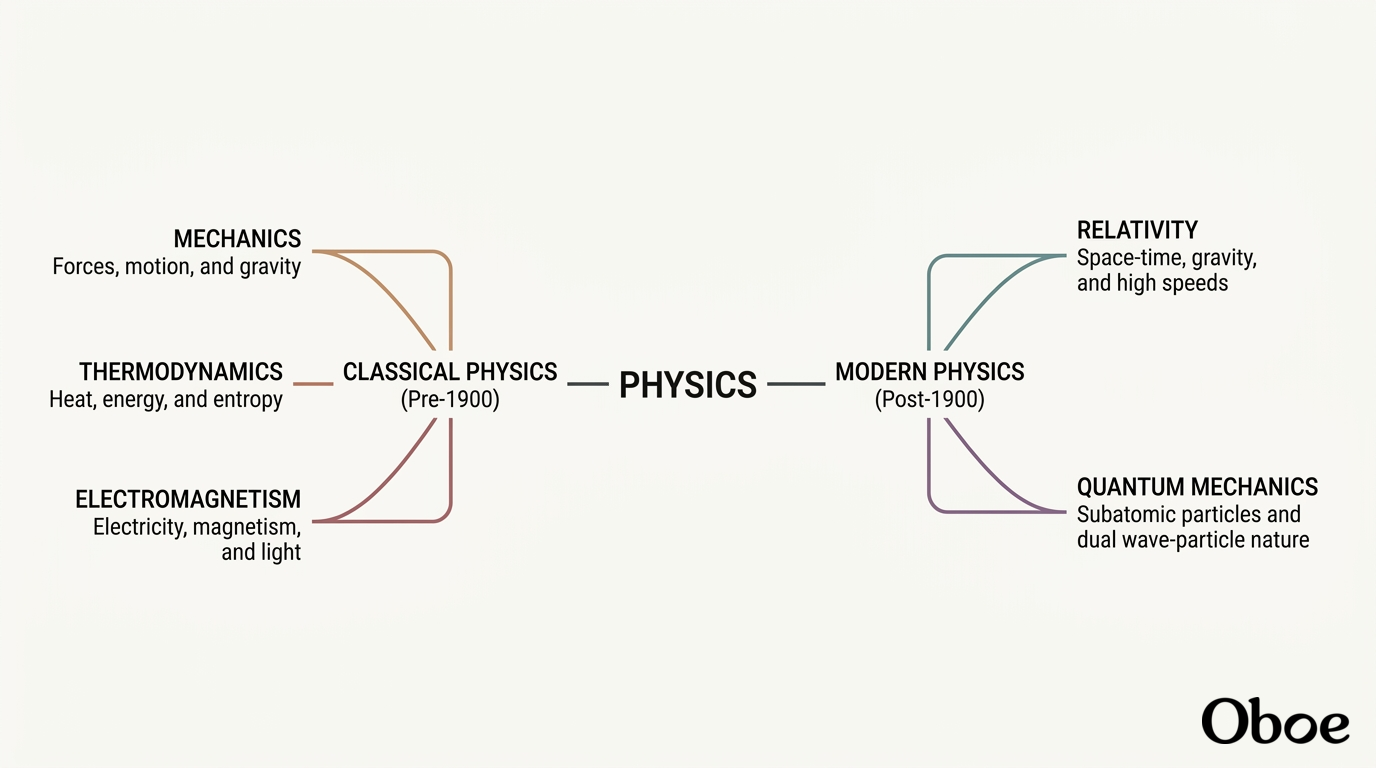
I've put together a visual layout that splits the entire landscape of physics into its two grand kingdoms: Classical Physics (the intuitive rules of our everyday world, like rolling balls and hot engines) and Modern Physics (the mind-bending rules of the extremely fast and the unimaginably small).
Seeing them side-by-side really highlights how our understanding of nature shifted over time. Now that you have this roadmap in mind, are you ready to look at the "reality check" that physicists use to build this map in the first place—the scientific method?
Are there areas where classical and modern physics overlap?
That is an incredibly sharp question! The short answer is yes—and those overlapping regions are actually where some of the most exciting, cutting-edge research in modern science is happening right now.
While we often draw a hard line between classical and modern physics, nature doesn't always respect our neat categories. When we look at systems that are on the border—like things that are extremely small but still interact with our macroscopic world—the two realms collide. This boundary is often explored through a concept called the , which states that new, modern physical theories must match the predictions of classical physics when we apply them to everyday, macroscopic situations.
Think of classical physics as a smooth, continuous ramp, and modern physics (specifically quantum mechanics) as a flight of individual, tiny stairs. When you stand up close to the stairs, you see the individual steps clearly. But if you zoom out far enough, those tiny steps start to look like a perfectly smooth, classical ramp.
One of the most famous crossover fields is statistical mechanics, which acts as a bridge. It uses the microscopic, quantum rules of individual atoms to explain classical, large-scale properties like the temperature and pressure of a gas.
Now that we see how these different eras of physics talk to each other, are you ready to dive into the core engine that drives all these discoveries—the scientific method?
Continue to the scientific method as our reality check
I love that you're ready to jump straight into this! The is the heartbeat of physics—it is what keeps us from just making up beautiful stories about how the universe works and forces us to prove them.
At its core, the scientific method in physics is a loop of observation, mathematical modeling, and experimental testing.
Physicists start with an observation about the world (for example, "heavy things and light things seem to fall at different speeds when dropped in air").
From there, they formulate a hypothesis—a testable explanation. Next comes the crucial part: using mathematics to make a highly specific, quantitative prediction that can be tested in an experiment.
Let us look at a famous historical walkthrough. People used to believe that heavier objects fall faster than lighter ones simply because they have more mass. Galileo Galilei questioned this. He predicted that if you eliminate air resistance, all objects will fall with the exact same acceleration, regardless of their mass.
If we write this prediction mathematically, the acceleration of a falling object near Earth's surface due to gravity is expressed simply as:
To test this hypothesis, physicists had to build a vacuum chamber to remove air resistance. When they finally dropped a feather and a bowling ball together inside a giant vacuum, they fell in perfect lockstep. The experimental data matched the mathematical prediction beautifully.
This is why we call it a loop: if the experiment had shown the bowling ball falling faster even in a vacuum, the mathematical model would have been instantly rejected or modified. Reality always gets the final vote.
Now that we have seen how this testing loop works, are you ready to explore how we upgrade a highly successful hypothesis into a full-fledged scientific theory, and how that differs from a physical law?