Foundations of Data Communication and Networking
Introduction to Networking
What Is a Network?
Think about the last time you sent a text message. You typed something on your phone, hit send, and moments later, it appeared on your friend's screen. That seemingly simple act is a perfect example of data communication.
Data Communication
noun
The process of exchanging data between two or more devices through some form of transmission medium.
This exchange doesn't happen by magic. It happens over a computer network. A network is what connects our devices, allowing them to share information, whether it's a text, a video stream, or a website.
Networks are the invisible backbone of our modern world. They let us share files at the office, play games with people across the globe, and access the vast library of knowledge on the internet. Without them, our digital lives would grind to a halt.
The Building Blocks
Every network, from the small one in your home to the global internet, is built from a few basic components.
The simplest parts are nodes and links. A node is any device on the network: your laptop, a smartphone, a printer, or a server. A link is the pathway that connects the nodes. You can think of nodes as cities and links as the roads that connect them.
Of course, just having roads isn't enough. You need traffic controllers to direct the flow of information efficiently. That's where switches and routers come in.
A switch operates within a single, local network, like an office building. It's like a mail sorter in the building's mailroom. When a computer sends data to another computer on the same network, the switch makes sure it goes directly to the correct recipient, not to every device in the office. It keeps local traffic moving smoothly and efficiently.
A router connects different networks together. It's like the city's main post office. It looks at data coming from your local network and decides the best path to send it across the internet to its final destination, which could be a server on another continent. Routers make the global internet possible by directing traffic between millions of different networks.
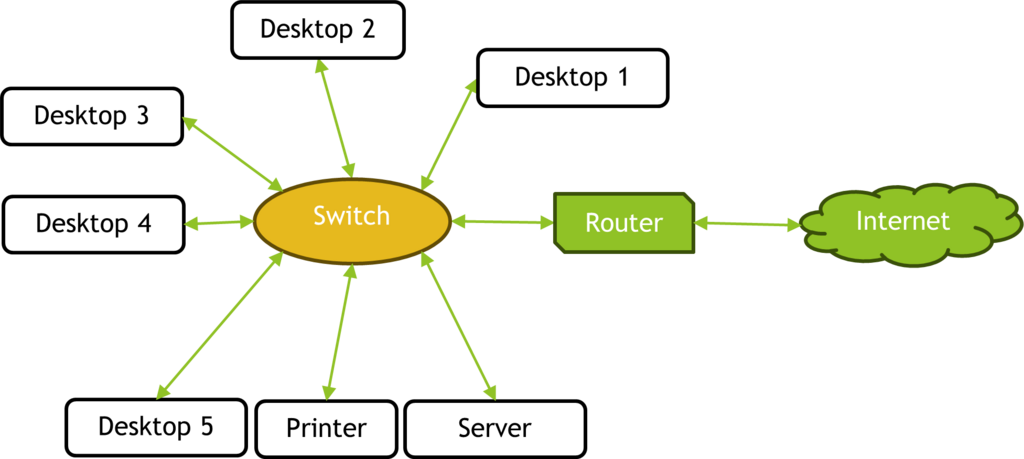
| Component | Function | Analogy |
|---|---|---|
| Switch | Connects nodes on the same network | Mail sorter for one office building |
| Router | Connects different networks together | City post office sending mail to other cities |
How Data Travels
When you send a large file, your device doesn't just shoot the whole thing across the network in one go. That would be like trying to ship a whole encyclopedia in a single, massive box. It's inefficient and risky. If one part gets lost, the whole thing is ruined.
Instead, networks use a smarter approach. They break the data into small, manageable pieces called packets. Each packet is like a single page from the encyclopedia, individually numbered and addressed. These packets travel across the network, sometimes taking different routes, and are reassembled in the correct order at their destination.
This method is incredibly robust. If one packet gets lost or corrupted, only that small piece needs to be sent again, not the entire file. This is the fundamental principle that allows for reliable data transmission over the complex and sometimes unpredictable network of the internet.
Now, let's test your understanding of these core components.
What are the two most fundamental components of any computer network, analogous to cities and the roads connecting them?
Which device's primary role is to connect different networks and direct traffic between them, like a city's main post office sending mail to other cities?
Understanding these basic building blocks—nodes, links, switches, and routers—and the principle of packet-based transmission provides a solid foundation for exploring the more complex aspects of computer networking.