Foundational Science and Tech Mastery
Biology Fundamentals
The Cell: Life's Building Block
Every living organism, from the smallest bacterium to the largest whale, is made up of cells. The cell is the most basic unit of life. Think of it as a tiny, self-contained factory that performs all the functions necessary for survival. We'll focus on eukaryotic cells, the type that make up animals, plants, and fungi, including humans.
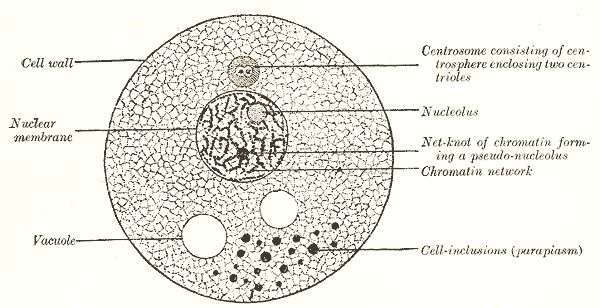
Inside each cell are specialized structures called organelles, each with a specific job. Here are a few of the most important ones:
- Nucleus: This is the cell's command center. It holds the genetic material, DNA, which contains all the instructions for building and operating the cell.
- Mitochondria: Often called the powerhouses of the cell, mitochondria convert nutrients into energy (in the form of a molecule called ATP) that the cell can use.
- Ribosomes: These are the protein factories. They read instructions from the nucleus and assemble proteins, which carry out a vast array of tasks.
- Cell Membrane: This outer layer encloses the cell, separating its internal environment from the outside. It's selectively permeable, meaning it controls what enters and leaves.
The Blueprint of Life: DNA and RNA
The instructions stored in the nucleus are encoded in a molecule called deoxyribonucleic acid, or DNA. DNA is shaped like a twisted ladder, a structure known as a double helix. The rungs of this ladder are made of pairs of chemical bases: Adenine (A), Guanine (G), Cytosine (C), and Thymine (T).
The pairing rule is simple and strict: Adenine always pairs with Thymine (A-T), and Cytosine always pairs with Guanine (C-G). The sequence of these bases along the DNA strand forms a code that tells the cell what to do.
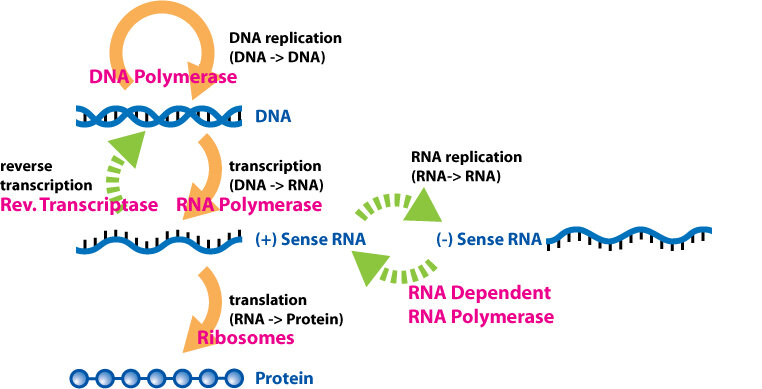
But the DNA master plan never leaves the safety of the nucleus. To get the instructions to the protein-building machinery in the cytoplasm, the cell uses a messenger molecule called ribonucleic acid, or RNA. RNA is similar to DNA, but it's a single strand and uses a base called Uracil (U) instead of Thymine. A segment of DNA is transcribed into a matching segment of RNA, which then travels out of the nucleus.
From Code to Action: Protein Synthesis
Creating a protein from the genetic blueprint is a two-step process. First is transcription, which we just mentioned. It happens in the nucleus, where a specific gene on the DNA is copied into a molecule of messenger RNA (mRNA).
Next comes translation. The mRNA molecule leaves the nucleus and finds a ribosome in the cytoplasm. The ribosome reads the sequence of bases on the mRNA in groups of three, called codons. Each codon specifies a particular amino acid, the building block of proteins. Another type of RNA, called transfer RNA (tRNA), brings the correct amino acid to the ribosome, which links them together in a chain. This growing chain of amino acids folds into a complex three-dimensional shape to become a functional protein.
This process is fundamental to virtually everything that happens in an organism. Proteins act as enzymes to speed up chemical reactions, provide structural support, transport substances, and send signals, among many other roles.
Passing on the Code: Genetic Inheritance
How are traits passed from parents to offspring? The principles of genetic inheritance were first described by Gregor Mendel in the 19th century. Humans are diploid organisms, meaning we have two copies of each chromosome in our cells, one inherited from each parent. Chromosomes are the structures inside the nucleus that are made of DNA tightly coiled around proteins.
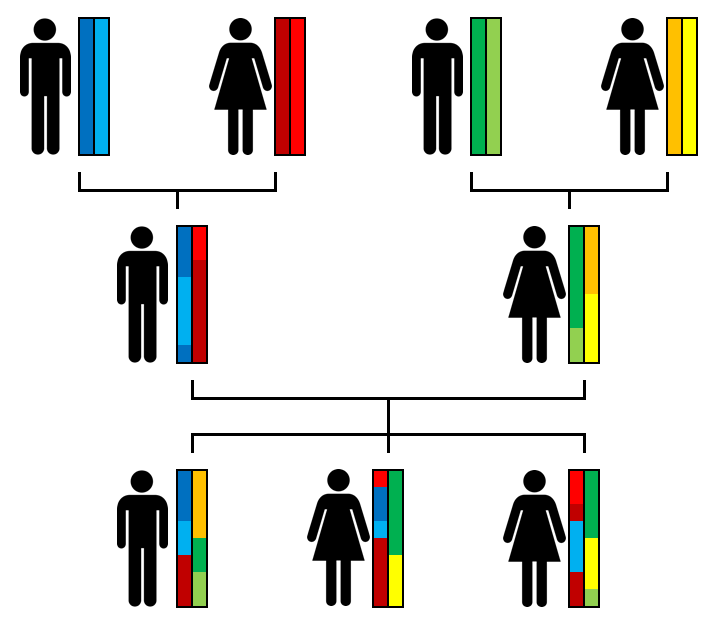
Different versions of the same gene are called alleles. For any given gene, you have two alleles, one from your mother and one from your father. These alleles can be dominant or recessive.
- A dominant allele (represented by a capital letter, like 'A') will express its trait even if only one copy is present.
- A recessive allele (represented by a lowercase letter, 'a') will only express its trait if two copies are present.
This means a person's genetic makeup, or genotype, can be homozygous dominant (AA), heterozygous (Aa), or homozygous recessive (aa). The observable trait, or phenotype, for both AA and Aa genotypes would be the dominant trait, while only the aa genotype would show the recessive trait.
These fundamental principles of cell biology, molecular genetics, and inheritance form the bedrock for understanding more complex biological systems.
Time to check your understanding of these core concepts.
What is the primary function of mitochondria in a eukaryotic cell?
The process where a ribosome reads an mRNA molecule to build a chain of amino acids is called:
Understanding these basics of how life is built and operated at the microscopic level is the first step toward exploring the complexities of the brain and nervous system.