Exploring the Human Body
Introduction to Human Anatomy
A Map of the Body
To talk about the human body, we need a shared language. It wouldn't work if “up” meant toward the head for one person and toward the ceiling for another. That’s why anatomy has a standard reference point: the anatomical position.
The anatomical position is a person standing upright, with feet parallel and flat on the floor, head level, and eyes looking forward. The arms are at either side of the body with the palms facing forward.
With this position as our baseline, we can use precise terms to describe where one body part is in relation to another. These terms often come in pairs of opposites.
| Term | Definition | Example |
|---|---|---|
| Superior (cranial) | Toward the head; higher | The nose is superior to the mouth. |
| Inferior (caudal) | Away from the head; lower | The stomach is inferior to the heart. |
| Anterior (ventral) | Toward the front | The sternum is anterior to the spine. |
| Posterior (dorsal) | Toward the back | The heel is posterior to the toes. |
| Medial | Toward the midline | The heart is medial to the lungs. |
| Lateral | Away from the midline | The ears are lateral to the nose. |
| Proximal | Closer to the origin of a body part | The elbow is proximal to the wrist. |
| Distal | Farther from the origin of a body part | The ankle is distal to the knee. |
Slicing It Up
To see inside the body, we imagine it cut or sectioned along flat surfaces called planes. These are like the slices a baker makes in a loaf of bread, but for anatomical study. There are three main planes used in anatomy.
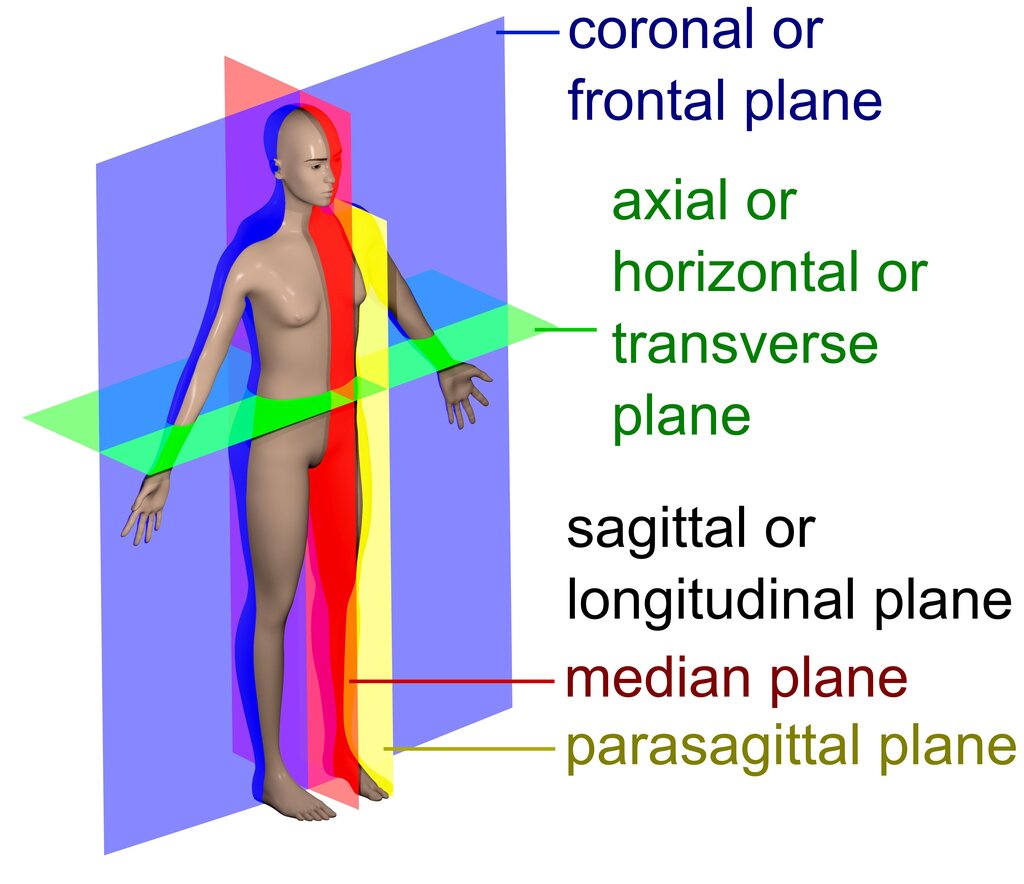
The sagittal plane is a vertical plane that divides the body into left and right parts. If it runs directly down the midline, it's a midsagittal plane. If it's off-center, it's a parasagittal plane.
The frontal (or coronal) plane is also vertical, but it divides the body into anterior (front) and posterior (back) parts. Think of it as separating the face from the back of the head.
The transverse (or axial) plane is horizontal. It divides the body into superior (upper) and inferior (lower) parts, producing a cross-section.
Levels of Organization
The human body is incredibly complex, but it's built from simple parts, organized in levels. This hierarchy is a fundamental concept in anatomy.
Everything begins at the chemical level, with atoms combining to form molecules. These molecules create organelles, the functional components of cells.
At the cellular level, cells are the smallest units of life. Similar cells group together to form tissues at the tissue level. Tissues then combine to form organs at the organ level. An organ is a distinct structure, like the stomach or liver, that performs specific functions.
Organs that work together form an organ system, such as the digestive system. Finally, all the organ systems together make up the organismal level – a complete human being.
The Body's Compartments
The body isn't just a solid mass. It has internal spaces called cavities that house and protect our organs. These cavities are separated into two main sets.
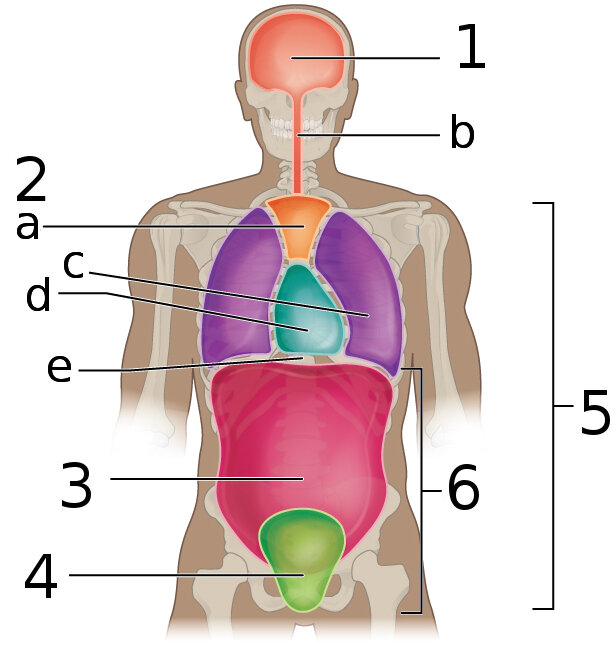
The dorsal body cavity is located at the back of the body and is subdivided into two parts. The cranial cavity encases the brain, and the vertebral cavity runs down the spine, protecting the spinal cord.
The ventral body cavity is at the front and is larger. It's separated by the diaphragm into the thoracic cavity (containing the heart and lungs) and the abdominopelvic cavity. The abdominopelvic cavity is further divided into the superior abdominal cavity (stomach, liver, intestines) and the inferior pelvic cavity (bladder, reproductive organs).
Understanding these basic concepts of position, direction, structure, and organization provides the framework for all further study of human anatomy.
What is the primary purpose of the standard anatomical position?
A plane that divides the body into superior and inferior parts is known as a:
With this foundational language, we can begin to explore the body's systems in more detail.