Exploring Tantra
Origins of Tantra
What's in a Name?
The word "Tantra" itself offers a clue to its philosophy. It comes from Sanskrit and has several interconnected meanings.
Tantra
noun
A spiritual tradition originating in medieval India, seeking liberation and spiritual power through a synthesis of practices such as meditation, yoga, and ritual.
The root tan means "to stretch" or "to extend," and tra means "instrument." So, at its most basic, a tantra is an instrument for expansion, specifically of consciousness. Another beautiful translation is "to weave," as on a loom. This metaphor is central to the tradition. Tantra is seen as a great weaving together of many different threads: body and spirit, the mundane and the divine, ancient philosophies and practical techniques.
Tantra weaves together various spiritual threads into a single, cohesive path toward enlightenment.
Ancient Roots
Tantra didn't appear out of thin air. Its roots run deep into the soil of ancient India, drawing nourishment from a variety of sources that existed long before Tantra became a distinct path. Some scholars trace its earliest influences back to the pre-Vedic Indus Valley Civilization, with its focus on goddess worship and nature-based spirituality.
More concretely, Tantra grew alongside and often in response to the dominant Vedic traditions. The Vedas are the oldest scriptures of Hinduism, emphasizing elaborate fire rituals and a hierarchical social structure. While Tantra incorporated some Vedic elements, like the use of mantras, it often took a different approach. It turned away from external rituals and focused more on internal transformation, using the body itself as the primary altar.
Crucially, Tantra integrated many indigenous, or folk, spiritual practices. These included local goddess cults, shamanistic traditions, and forms of yoga that were passed down outside of the mainstream religious institutions. This blending of established philosophy with grassroots spirituality is a hallmark of Tantra.
A Distinct Path Emerges
By the middle of the first millennium CE, these diverse threads began to be woven into what we now recognize as Tantra. This was a period of immense spiritual innovation in India. New movements were questioning old assumptions, and a number of esoteric traditions emerged within both Hinduism and Buddhism.
Tantra developed as a powerful counter-current to traditions that advocated for renunciation and detachment from the world. Many paths taught that the body and the material world were obstacles to be overcome. Tantra proposed a radical alternative: the body is not a prison but a vehicle for liberation. The physical world isn't an illusion to be escaped but a manifestation of divine energy to be engaged with.
This principle led to the development of unique esoteric yogic practices. Within Hinduism, Tantric schools flourished, particularly those dedicated to the deities Shiva and Shakti. In Buddhism, this stream of thought evolved into the tradition known as Vajrayana, or the "Diamond Vehicle," which became the dominant form of Buddhism in Tibet.
A fundamental aspect of Tantra involves working with subtle energies within the body.
The First Texts
As these traditions solidified, they produced a vast body of literature. These texts, known as the Tantras, Agamas, and Samhitas, codified the philosophy and practices of the emerging path. Many were written in the form of a dialogue, typically between a god and a goddess, such as Shiva and his consort Parvati. In these conversations, the goddess asks questions about the nature of reality and the path to liberation, and the god provides the answers.
These scriptures were revolutionary. They laid out a comprehensive system for spiritual development that was, in many cases, accessible to people regardless of their caste or gender, a significant departure from the more restrictive Vedic traditions.
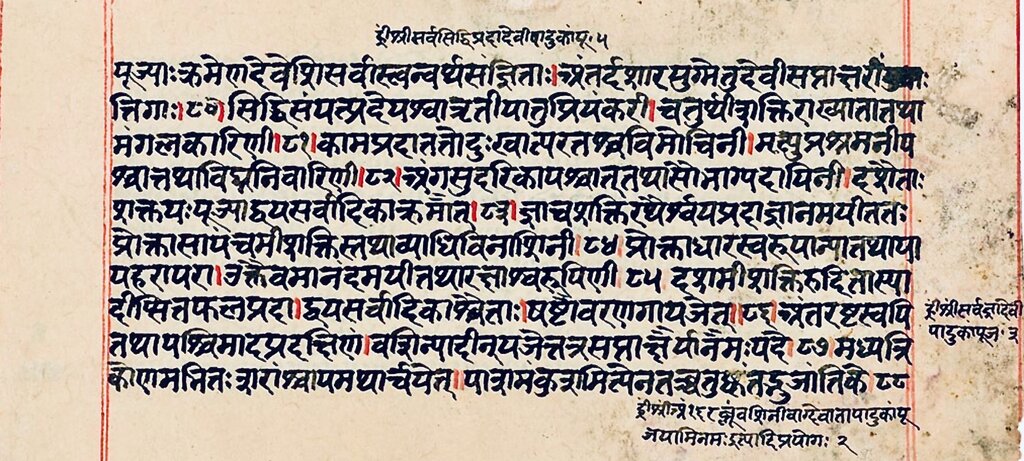
The texts covered everything from complex metaphysics and cosmology to specific techniques for meditation, yoga postures, mantras (sacred sounds), and yantras (mystical diagrams). They provided a complete toolkit for the practitioner to explore the universe within their own body.
This rich combination of ancient folk wisdom, philosophical inquiry, and practical techniques created a spiritual path that was both profound and pragmatic. It was a system designed not just for ascetics in remote caves, but for anyone seeking to experience the divine in their everyday lives.
Time to check your understanding of Tantra's origins.
The Sanskrit word 'Tantra' is often translated as 'to weave' or as an 'instrument for expansion.' What is it that Tantra seeks to expand?
Tantra developed as a counter-current to traditions that viewed the body as an obstacle. What is the fundamental Tantric view of the physical body?
Tantra's history reveals it as a dynamic synthesis of diverse spiritual streams, creating a unique and enduring path for self-realization.