Exploring Cursor.com
Introduction to Domain Names
What's in a Name?
Computers on the internet find each other using strings of numbers called IP addresses, like 142.250.191.78. Imagine having to remember a unique number for every website you visit. It would be impossible.
That's where domain names come in. They are the human-friendly addresses for the internet. Instead of typing a long number, you just type google.com. A domain name is essentially a memorable label that points to a specific IP address, making the web much easier to navigate.
Think of it like your phone's contact list. You don't dial your friends' phone numbers directly. You just tap their name, and your phone does the work of connecting to the right number. Domain names do the same for websites.
Anatomy of a Domain Name
Domain names have a clear, hierarchical structure. Let's break down a typical domain name, like wikipedia.org.
The part on the far right, .org, is called the Top-Level Domain, or TLD. It's the most general part of the name. You've seen many of these before.
Top-Level Domain
noun
The last segment of a domain name, located after the final dot. TLDs are managed by the Internet Corporation for Assigned Names and Numbers (ICANN).
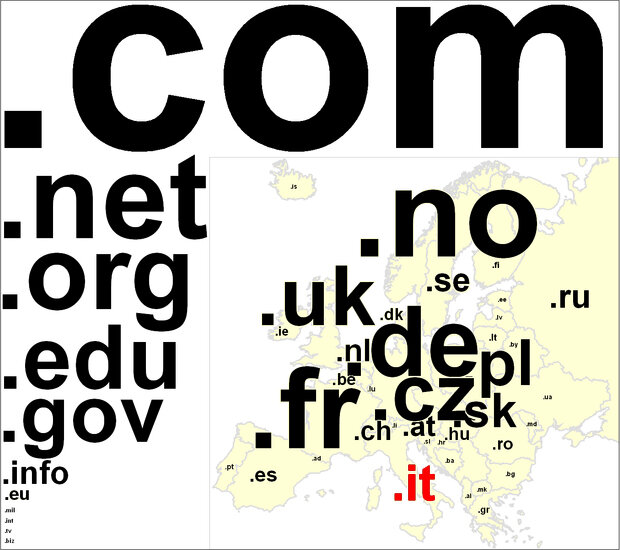
There are generic TLDs like .com, .net, and .info. Others are more specific, like .gov for government agencies or .edu for educational institutions. There are also country-code TLDs (ccTLDs) like .uk for the United Kingdom or .jp for Japan.
The part just to the left of the TLD, wikipedia, is the Second-Level Domain (SLD). This is the unique part of the name that you register. It's often the name of a company, organization, or brand.
Sometimes you'll see even more parts, like en.wikipedia.org. In this case, en is a subdomain. Subdomains help organize a website into different sections. Here, it directs users to the English-language version of the site.
The Internet's Phonebook
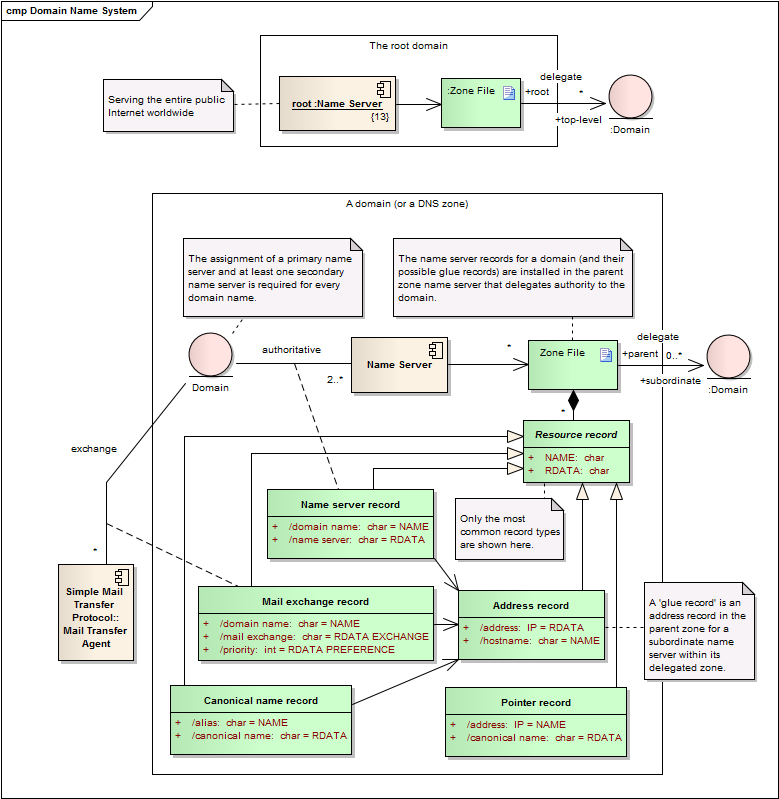
So how does your browser turn wikipedia.org into the right IP address? This is handled by the Domain Name System, or DNS. DNS is a global system that acts as the internet's phonebook. It maintains a massive directory of domain names and their corresponding IP addresses.
When you type a domain name into your browser, your computer sends a request to a DNS server. That server looks up the domain name, finds the matching IP address, and sends it back to your computer. Your computer then uses that IP address to connect to the website's server and load the page. This all happens in milliseconds.
Who's in Charge?
With millions of websites online, this system needs a central coordinator to avoid chaos. That coordinator is the Internet Corporation for Assigned Names and Numbers, or ICANN.
ICANN is a non-profit organization that helps keep the internet secure, stable, and interoperable. It doesn't run the internet, but it plays a key role in managing the domain name system. ICANN coordinates the allocation of IP addresses and manages the TLDs. It also accredits companies called domain registrars.
Think of ICANN as the organization that decides what area codes are available for phone numbers. It doesn't assign individual phone numbers, but it manages the overall system.
To get a domain name, you go through a domain registrar. These are companies authorized by ICANN to sell domain names to the public. You search for an available name, choose a TLD, and pay an annual fee to register it. The registrar then adds your new domain and its associated IP address to the global DNS directory.
This registration gives you the exclusive right to use that domain name for as long as you keep renewing it. This simple process is what allows anyone to carve out their own corner of the web.
What is the primary function of the Domain Name System (DNS)?
In the domain name en.wikipedia.org, what is the Top-Level Domain (TLD)?
That's a quick look at how domain names work. They're a fundamental piece of the internet's infrastructure, turning a complex network of numbers into a navigable world of names.