Evaluating Trigonometric Expressions
Introduction to Trigonometry
What is Trigonometry?
Trigonometry is the study of triangles. Specifically, it explores the relationship between the angles and the side lengths of triangles. The name itself comes from Greek words: trigonon meaning 'triangle' and metron meaning 'measure.'
At its heart, trigonometry gives us the tools to find unknown side lengths or angles in a triangle when we only have partial information. This might sound purely academic, but it has powerful real-world applications, from astronomy to video game design.
We'll start with the simplest case: the right-angled triangle.
Anatomy of a Right Triangle
A right-angled triangle, or just a right triangle, is any triangle with one angle that is exactly 90 degrees. This special angle is key. The two sides that form the right angle are called the legs, and the side opposite the right angle is always the longest. It's called the hypotenuse.
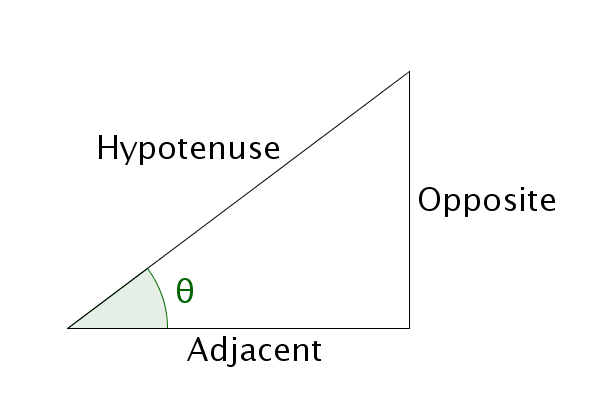
Now, let's focus on one of the other two angles. We'll call it theta, written as . The names of the two legs depend on which angle we're looking at:
- The opposite side is the leg across from angle .
- The adjacent side is the leg next to angle (that isn't the hypotenuse).
These three sides—opposite, adjacent, and hypotenuse—are the building blocks for the fundamental functions of trigonometry.
The Three Basic Ratios
For any given angle in a right triangle, the ratios of its side lengths are always the same, no matter how big or small the triangle is. Trigonometry gives names to these constant ratios: sine, cosine, and tangent.
A popular way to remember these is the mnemonic SOH CAH TOA.
| Mnemonic | Ratio | Definition |
|---|---|---|
| SOH | Sine = Opposite / Hypotenuse | The ratio of the length of the side opposite the angle to the length of the hypotenuse. |
| CAH | Cosine = Adjacent / Hypotenuse | The ratio of the length of the side adjacent to the angle to the length of the hypotenuse. |
| TOA | Tangent = Opposite / Adjacent | The ratio of the length of the side opposite the angle to the length of the side adjacent to it. |
Let's write these out as formulas:
These three functions are the foundation of trigonometry. By knowing just one side and one angle (besides the 90° angle), you can find all the other sides and angles of a right triangle.
Putting It to Use
Let's see how this works with a practical example. Imagine you want to measure the height of a tree without climbing it. You can stand a certain distance away from the base, and then measure the angle from the ground to the top of the tree.
Suppose you are standing 40 meters from the base of the tree. The angle of elevation to the top of the tree is 35 degrees.
In this scenario:
- The angle is 35°.
- The side adjacent to the angle is the distance from you to the tree (40 meters).
- The side opposite the angle is the tree's height, which is what we want to find.
Which trigonometric ratio uses the opposite and adjacent sides? That's the tangent.
Now, we plug in the values we know:
To solve for the height, we multiply both sides by 40:
Using a calculator, we find that is approximately 0.7002.
meters.
So, the tree is about 28 meters tall. We figured that out just by using an angle and a distance on the ground.
This is just one simple example. Trigonometry is used everywhere, from calculating the path of a satellite to creating realistic lighting in computer graphics.
Time to check your understanding.
What is the primary focus of trigonometry?
In a right-angled triangle, which side is always the longest?
By understanding sine, cosine, and tangent, you have the basic tools to solve a huge range of problems involving angles and distances.