Dynamics of the Solar System
Solar System Genesis
From Cloud to Disk
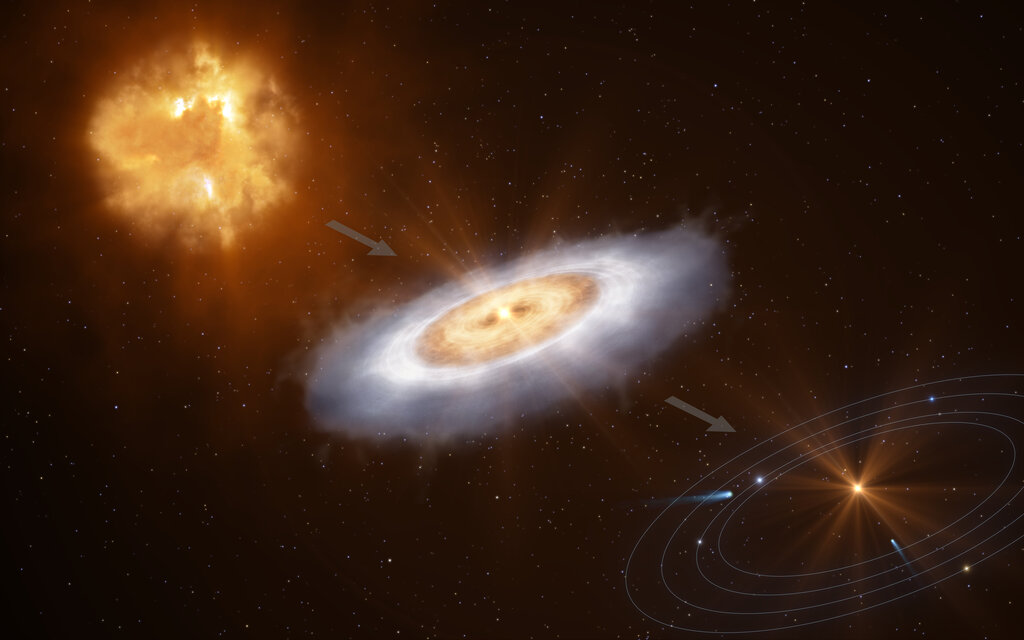
Our solar system began as a vast, cold, and slow-spinning cloud of gas and dust, a tiny fragment of a much larger giant molecular cloud. Over millions of years, a disturbance—perhaps a nearby supernova—caused a dense pocket within this cloud to collapse under its own gravity. As the cloud contracted, it began to spin faster due to the conservation of angular momentum, the same principle that makes a figure skater spin faster when they pull their arms in.
This rotation prevented all the material from simply falling into the center. Instead, the cloud flattened into a spinning, pancake-like structure called a protoplanetary disk. At the heart of this disk, the pressure and temperature soared, igniting a protostar: our young Sun. This entire process is the core idea of the Nebular Hypothesis, which describes how stars and their planetary systems are born.
Building the Planets
Within the swirling protoplanetary disk, tiny dust grains, many smaller than a grain of sand, began to collide and stick together through electrostatic forces. This process, called accretion, gradually built larger and larger objects. First came pebble-sized bodies, then kilometre-sized , which were massive enough to attract more material through their own gravity.
Over tens of millions of years, these planetesimals continued to collide and merge, growing into protoplanets, the embryos of the planets we know today. This step-by-step construction of planetary cores from the bottom up is known as the core accretion model. It was a chaotic and violent period, a cosmic construction site filled with high-speed collisions.
The Great Divide
The protoplanetary disk wasn't uniform in temperature. It was scorching hot near the young Sun and grew progressively colder further out. This temperature gradient created a critical boundary known as the Frost Line, located somewhere between the present-day orbits of Mars and Jupiter.
Inside the Frost Line, it was too warm for volatile compounds like water, ammonia, and methane to condense into ice. Only rock and metal could remain solid. Outside the Frost Line, it was cold enough for these ices to form, adding a huge amount of solid material to the available building blocks. This simple division had profound consequences for planet formation.
In contrast, the giant planets (Jupiter, Saturn, Uranus, and Neptune) formed beyond the point between the orbits of Mars and Jupiter where material is cool enough for volatile icy compounds to remain solid (i.e. the Frost Line).
Planetary cores that formed beyond the Frost Line could grow much larger and faster by accreting both rock and abundant ice. Once a core reached about 10 times the mass of Earth, its gravity was strong enough to rapidly pull in vast amounts of hydrogen and helium gas directly from the surrounding disk. This is how the gas giants like Jupiter and Saturn acquired their massive atmospheres. Inside the Frost Line, the protoplanets were made only of rock and metal, so they remained much smaller and never grew massive enough to attract thick gaseous envelopes.
Jupiter's Journey
The final arrangement of our solar system wasn't set in stone after the initial formation. Jupiter, the first and largest planet to form, likely didn't stay put. The proposes that Jupiter migrated inward from its birthplace, moving as close to the Sun as Mars's modern orbit. This journey wreaked havoc on the inner solar system, scattering the planetesimals that were trying to form planets.
Jupiter's inward march was halted and reversed by the gravitational influence of Saturn, which had formed behind it. The two giants entered a gravitational resonance, causing them to migrate outward together, eventually settling near their current orbits. This 'tack', like a sailboat changing direction, explains several key features of our solar system. It likely cleared out the material that would have formed a larger Mars, explaining the Red Planet's small size. It also prevented the formation of any 'Super-Earths', a common type of planet found in other systems, by sweeping the inner solar system clean of building materials.
From a collapsing cloud to a spinning disk of dust and gas, and through a chaotic dance of migrating giants, our solar system took shape. The interplay of gravity, temperature, and chance collisions created the family of planets we know today.
What is the widely accepted theory that explains the formation of our solar system from a spinning cloud of gas and dust?
As the initial cloud of gas and dust collapsed, it began to spin faster and flatten into a disk. This is a direct result of: