Digital Wireless Audio Mastery
Digital vs Analog Artifacts
The Sound of Silence (and Noise)
When a wireless microphone system works perfectly, you don't notice it. The audio is clear, present, and free of distractions. But when things go wrong, the type of noise you hear tells a story about the technology inside. Analog and digital systems fail in very different, very characteristic ways. Understanding these failure modes is key to diagnosing problems on the fly.
Analog systems are masters of graceful degradation. As the RF signal weakens, the audio quality slowly deteriorates, often with a gentle hiss that grows louder. This is preferable to a sudden dropout, but analog's constant battle to transmit a wide dynamic range wirelessly introduces its own unique problems, primarily through a process called companding
Companding compresses the audio's dynamic range before transmission and expands it at the receiver. This trick allows a signal with a wide range of loud and soft sounds to fit into the narrower frequency bandwidth available for wireless transmission. However, it's not a perfect process. When the RF signal is weak, the expander circuit at the receiver can get confused. It might amplify the background noise floor during quiet moments, creating a noticeable 'breathing' or 'pumping' sound. This is the sound of the noise floor being raised and lowered as the expander tries, and fails, to perfectly reconstruct the original signal.
Analog artifact checklist: Hiss, static, breathing, and pumping sounds, especially when the signal is weak or during quiet passages.
The Digital Cliff
Digital systems handle audio very differently. They convert the analog sound wave into a stream of ones and zeros. As long as the receiver can clearly distinguish between these ones and zeros, the audio quality is perfect. It's an all-or-nothing game. There is no gentle slide into static. Instead, you get what's known as the 'digital cliff' effect.
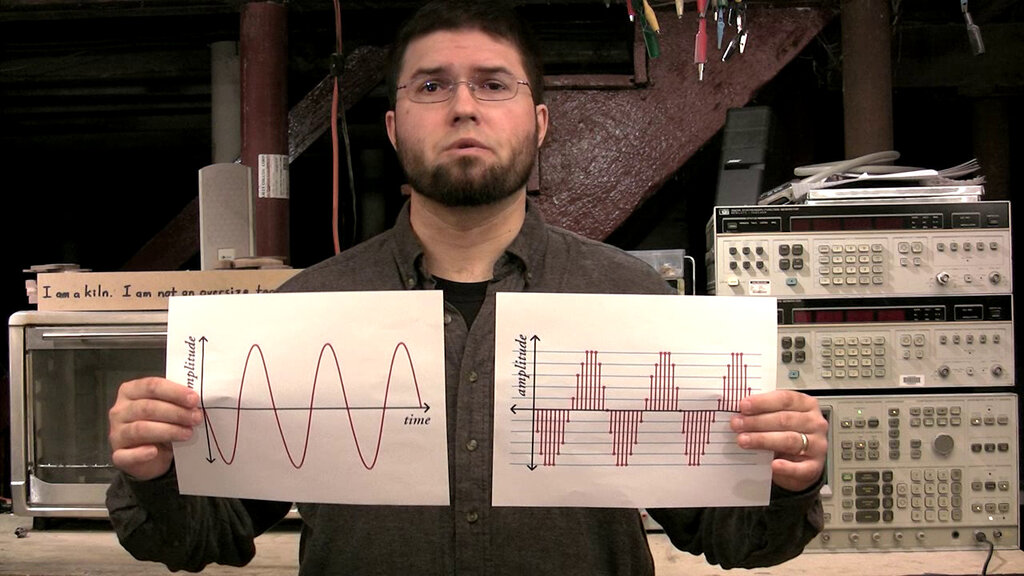
As a digital signal weakens, the audio remains pristine right up to the point where the receiver can no longer accurately interpret the data. When this happens, the audio doesn't just get noisy; it drops out completely or becomes a garbled mess of clicks and digital shrieks. This is the result of bit errors—where the receiver mistakes a '1' for a '0' or vice versa. A few errors can often be corrected by the system's error-correction algorithms, but once the error rate passes a certain threshold, the audio becomes unusable.
Digital artifact checklist: Sudden audio dropouts, garbled sound, clicks, or digital noise. The audio is either perfect or gone.
Comparing Failure Modes
To make this practical, let's compare how each system type might behave in a real-world scenario. Imagine a presenter walking to the edge of a stage, pushing the limits of the wireless system's range.
| Scenario | Analog System Reaction | Digital System Reaction |
|---|---|---|
| Weak Signal | Audio becomes progressively hissy and noisy. Companding artifacts like 'breathing' may appear. | Audio remains perfectly clear until a certain point, then drops out completely. |
| Brief RF Interference | A burst of static or a 'squelch' sound is heard, layered on top of the audio. | A momentary dropout or a quick 'glitch' in the sound. The audio might sound garbled for an instant. |
| Heavy RF Interference | Overwhelming static, making the audio unintelligible but still present underneath the noise. | Complete audio dropout. The receiver is muted until a clean signal is re-established. |
For critical applications like live broadcasts or major presentations, the unforgiving nature of the digital cliff can be a risk. However, the superior audio quality when the signal is strong often makes digital the preferred choice. The key is to ensure robust RF signal strength at all times, preventing the system from ever approaching that cliff.
When an analog wireless microphone system has a weak RF signal, the 'breathing' or 'pumping' sound is caused by what process malfunctioning?
You are monitoring audio from a presenter on stage. As they walk to the far edge of the stage, the audio remains perfectly clear until it suddenly cuts out completely. What type of system is most likely in use?