Develop Your First AI Tool
Introduction to AI
What Is AI?
Artificial intelligence is the science of making machines that can think like humans. This doesn't mean creating robots that look and act just like us. Instead, it's about giving computers the ability to learn, reason, and perceive the world in ways that were once unique to people.
Think about how you learn. You observe, you make connections, and you adapt based on new information. AI aims to replicate this process in a machine. It's not about a single technology but a broad field of study with many different approaches.
algorithm
noun
A set of rules or instructions given to a computer to help it solve a problem or complete a task.
At its core, AI runs on algorithms. These aren't just simple instructions like in a standard computer program. AI algorithms are designed to analyze huge amounts of data, identify patterns, and make decisions or predictions. A simple program follows a fixed path, but an AI can forge its own.
A Brief History
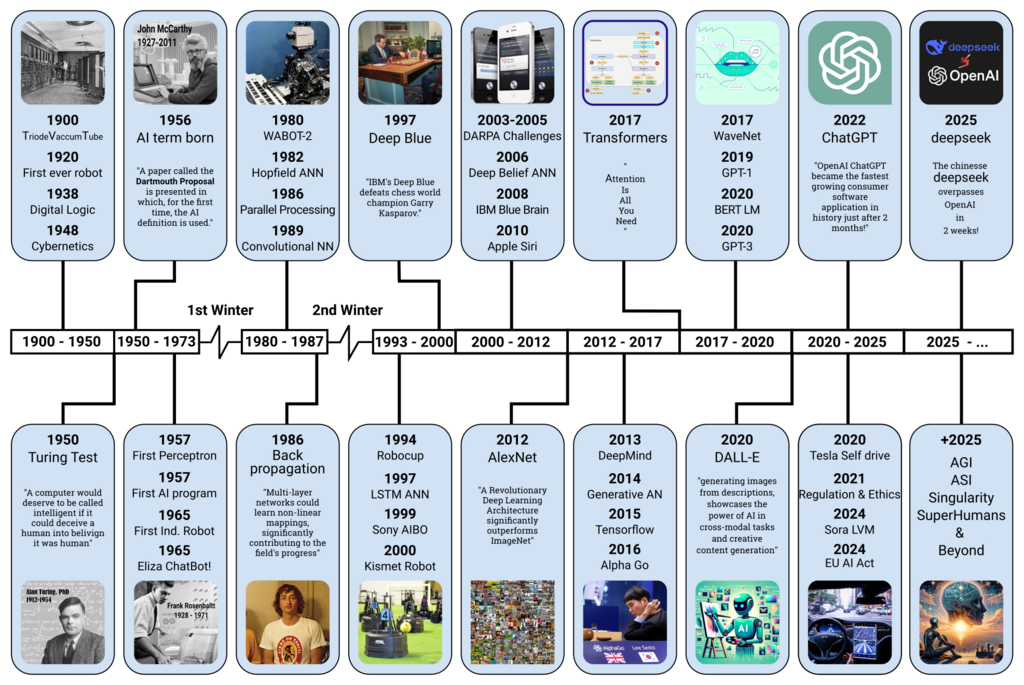
The idea of artificial beings with intelligence has been around for centuries, but the scientific field of AI is much younger. It officially began in the summer of 1956 at a conference at Dartmouth College. A small group of mathematicians and scientists gathered to explore the idea that "every aspect of learning or any other feature of intelligence can in principle be so precisely described that a machine can be made to simulate it."
Early progress was exciting but slow. Computers lacked the processing power and data needed for complex thought. The field went through periods of optimism followed by "AI winters," when funding and interest dried up due to unmet expectations. But in the last couple of decades, two key things changed: the explosion of big data and the development of powerful computers. This combination has fueled the rapid progress we see today.
The Branches of AI
AI isn't a single entity. It's an umbrella term for a collection of specialized fields. Think of it like biology, which has subfields like genetics, botany, and zoology. Some of the most important branches of AI are Machine Learning, Deep Learning, Natural Language Processing, and Computer Vision.
Machine Learning (ML) is the most common approach to AI today. Instead of being explicitly programmed, an ML system learns from data. You show it thousands of pictures of cats, and it learns to identify a cat on its own. It's about recognizing patterns and making predictions.
Deep Learning (DL) is a more advanced subfield of machine learning. It uses structures called neural networks, which are inspired by the human brain. Deep learning is behind some of the most impressive AI breakthroughs, like advanced image recognition and natural-sounding language generation. It's particularly good at finding complex, subtle patterns in very large datasets.
Natural Language Processing (NLP) focuses on the interaction between computers and human language. When you talk to a voice assistant, use a translation app, or see a chatbot pop up on a website, you're interacting with NLP. Its goal is to enable computers to understand, interpret, and generate human language.
Computer Vision gives machines the ability to see and interpret the visual world. This field works to replicate the power of human vision. Self-driving cars use computer vision to understand roads and obstacles. It’s also used in facial recognition technology and medical imaging analysis to spot diseases.
AI in the Real World
AI is no longer just a concept from science fiction. It's integrated into our daily lives and is transforming industries.
- Healthcare: AI helps doctors diagnose diseases earlier and more accurately by analyzing medical scans like X-rays and MRIs. It can also personalize treatment plans based on a patient's genetic makeup.
- Finance: Banks use AI to detect fraudulent transactions in real-time, saving customers millions. Algorithmic trading uses AI to make high-speed decisions in the stock market.
- Entertainment: Streaming services use AI to recommend movies and shows you might like based on your viewing history. Video games use AI to create realistic and challenging non-player characters.
- Transportation: Navigation apps use AI to find the fastest route by analyzing real-time traffic data. The development of self-driving cars is one of the most ambitious AI projects in this sector.
From personalized recommendations to fraud detection, many of the technologies we use every day are powered by different forms of AI.
Ethical Questions
As AI becomes more powerful, it raises important ethical questions that we must address. These aren't just technical problems; they're societal ones.
One major concern is bias. If an AI is trained on biased data, it will produce biased results. For example, an AI hiring tool trained on historical data from a male-dominated industry might unfairly screen out female candidates. Ensuring fairness is a critical challenge.
Privacy is another key issue. AI systems often require vast amounts of personal data to function. How is this data collected, stored, and used? Protecting individual privacy while harnessing the benefits of AI is a delicate balancing act.
Finally, there's the question of accountability. When an AI system makes a mistake, who is responsible? Is it the programmer, the company that deployed it, or the user? Establishing clear lines of responsibility is essential for building trust in AI.

Navigating these ethical challenges requires collaboration between technologists, policymakers, and the public. Building trustworthy AI is just as important as building powerful AI.
Time to test what you've learned about the fundamentals of AI.
What is the primary goal of Artificial Intelligence as a scientific field?
The history of AI has seen periods known as "AI winters." What characterized these periods?