
Oboe
No history yet

i want to do a deep literary dive into the epic the odyssey

Welcome to our literary salon! Before we cast off and set sail into the wine-dark sea of Homer's epic, I want to make sure this journey is customized exactly to your liking.

To tailor our deep dive, could you tell me a bit about your background with the text? Have you read it before, or is this your first time? Also, are there specific themes or characters you're most interested in focusing on?

I've read it before! I want a deep dive into the poetry, structure, and themes like xenia.

Your path
Major Themes: Hospitality, Loyalty, and Cunning
Character Analysis: The Evolution of Odysseus and Telemachus
Literary Techniques and Oral Style

The Architecture of Epic Poetry

To truly appreciate The Odyssey, we have to look at it not just as a story, but as a highly structured, performance-based masterpiece. It belongs to the genre of , which in the ancient Greek world wasn't read silently in cozy chairs, but belted out by traveling singers called to the strumming of a lyre.

Because these poems were massive, Homer used a distinct metrical structure called dactylic hexameter—often called the "meter of heroes"—to give the performance a driving, musical rhythm. Let's look at the rhythmic structure of a single line of dactylic hexameter:

Line=          \text{Line} = -\cup\cup \ | \ -\cup\cup \ | \ -\cup\cup \ | \ -\cup\cup \ | \ -\cup\cup \ | \ --

Now, before we look at how Homer actually uses this rhythm to paint his world, let's explore the origins of this monumental story. Would you like to dive into the oral tradition and the mystery of Homer himself, or shall we look at a diagram of how this poetic meter actually sounds in Greek?

Let's continue to the oral tradition and Homer.

Let's plunge right into the heart of the legendary creator behind these verses, and explore the fascinating mystery that has kept scholars arguing for centuries.

The Ghost of Homer

While we attribute The Odyssey and The Iliad to a single, blind poet named Homer, we actually know next to nothing about him. In fact, classical scholars have spent centuries debating what is known as the : did Homer actually exist, or is "Homer" simply a collective name for generations of oral singers whose works were eventually stitched together and written down?
Rather than claiming personal authorship, the poet of The Odyssey steps back and begins the entire epic with an . By asking a goddess to sing through him, the poet acts not as an inventor of fiction, but as a sacred vessel transmitting a divine, pre-existing history.

Continue to the narrative structure and starting 'in medias res'

Let's plunge right into how Homer structures his story, because the way he opens the narrative is a masterstroke of design. Instead of starting at the chronological beginning with the fall of Troy, The Odyssey begins —a Latin phrase meaning "in the middle of things."
When the curtain rises in Book 1, Odysseus has already been missing for twenty years. Rather than showing us his famous battles or early sea monsters, Homer drops us straight into a double crisis: Odysseus is trapped on a remote island by the nymph Calypso, and back home in Ithaca, insolent suitors are devouring his estate and pressuring his wife, Penelope.
This structure is brilliant for two main reasons. First, it creates immediate dramatic tension by showing us the stakes right away—if Odysseus doesn't get home soon, he will lose everything. Second, it allows Homer to use character-driven flashbacks later on. When Odysseus finally tells his own story to the Phaeacians, we get to hear about the Cyclops and the Sirens directly from his perspective, which lets us evaluate his reliability and growth as a storyteller.

Make a structural diagram of the timeline

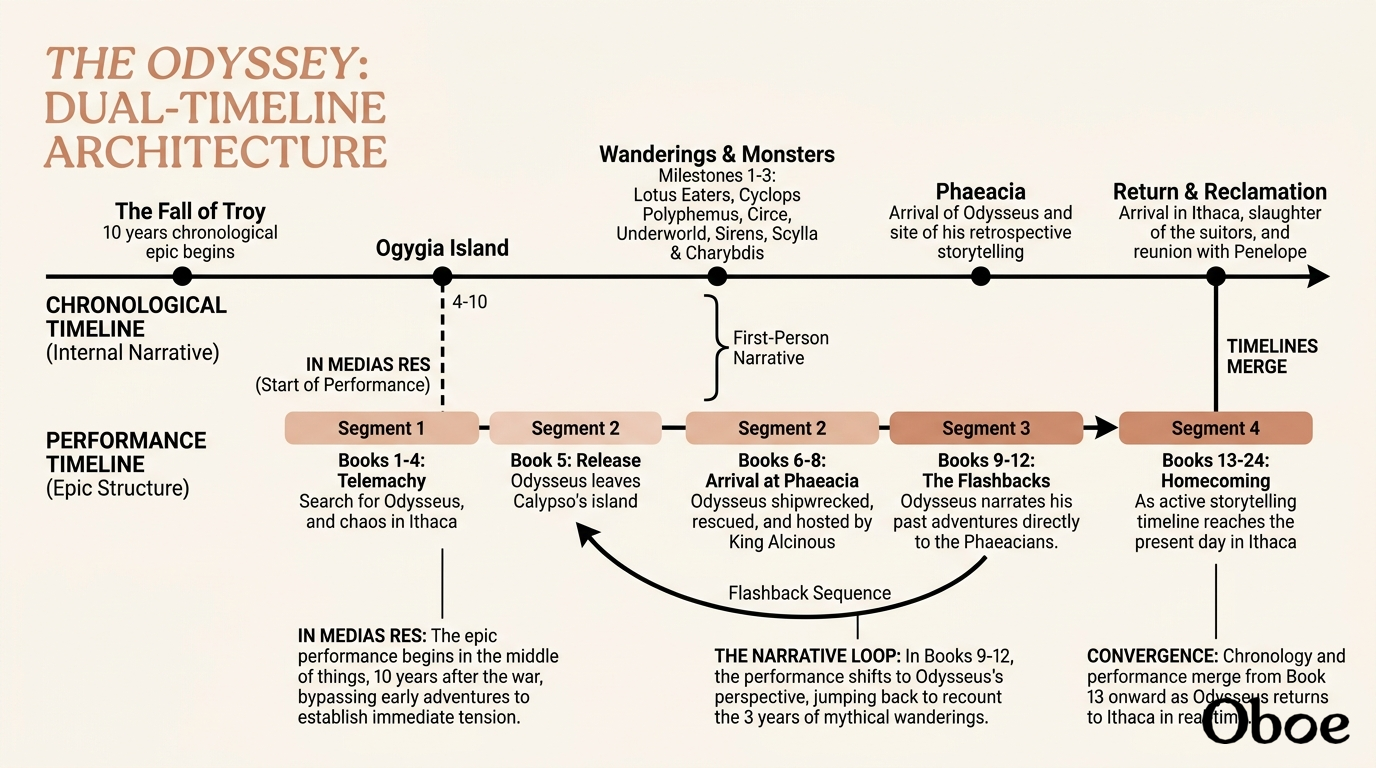
You've got it! A visual timeline is the perfect way to demystify how Homer plays with time, because The Odyssey doesn't move in a straight line—it loops back on itself in a giant narrative circle.

DIAG
Diagram
Generated diagram

This structural overview maps out the brilliant double-track system Homer uses. While the actual performance starts years after the Trojan War has ended, the narrative loop allows us to experience the wild, mythical adventures—like the or the sorceress —as a vivid story-within-a-story, told directly by Odysseus to his hosts in Phaeacia.

Now that you can see how this grand flashback structure fits together, we can explore how Homer transitions from this framing device into his major themes. Shall we dive into the sacred ancient Greek social code of xenia, or would you like to test your understanding of this timeline structure first?