Decoding Audio Spectrograms
Introduction to Sound Waves
What is Sound?
Sound begins with a vibration. When you clap your hands, the sudden movement pushes air molecules together. This creates a tiny pocket of high-pressure air. Those molecules then push on the ones next to them, which push on the next, and so on. This creates a wave of pressure that travels outwards.
Sound is a sequence of waves of pressure that are transmitted mechanically by compression and expansion of air through mediums such as gas, liquids, solids, and plasma.
Think of it like a ripple in a pond. The water itself doesn't travel across the pond; it just moves up and down. It's the energy that travels in the form of a wave. Sound works the same way. It's a mechanical wave, meaning it needs a substance, or medium, to travel through. In space, where there is no medium, there is no sound.
The areas where air molecules are squeezed together are called compressions. The areas where they spread apart are called rarefactions. This alternating pattern is the sound wave itself.
The Anatomy of a Wave
To describe a sound wave, we use three key properties: amplitude, wavelength, and frequency. They tell us everything about how a sound is perceived, from its loudness to its pitch.
Amplitude
noun
The maximum displacement or distance moved by a point on a vibrating body or wave measured from its equilibrium position.
In simple terms, amplitude is the wave's intensity or power. In sound, we perceive amplitude as loudness. A quiet whisper creates a sound wave with a small amplitude, while a loud shout creates one with a large amplitude.
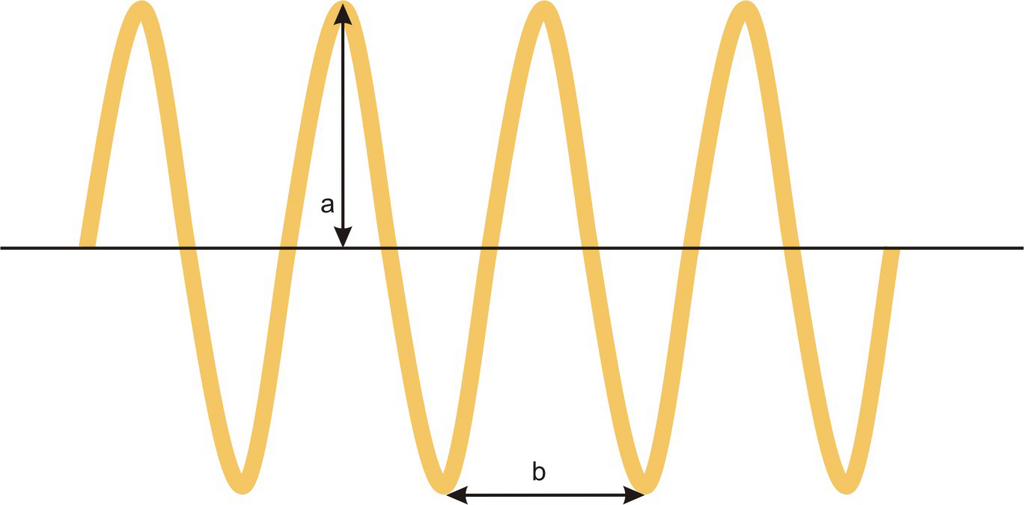
Wavelength is the physical distance between two consecutive peaks (or troughs) of a wave. A long wavelength means the peaks are far apart, while a short wavelength means they are close together.
Closely related to wavelength is frequency. It measures how many full wave cycles happen in one second. The unit for frequency is Hertz (Hz).
Frequency
noun
The rate at which a vibration occurs that constitutes a wave, measured per second.
We perceive frequency as pitch. A low-frequency sound, like a bass drum, has a low pitch. A high-frequency sound, like a whistle, has a high pitch.
Wavelength and frequency have an inverse relationship. When one is high, the other is low. A long wavelength means a low frequency, and a short wavelength means a high frequency. The speed of the wave connects them:
Sound on the Move
Sound can't travel in a vacuum because there are no particles to vibrate. But it travels very effectively through solids, liquids, and gases.
The speed of sound changes depending on the medium. It's determined by how closely packed the particles are and how quickly they can return to their original position. In general, sound travels fastest through solids, slower through liquids, and slowest through gases.
For example, sound travels through steel more than 15 times faster than it travels through air.
This is why you can hear a distant train approaching by putting your ear to the metal track long before you can hear it through the air. The vibrations travel much more efficiently through the solid steel than through the less dense air.
Temperature also affects the speed of sound. In warmer air, molecules move faster and bump into each other more often, allowing the sound wave to travel more quickly.
Now let's check your understanding of these fundamental properties.
What is the fundamental cause of sound?
If a sound wave has a long wavelength, what must be true about its frequency?
Understanding these basics of sound—what it is, its core properties, and how it moves—is the first step toward analyzing more complex audio information.