Database Management Systems Explained
Introduction to Databases
What is a database?
Think of a library. It's a huge collection of books, but it's not just a pile of them in a room. The books are organized by subject, author, and title. A librarian manages the collection, helps you find what you need, and keeps track of who has checked out which books. A database is like a digital library for information.
A database is a structured collection of data, organized for easy access, management, and updating.
Its main job is to store vast amounts of information in a way that makes it simple to find, add, or change data whenever needed. From your social media feed to your bank account balance, databases are working behind the scenes to keep modern life running smoothly.
From files to databases
Before databases became common, information was often stored in simple files, much like documents in a physical filing cabinet. Imagine a small business keeping customer records on index cards. Each card holds a customer's name, address, and purchase history. This works for a while, but problems appear as the business grows.
What if a customer moves? You'd have to find every single card with their old address and update it. If you miss one, your records become inconsistent. What if two salespeople try to update the same customer's card at once? It could get messy. Sharing information is also tricky and not very secure.
Early computer systems faced the same issues using individual files (like text documents or spreadsheets) to store data. This method led to several headaches.
Data was often duplicated, inconsistent, and hard to manage securely. Answering new questions about the data required writing a whole new program each time.
Databases were created to solve these problems. They provide a centralized, controlled way to manage data, ensuring it remains accurate, secure, and easily accessible. Here's how they stack up against older file systems:
| Feature | Traditional File System | Database System |
|---|---|---|
| Data Redundancy | High (data often duplicated) | Minimal (centralized storage) |
| Data Consistency | Low (updates can be missed) | High (changes apply everywhere) |
| Data Access | Difficult (requires custom programs) | Easy (uses standard query languages) |
| Security | Basic (file-level permissions) | Advanced (fine-grained user controls) |
| Concurrent Access | Poor (can lead to data corruption) | Excellent (manages multiple users safely) |
Key terms to know
As you learn more about databases, you'll come across a few key terms. Understanding them is the first step to mastering how databases work.
Database
noun
An organized collection of structured data, typically stored electronically in a computer system.
While 'database' often refers to the data itself, it's managed by a special piece of software.
DBMS
noun
Database Management System. The software that allows users to create, read, update, and delete data in a database. It acts as an intermediary between the user and the database.
Think of the DBMS as the librarian. You don't interact with the library's shelves directly; you ask the librarian, and they handle the request for you, ensuring everything stays organized and secure.
Every database also needs a blueprint.
Schema
noun
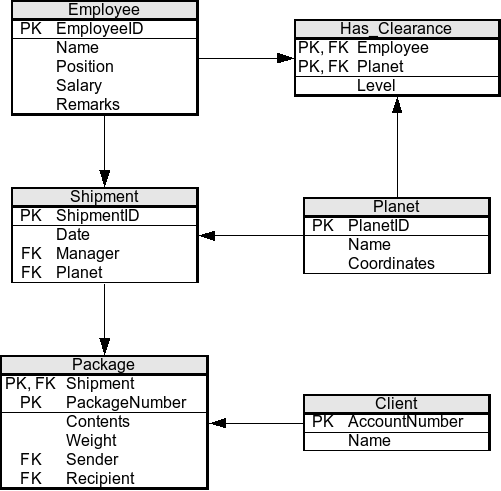
The formal description of a database's structure. It defines how data is organized, the relationships between different pieces of data, and other constraints.
Finally, the data itself is always changing.
Instance
noun
A snapshot of the data in the database at a particular moment in time. The actual data stored in the database at any given point.
If the schema is the empty library with all its shelves and sections, an instance is a photo of the library at a specific time, showing exactly which books are on which shelves and which ones are checked out.
What is the primary job of a database?
In the analogy of a library, what role does the Database Management System (DBMS) play?
Databases are the foundation of how we interact with information today, offering a powerful and reliable way to manage the data that drives our world.