Control Systems Fundamentals
Control System Basics
What Are Control Systems?
At its core, a control system manages the behavior of other devices or systems. Think of the cruise control in a car. You set a desired speed, and the control system takes over, adjusting the engine's throttle to maintain that speed, whether you're going uphill or downhill. The goal is to make a system behave in a specific, desired way, automatically.
Every control system has a few key parts. There's an input, which is the desired goal or setpoint (like 65 mph). There's the system itself, often called the "plant," which is the thing being controlled (the car's engine and drivetrain). And there's the output, which is the actual result (the car's actual speed).
Engineers classify these systems in several ways to better understand, analyze, and design them. Let's walk through the most common classifications.
Open-Loop vs. Closed-Loop
One of the most important distinctions is whether a system uses feedback.
An open-loop system's control action is independent of the output. It follows its instructions without checking the result. A simple toaster is a great example. You set the timer, and it toasts for that amount of time, regardless of whether the bread is perfectly brown or completely burnt.
A closed-loop system, on the other hand, uses feedback. It measures its output and compares it to the input to make adjustments. This is how a thermostat works. It constantly measures the room's temperature (the output) and compares it to your desired temperature setting. If it's too cold, it tells the furnace to turn on. Once the desired temperature is reached, it tells the furnace to turn off. This loop of measuring and adjusting is called feedback.
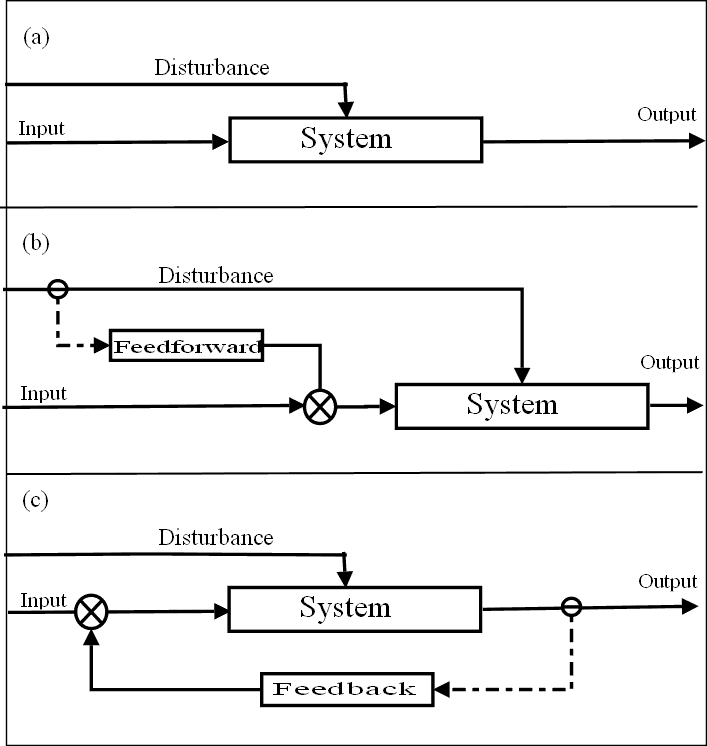
Closed-loop systems are generally more accurate and can adapt to disturbances, like a window being left open on a cold day. Open-loop systems are simpler and cheaper but can't compensate for unexpected changes.
Other Key Classifications
Beyond the feedback loop, we can categorize systems based on their mathematical properties and their relationship with time.
Linear System
noun
A system where the output is directly proportional to the input. If you double the input, the output also doubles. It follows the principle of superposition.
A non-linear system is one where this proportional relationship doesn't hold. The cruise control system is actually non-linear. Doubling the throttle doesn't necessarily double your speed, due to factors like wind resistance and friction, which don't increase proportionally with speed. Most real-world systems are non-linear, but they can often be approximated as linear under specific operating conditions to make them easier to analyze.
We also consider how a system behaves over time.
A time-invariant system is one whose behavior doesn't change over time. An input today will produce the same output as the same input tomorrow. The components don't age or wear out in the model.
Conversely, a time-variant system's behavior does change. A rocket is a time-variant system because its mass decreases as it burns fuel. The same amount of thrust will produce a greater acceleration later in its flight than it does at liftoff.
Finally, we can look at whether a system has memory.
| System Type | Description | Key Feature |
|---|---|---|
| Static | A memoryless system. The output at any given moment depends only on the input at that exact same moment. | Instantaneous |
| Dynamic | A system with memory. The output depends on past inputs as well as the current one. | Has Memory |
A simple light switch is a static system. Its output (light on/off) depends only on its current input (switch position). A car's velocity, however, is the output of a dynamic system. Your current speed depends on how much you've been accelerating or braking over a period of time, not just the pedal's position right now.
Ready to check your understanding? Let's see if you can apply these concepts.
What is the primary goal of a control system?
A standard electric toaster toasts bread for a fixed amount of time set by a dial, regardless of how brown the bread actually is. How would you classify this system?
Understanding these basic classifications is the first step in analyzing, predicting, and designing systems that shape the world around us.