Computer Networking Fundamentals
Layered Data Flow
How Data Travels Through the Network
When you send an email or load a webpage, the data doesn't just zap from your computer to the server in one piece. Instead, it's broken down, packaged, and sent through a series of steps defined by a networking model. This process ensures that complex communication can happen reliably between any two computers in the world. The journey begins with a process called encapsulation.
Encapsulation is like putting a letter inside an envelope, which then goes inside a bigger package, which is then loaded onto a truck. Each layer adds information needed for the next step of the journey.
At each layer of the networking model, a specific header is added to the data. This header contains instructions for the corresponding layer on the receiving end. The data unit at each layer has a special name, known as a Protocol Data Unit (PDU). As data moves down the stack from the Application Layer, it is transformed at each step.
Once the data arrives at its destination, the reverse process, called de-encapsulation, occurs. Each layer on the receiving computer strips off the header added by its corresponding layer on the sending computer. It reads the instructions in the header, performs the required actions, and passes the remaining data up to the next layer. This continues until the original data reaches the application on the receiving machine.
OSI vs. TCP/IP
You'll encounter two primary models that describe these layers: the OSI (Open Systems Interconnection) model and the TCP/IP model. The OSI model is a theoretical, seven-layer framework that was created to standardize network protocols. It's incredibly useful for teaching and for conceptually separating network functions.
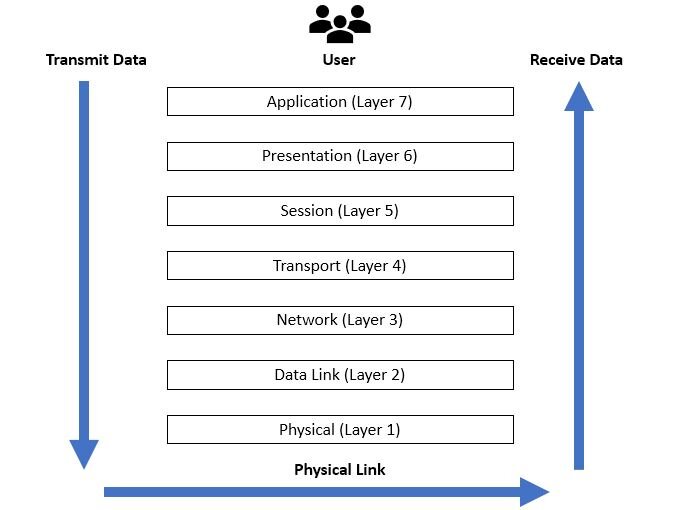
The TCP/IP model, on the other hand, is the practical model that the modern internet is built on. It's simpler, with only four layers. It maps directly to the specific protocols, like TCP (Transmission Control Protocol) and IP (Internet Protocol), that govern the internet.
| OSI Model (7 Layers) | TCP/IP Model (4 Layers) | Key Functions |
|---|---|---|
| Application (7) | Application | User-facing protocols (HTTP, FTP, SMTP) |
| Presentation (6) | Application | Data translation, encryption, compression |
| Session (5) | Application | Manages conversations between applications |
| Transport (4) | Transport | End-to-end communication, reliability (TCP, UDP) |
| Network (3) | Internet | Logical addressing and routing (IP) |
| Data Link (2) | Network Access | Physical addressing (MAC), framing |
| Physical (1) | Network Access | Transmitting raw bits over a medium |
As you can see, the TCP/IP model combines the top three layers of the OSI model into a single Application layer and the bottom two layers into a Network Access layer. While network engineers often refer to the OSI layers by number (e.g., "a Layer 2 issue"), the underlying architecture they're working with is almost always TCP/IP.
Layer Interaction in Practice
The layers don't work in isolation. Each layer provides a service to the layer directly above it. This interaction happens at specific points called Service Access Points (SAPs). Think of a SAP as a doorway between floors in an office building. To get from your office on the 4th floor to one on the 3rd, you must go through a specific stairwell or elevator door.
For example, the Network Layer (Layer 3) provides the service of routing packets from a source host to a destination host. The Transport Layer (Layer 4) uses this service to provide end-to-end reliable communication for applications.
A key aspect of this layered interaction is reliability. Not all layers are concerned with making sure data arrives perfectly. TCP, at the Transport Layer, is connection-oriented. It establishes a connection, ensures all segments arrive in the correct order, and re-transmits any that are lost. It performs end-to-end error checking.
The Data Link Layer also performs error checking, but only for a single hop between two directly connected nodes (e.g., your computer and your router). It uses a checksum in the frame trailer to detect if the frame was corrupted during transit across that specific link. If it was, the frame is simply discarded. It's up to a higher layer protocol like TCP to notice the data is missing and request a re-transmission.
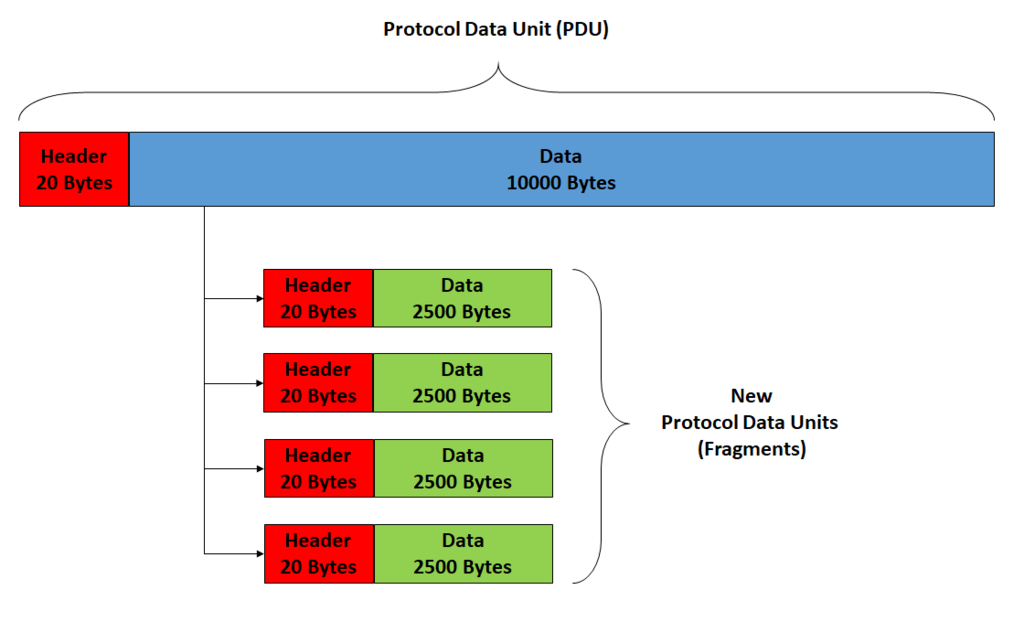
This division of labor is what makes modern networking so robust and flexible. By separating functions like physical transmission, local addressing, global routing, and session reliability, different technologies can be swapped in and out at each layer without breaking the whole system. You can switch from Wi-Fi to a wired Ethernet connection, and your web browser doesn't even notice, because the changes happen at the lower layers, well below where the application operates.
Let's test your understanding of how data flows through network layers.
What is the process of adding a header to data as it moves down the network stack called?
The OSI model is a theoretical 7-layer framework, while the TCP/IP model that powers the modern internet is a more practical, 4-layer framework.
Understanding this layered flow is fundamental. It not only explains how the internet works but also provides a logical framework for diagnosing problems. If a connection fails, a network engineer can investigate layer by layer to pinpoint the source of the issue.