Cognitive Behavioral Therapy for Counselors
Introduction to CBT
What is CBT?
Cognitive Behavioral Therapy, or CBT, is a type of talk therapy that helps you become more aware of inaccurate or negative thinking. The goal is to learn how to view challenging situations more clearly and respond to them in a more effective way.
The core of CBT lies in the understanding that thoughts, feelings, and actions are all connected.
Imagine you have a big presentation at work. If you think, "I'm going to mess this up," you'll likely feel anxious. That anxiety might cause you to procrastinate or avoid preparing. The behavior (avoidance) then reinforces the initial thought ("I knew I couldn't do it"). CBT works by breaking this cycle.
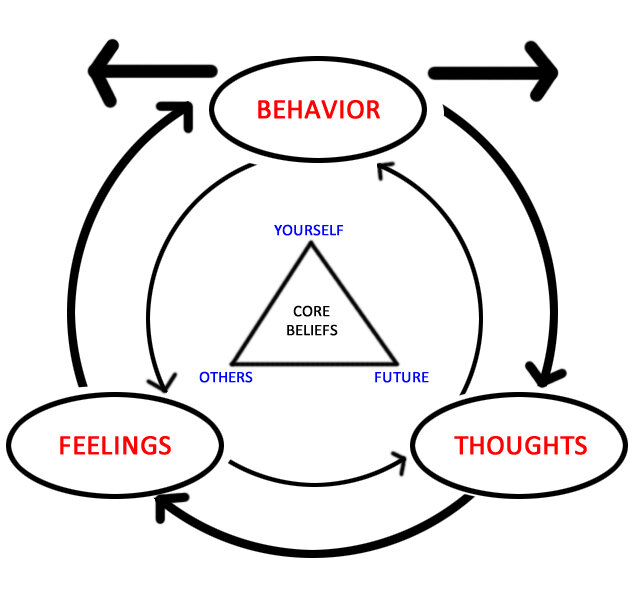
It’s a practical, hands-on approach. Rather than dwelling on the past, CBT focuses on the here and now. It gives you tools and strategies to tackle current problems. Think of it as building a mental toolkit to help you navigate life's challenges.
A Quick History
CBT didn't appear out of nowhere. It evolved from two earlier schools of thought: behaviorism and cognitive therapy.
In the early 20th century, behaviorism was dominant. Therapists focused only on observable behaviors, believing that our actions are learned responses to our environment. Then, in the 1960s, a new wave of thinking emerged. Psychologists like Aaron Beck and Albert Ellis argued that we couldn't ignore what was happening inside our minds.
They realized that it's not the event itself that causes our emotional reactions, but our interpretation of the event.
Aaron Beck, often called the father of cognitive therapy, noticed that his patients with depression often had a stream of automatic negative thoughts. He developed a structured approach to help them identify and challenge these thoughts. Albert Ellis developed a similar approach called Rational Emotive Behavior Therapy (REBT).
CBT combines the practical, action-oriented techniques of behavior therapy with the thought-challenging methods of cognitive therapy. It brought together the best of both worlds to create a powerful and effective treatment.
The Theory Behind It
CBT is built on two core models: the cognitive model and the behavioral model.
Cognitive Model
noun
The idea that our thoughts and perceptions influence our feelings and behaviors. It's not events, but our interpretation of them, that shapes our emotional response.
The cognitive model focuses on identifying and changing distorted thinking patterns. For example, if you fail an exam, an automatic thought might be, "I'm a complete failure." This is a cognitive distortion called "overgeneralization." CBT helps you recognize this thought and reframe it to something more realistic, like, "I didn't pass this one exam, but I can study differently and do better next time."
Here’s how that cycle might look:
The behavioral model, on the other hand, is rooted in the idea that behaviors are learned and can be unlearned. It examines how our actions, like avoiding feared situations, can maintain or worsen our problems. For instance, if someone with social anxiety consistently avoids parties, they never get the chance to learn that they can handle social situations, which reinforces their anxiety.
Why It Works
CBT is not just a popular theory; it's one of the most researched forms of psychotherapy. Numerous studies have shown it to be effective for a wide range of issues, including depression, anxiety disorders, PTSD, and eating disorders. This makes it an "evidence-based" practice.
CBT is one of the most extensively studied forms of psychotherapy.
One reason for its success is its structured, goal-oriented nature. Sessions are focused, and clients work collaboratively with their therapist to set clear goals. Another key component is
Homework is another important part of CBT, regardless of the techniques you use.
This doesn't mean writing essays. Homework usually involves practicing the skills learned in therapy in real-world situations, such as tracking thoughts, practicing relaxation techniques, or gradually facing feared situations. This practical application is what helps create lasting change.
Ready to check your understanding of these core concepts?
What is the fundamental principle of Cognitive Behavioral Therapy (CBT)?
CBT is a hybrid approach that evolved from which two earlier schools of thought?
By understanding the connection between what we think, how we feel, and what we do, CBT provides a powerful framework for change. It empowers individuals with practical skills to manage their mental health more effectively.