Class 11 Modern Periodic Table
Modern Periodic Law
The Modern Periodic Law
For a long time, scientists arranged elements based on their atomic mass. This worked, but had some inconsistencies. The puzzle wasn't fully solved until the early 20th century, when a British physicist named Henry Moseley conducted a series of experiments. He discovered a more fundamental property of elements: the atomic number.
Moseley found that the atomic number, which equals the number of protons in an atom's nucleus (and also the number of electrons in a neutral atom), was the true key to understanding the periodic patterns. This led to a revision of the periodic law.
The Modern Periodic Law states that the physical and chemical properties of elements are the periodic functions of their atomic numbers.
This modern law is the foundation of the periodic table we use today. Unlike atomic mass, the atomic number increases by exactly one whole number from one element to the next. This perfect progression allows for a precise and gapless arrangement, revealing how an element's electron structure dictates its chemical behaviour.
Structure of the Modern Table
The modern periodic table, also called the long form table, is a direct visual representation of this law. It organises elements into a grid of 18 vertical columns and 7 horizontal rows.
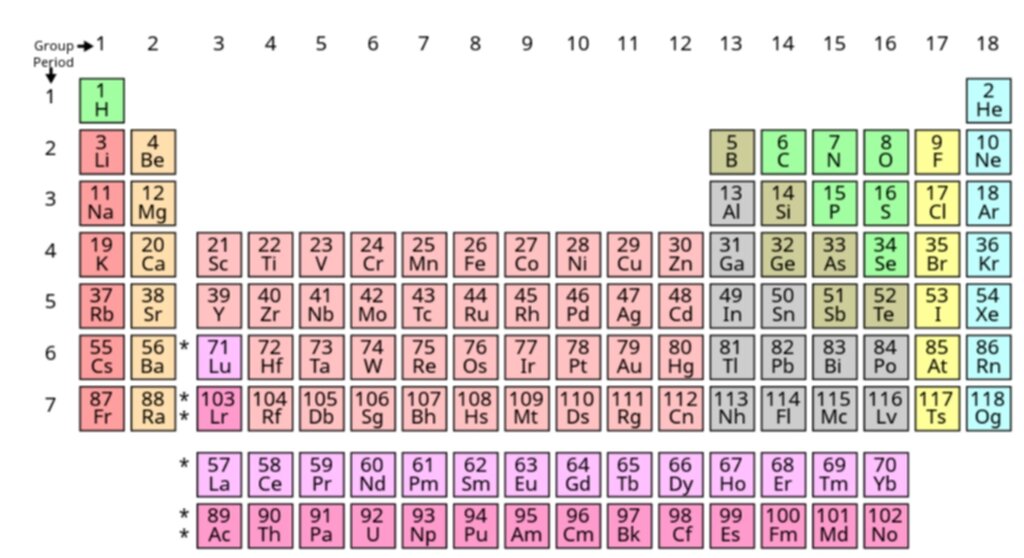
- Groups: The 18 vertical columns are called groups. Elements within the same group share similar chemical properties because they have the same number of electrons in their outermost, or valence shell.
- Periods: The 7 horizontal rows are called periods. Each period corresponds to the filling of a new principal energy level. The first period has only two elements (Hydrogen and Helium), while subsequent periods have more.
A deeper level of organisation comes from dividing the table into four distinct blocks. This classification is based on which subshell the last electron, the 'differentiating electron', enters according to the .
| Block | Groups | Valence Electron Configuration |
|---|---|---|
| s-block | 1 and 2 | ns¹ or ns² |
| p-block | 13 to 18 | ns²np¹ to ns²np⁶ |
| d-block | 3 to 12 | (n-1)d¹⁻¹⁰ns⁰⁻² |
| f-block | Lanthanides & Actinides | (n-2)f¹⁻¹⁴(n-1)d⁰⁻¹ns² |
This structure isn't just for neatness. The position of an element in the periodic table allows us to predict its properties with remarkable accuracy, from its atomic size and reactivity to the type of chemical bonds it will form. It's a comprehensive map of the elements, built on the simple, elegant foundation of the atomic number.
What is the fundamental principle that governs the arrangement of elements in the modern periodic table?
Elements in the same vertical column of the periodic table, known as a group, share which of the following characteristics?
The modern periodic table is one of the most powerful tools in chemistry. By understanding its structure based on atomic number, you can unlock the secrets of elemental properties and predict how they will interact.