Christian Epistemology
Introduction to Epistemology
How Do You Know What You Know?
Think about something you're absolutely sure of. Maybe it's that the sky is blue, or that 2 + 2 = 4, or that you're reading this right now. But how do you know? What does it even mean to 'know' something, rather than just believe it or guess it correctly?
These are the kinds of questions that have puzzled philosophers for centuries. This field of inquiry has a specific name: epistemology.
Epistemology
noun
The branch of philosophy concerned with the nature of knowledge, how it is formed, and how much we can truly know.
For a long time, the standard answer to "What is knowledge?" was the idea of "justified true belief." This model suggests that for you to truly know something, three conditions must be met.
- You must believe it. Knowledge requires a personal conviction. You can't know something you don't believe.
- It must be true. Your belief has to align with reality. You can't know that the Earth is flat, because it isn't.
- Your belief must be justified. You need a good reason for your belief. It can't be a lucky guess.
Imagine a Venn diagram where these three criteria overlap. Knowledge, in this classic view, exists only in that central intersection.
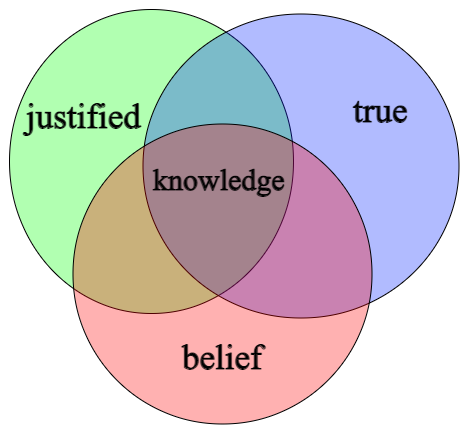
This definition seems solid, but it's not without its challenges. Philosophers have come up with clever thought experiments showing you can have a justified true belief that still doesn't quite feel like knowledge. This debate shows just how tricky pinning down the nature of knowledge can be.
Where Does Knowledge Come From?
If knowledge is more than just a lucky guess, where do we get it? This question created a major split in philosophy, leading to two main schools of thought: rationalism and empiricism.
Rationalists argue that our primary source of knowledge is reason. They believe we can understand the world through logic and innate ideas, things we know without needing to experience them first. Think of mathematical truths. You don't need to run an experiment to know that a triangle has three sides; you know it through the definition and logic.
Empiricists, on the other hand, argue that all knowledge comes from sensory experience. For them, the mind is a blank slate at birth, and we fill it with knowledge gathered through seeing, hearing, touching, tasting, and smelling. To know that a fire is hot, you have to experience its heat. Scientific observation is a powerful example of empiricism in action.
Most philosophers today believe that both reason and experience play crucial roles. We use our senses to gather information about the world, and we use our reason to organize, interpret, and draw conclusions from that information.
What Are the Limits of Knowledge?
The final big question in epistemology is about scope. What can we know? Is there a limit to human knowledge? This leads to the position of skepticism.
A skeptic is someone who questions whether we can know anything for sure. Philosophical skepticism isn't just about being doubtful; it's a rigorous process of questioning our claims to knowledge. Could we be living in a dream? Could our senses be deceiving us? While extreme skepticism is rare, it serves a valuable purpose. It forces us to be more critical about our beliefs and to seek stronger justification for the things we claim to know.

By exploring what knowledge is, where it comes from, and its potential limits, epistemology provides a framework for thinking more clearly about our own beliefs and the world around us. It's a foundational part of understanding how we engage with reality.
Let's test your understanding of these core concepts.
What is the central focus of the philosophical field of epistemology?
According to the traditional 'Justified True Belief' model, which of the following is NOT a required condition for knowledge?