Chemistry Careers and Applications
Introduction to Chemistry Careers
The Central Science
Chemistry is often called the “central science,” and for good reason. It’s the study of matter—what it’s made of, what its properties are, and how it changes. Think about it: everything you can touch, taste, or smell is made of chemicals.
This field forms a fundamental bridge between the other major sciences. It connects the principles of physics, which govern the behavior of atoms and energy, with the complex systems studied in biology, like the intricate chemical reactions that power living cells. It also underpins geology, explaining how minerals form, and environmental science, helping us understand pollutants and planetary cycles. Because it links so many disciplines, a background in chemistry opens doors to a surprisingly wide array of fields.
This central position means that chemists are not just confined to laboratories. Their expertise is needed everywhere, from developing life-saving drugs to creating the materials for our smartphones, ensuring our food is safe, and tackling climate change. A chemistry degree doesn't lead to just one job; it leads to hundreds of possibilities.
Beyond the Beaker
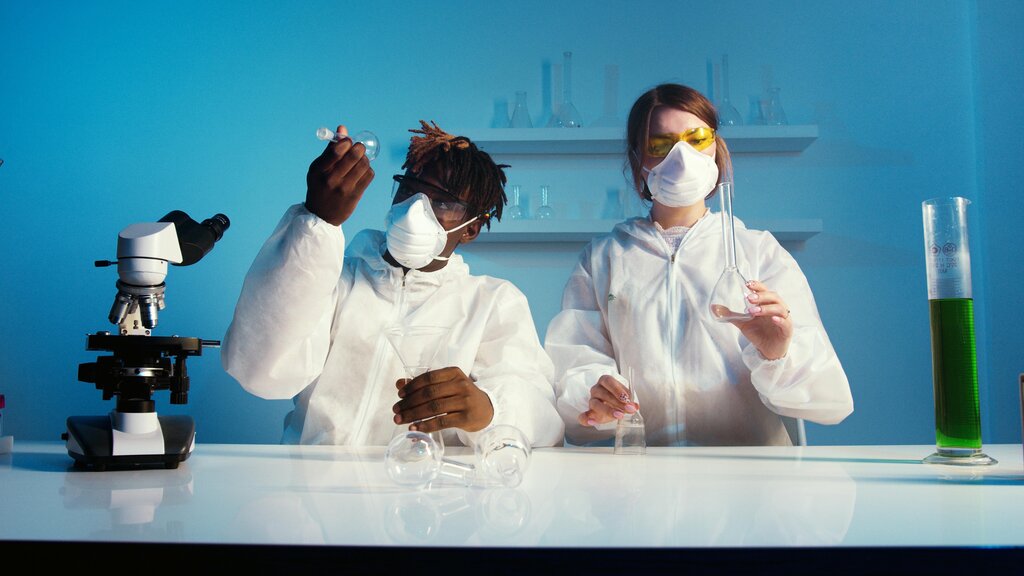
When you picture a chemist, you might imagine someone in a white lab coat surrounded by bubbling beakers. While that's certainly one path, it's far from the only one. Chemists work in three main sectors: private industry, academia, and government.
Each sector offers a unique environment and focuses on different goals, from creating new consumer products to pushing the boundaries of human knowledge.
In industry, chemists are innovators. They work for companies in pharmaceuticals, agriculture, energy, cosmetics, and materials science to research and develop new products. They might formulate a more effective sunscreen, invent a biodegradable plastic, or design a more efficient battery. This work is often team-based and driven by practical, real-world problems.
Academia is the world of universities and colleges. Here, chemists focus on teaching the next generation and conducting fundamental research. An academic chemist might spend years investigating a specific molecular reaction, not for a particular product, but simply to expand our understanding of how the world works. Their findings are published in scientific journals, contributing to the collective knowledge of humanity.
Chemists in government serve the public. They work for agencies like the Environmental Protection Agency (EPA) to monitor pollution, the Food and Drug Administration (FDA) to ensure the safety of our food and medicine, or in forensic labs to help solve crimes. This work involves regulation, analysis, and policy-making to protect public health and safety.
A World of Roles
Within these sectors, the specific jobs are incredibly varied. A chemist's day-to-day work depends entirely on their role. Some focus on hands-on experimentation, while others work with data, people, or ideas.
| Career Area | What They Do |
|---|---|
| R&D Scientist | Conducts experiments to discover new molecules or create new materials. |
| Analytical Chemist | Measures the chemical composition of substances with high precision. |
| Quality Control | Ensures products (like medicines or foods) meet safety and purity standards. |
| Forensic Scientist | Analyzes physical evidence from crime scenes to help investigations. |
| Chemical Engineer | Designs and operates large-scale processes to produce chemicals and goods. |
| Science Writer | Communicates complex scientific topics to the public or other scientists. |
| Patent Lawyer | Uses a chemistry background to help protect new scientific inventions. |
This is just a small sample. Many chemists also become entrepreneurs, high school teachers, policy advisors, and medical professionals. The skills you gain studying chemistry—problem-solving, analytical thinking, and a deep understanding of the material world—are valuable in almost any field.
Ready to test your knowledge?
Why is chemistry often referred to as the 'central science'?
A chemist working to develop a new biodegradable plastic for a consumer goods company is most likely employed in which sector?
As you can see, chemistry is more than just a subject in a textbook. It's a passport to a vast and impactful range of careers that shape our world.