Building Autonomous Agents with Google Gemini
Gemini 3 Agent Foundations
Beyond the Chatbot
Large language models have traditionally operated like brilliant parrots. You give them a prompt, and they predict the most likely sequence of words to follow. This is a reactive process. It can write a poem, summarize a report, or translate text, but it doesn't plan or take independent action.
AI agents represent a fundamental shift from this model. Instead of just responding, an agent acts to achieve a goal. It's the difference between asking a librarian for a book title and giving them a research topic, then having them return with a curated stack of books, relevant articles, and a summary of key findings.
This move from reactive prediction to proactive problem-solving is the core of agentic AI. The model is no longer just a text generator; it's the brain of a system that perceives its environment, reasons about a course of action, and executes steps to complete a task.
An agent combines a model's reasoning with the ability to use tools and remember past events to achieve a goal autonomously.
The Agent's Mind
At the heart of a Gemini 3 agent is a new operational cycle: the Observe-Reason-Act loop. This isn't just a clever name; it describes a distinct, internal process that separates it from older models. The agent doesn't simply predict the next token in a sentence. Instead, it follows a structured thinking process.
First, it Observes. The agent takes in the user's request and assesses the available information and tools. This could be anything from a simple text prompt to a complex set of documents, images, and API specifications.
Next, it Reasons. This is the critical step. The model formulates a plan, breaking the goal down into smaller, logical steps. It might think, "To answer this question, I first need to search the web for recent data, then run that data through my code interpreter tool, and finally, format the result as a table."
Finally, it Acts. The agent executes the first step of its plan by calling a tool, running code, or asking a clarifying question. The result of this action becomes a new observation, starting the loop over again until the goal is achieved.
This loop is powered by one of two core models in the Gemini 3 family. Gemini 3 Pro is the powerhouse, designed for complex, multi-step reasoning. It excels at tasks that require deep analysis, planning, and creative problem-solving. Gemini 3 Flash, on the other hand, is optimized for speed and efficiency. It's ideal for high-frequency, lower-complexity tasks like routing user queries, extracting information, or powering a conversational interface where low latency is key. Choosing the right model is like choosing between a master strategist and a rapid-response specialist.
Memory and Senses
An agent can't act effectively if it can't remember what it's doing or perceive its environment. Gemini 3 addresses this with two key features: a massive context window and native multimodality.
The context window is the model's short-term memory. It's the space where the agent holds the current conversation, documents it's analyzing, and the history of its own actions. With up to 1 million tokens, Gemini 3's context window is large enough to hold an entire codebase or a small novel. This allows the agent to maintain a deep understanding of the task at hand without forgetting crucial details from one step to the next.
Beyond just text, Gemini 3 has native multimodality. This means it was designed from the ground up to understand and reason across different types of information simultaneously. An agent can look at a screenshot of a website, read its HTML code, and understand a user's verbal command about what to change. It doesn't need separate models to handle images, code, and text; it processes them all in a single, unified way. This gives the agent a much richer, more human-like understanding of the world it operates in.
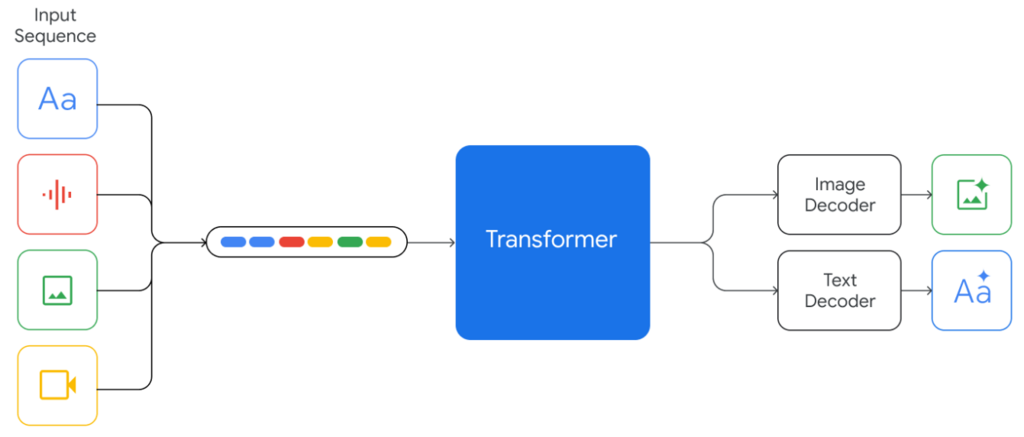
These components, the reasoning loop, the choice of a specialized model, a vast short-term memory, and multimodal senses, form the foundation of a Gemini 3 agent. They enable a system to go beyond simple text prediction and begin to tackle complex, real-world goals.
What is the primary difference between a traditional large language model and an AI agent?
What are the three stages of the core operational cycle for a Gemini 3 agent?