Brainwave Audio Information Encoding
Auditory System Basics
The Journey of Sound
Sound is all around us, but what is it, really? At its core, sound is a vibration, a pressure wave that travels through a medium like air. Our auditory system has the incredible job of capturing these invisible waves and turning them into the rich world of sounds we experience, from a whispered secret to a crashing cymbal. This process is a fascinating journey through three distinct parts of the ear.
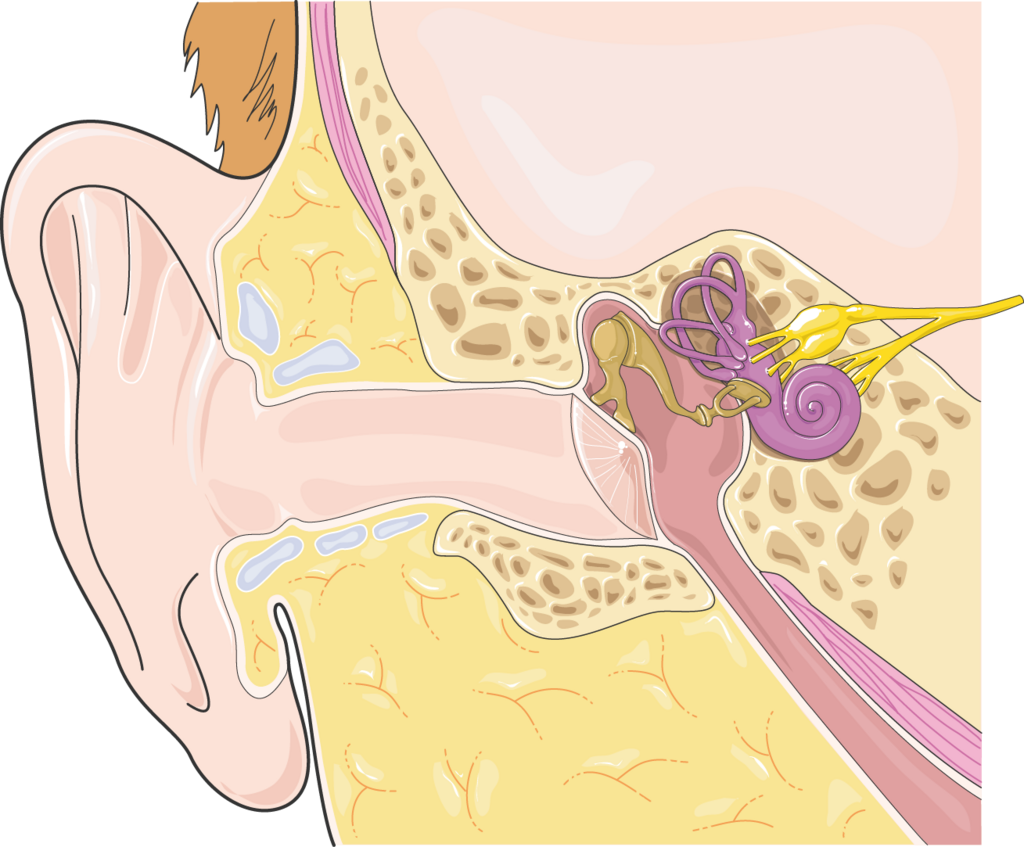
The journey begins with the part of the ear you can see.
The Outer Ear Funnel
The visible, fleshy part of your ear is called the pinna, or auricle. Its unique folds and curves aren't just for show; they are expertly shaped to capture sound waves and funnel them into the ear canal. Think of it as a natural satellite dish for sound.
Once collected, the sound waves travel down the ear canal, a short tube leading to the eardrum. This canal amplifies certain frequencies, making human speech easier to hear. At the end of this tunnel, the sound waves are about to meet a critical player: the eardrum.
The Middle Ear Amplifier
The middle ear is a small, air-filled chamber that acts as a mechanical amplifier. It starts with the tympanic membrane, more commonly known as the eardrum. When sound waves hit the eardrum, they cause it to vibrate, just like the skin of a drum.
These vibrations are then passed on to a chain of three tiny, connected bones called the ossicles. They are the smallest bones in the human body, and their names describe their shapes: the malleus (hammer), incus (anvil), and stapes (stirrup).
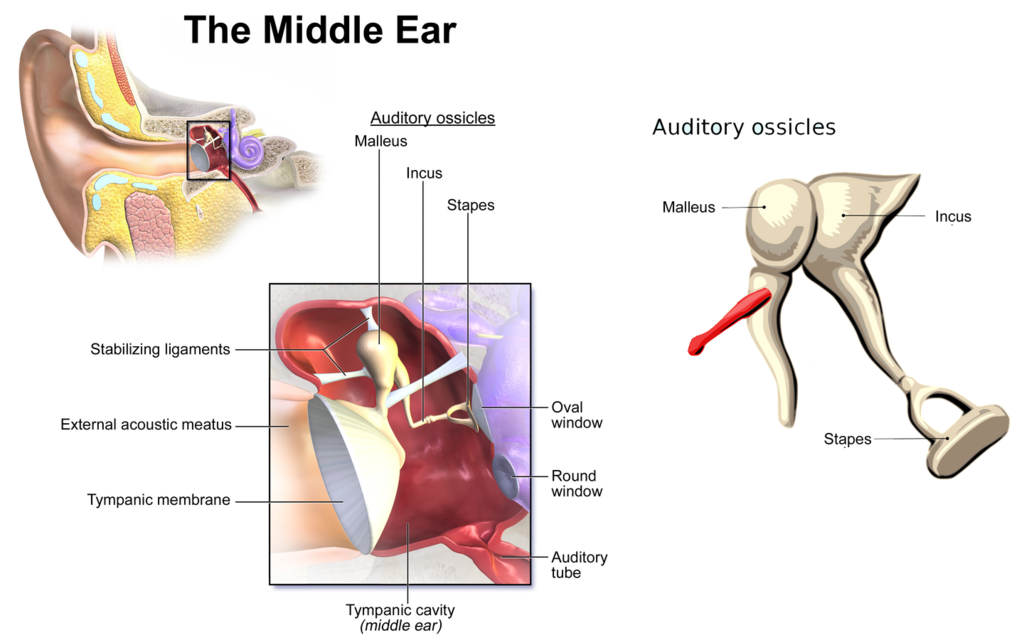
The ossicles work like a set of levers. The hammer is attached to the eardrum, and as the eardrum vibrates, the hammer strikes the anvil, which in turn moves the stirrup. This lever action concentrates the force of the vibrations, amplifying the sound. This amplification is crucial because the sound is about to move from the air-filled middle ear to the fluid-filled inner ear, and it needs more energy to make waves in fluid.
The Inner Ear Converter
The stapes presses against a small membrane called the oval window, which is the gateway to the inner ear. The star of the inner ear is the cochlea, a spiral-shaped, bony structure that looks like a snail shell. It’s filled with fluid and is where the magic of transduction happens: the conversion of mechanical vibrations into electrical signals.
As the stapes pushes on the oval window, it creates waves in the cochlear fluid. These waves travel along the basilar membrane, a structure that runs the length of the cochlea. Different parts of this membrane are sensitive to different frequencies. High-pitched sounds create vibrations near the base of the cochlea, while low-pitched sounds create vibrations near the apex, or tip.
This frequency mapping is like a piano keyboard unrolled along the cochlea, with each key corresponding to a specific spot on the basilar membrane.
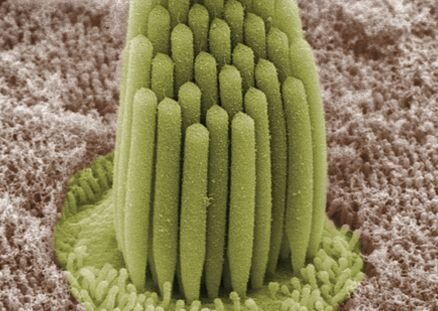
Lining the basilar membrane are thousands of microscopic hair cells, topped with tiny bundles of bristles called stereocilia. As the fluid waves move the basilar membrane, these hair cells bend. This bending action opens tiny channels in the cells, allowing electrically charged ions to rush in. This influx of ions creates an electrical signal.
From Ear to Brain
This electrical signal is the new form of the sound information. The auditory nerve, a bundle of nerve fibers connected to the hair cells, picks up these signals. It acts like a high-speed data cable, transmitting the information from the cochlea straight to the brain.
The signals travel to a specific region in the brain’s temporal lobe called the primary auditory cortex. This is the brain's main sound-processing center. Here, the raw electrical data is interpreted. The brain deciphers the pitch based on which hair cells were activated, the loudness from how many cells were activated and how fast they fired, and timing information that helps us locate the sound's source.
From a simple vibration in the air to a complex neural code, the auditory system performs a remarkable transformation, allowing us to perceive and interact with the world through sound.
What is the primary function of the pinna, the visible, fleshy part of the ear?
The middle ear must amplify sound vibrations. Why is this amplification so crucial for hearing?