Boolean Algebra Sums Explained
Boolean Algebra Basics
Logic Meets Algebra
In regular algebra, variables can stand for any number. But what if a variable could only be one of two things, like true or false? This is the core idea behind Boolean algebra.
Developed by English mathematician George Boole in the 1850s, this system gives a mathematical structure to logic. Boole wanted to find a way to use algebraic techniques to work with logical statements. His work created a powerful bridge between mathematics and logic.
In this system, we swap the words "true" and "false" with numbers. We use 1 to represent true and 0 to represent false. This simple substitution is the key. It allows us to analyze and simplify complex logical statements using a set of clear, consistent rules, much like how we'd solve a standard algebraic equation.
The Three Basic Operations
Boolean algebra is built on just three fundamental operations: AND, OR, and NOT. Every logical statement, no matter how complex, can be broken down into combinations of these three.
Conjunction
noun
The logical AND operation. A conjunction is true only if all of its components are true.
The AND operation, also known as conjunction, is like a strict requirement. For an AND statement to be true, both parts must be true. Think about it like this: to get a driver's license, you must pass the written test AND pass the driving test. If you only do one, you don't get the license.
We can represent this with a truth table, which shows every possible outcome. Let's use A and B as our two logical statements.
| A | B | A AND B |
|---|---|---|
| 0 | 0 | 0 |
| 0 | 1 | 0 |
| 1 | 0 | 0 |
| 1 | 1 | 1 |
As you can see, the result is 1 (true) only when both A and B are 1 (true).
Disjunction
noun
The logical OR operation. A disjunction is true if at least one of its components is true.
The OR operation, or disjunction, is more flexible. For an OR statement to be true, at least one of its parts must be true. For example, a restaurant might advertise, "Your meal comes with soup OR salad." You don't get both, but as long as you choose one, the condition is met. The statement is only false if you get neither.
| A | B | A OR B |
|---|---|---|
| 0 | 0 | 0 |
| 0 | 1 | 1 |
| 1 | 0 | 1 |
| 1 | 1 | 1 |
Notice the result is 0 (false) only when both A and B are 0 (false).
Negation
noun
The logical NOT operation. Negation reverses the truth value of a statement.
The NOT operation, or negation, is the simplest of the three. It just flips the truth value of a statement. If a statement is true, NOT makes it false. If it's false, NOT makes it true. If the statement is "The door is locked" (true), then "NOT The door is locked" means "The door is unlocked" (false).
| A | NOT A |
|---|---|
| 0 | 1 |
| 1 | 0 |
The Building Blocks of Digital Logic
This system of 0s and 1s, combined with the operations AND, OR, and NOT, is called a two-element Boolean algebra. It's the foundation of all modern computers.
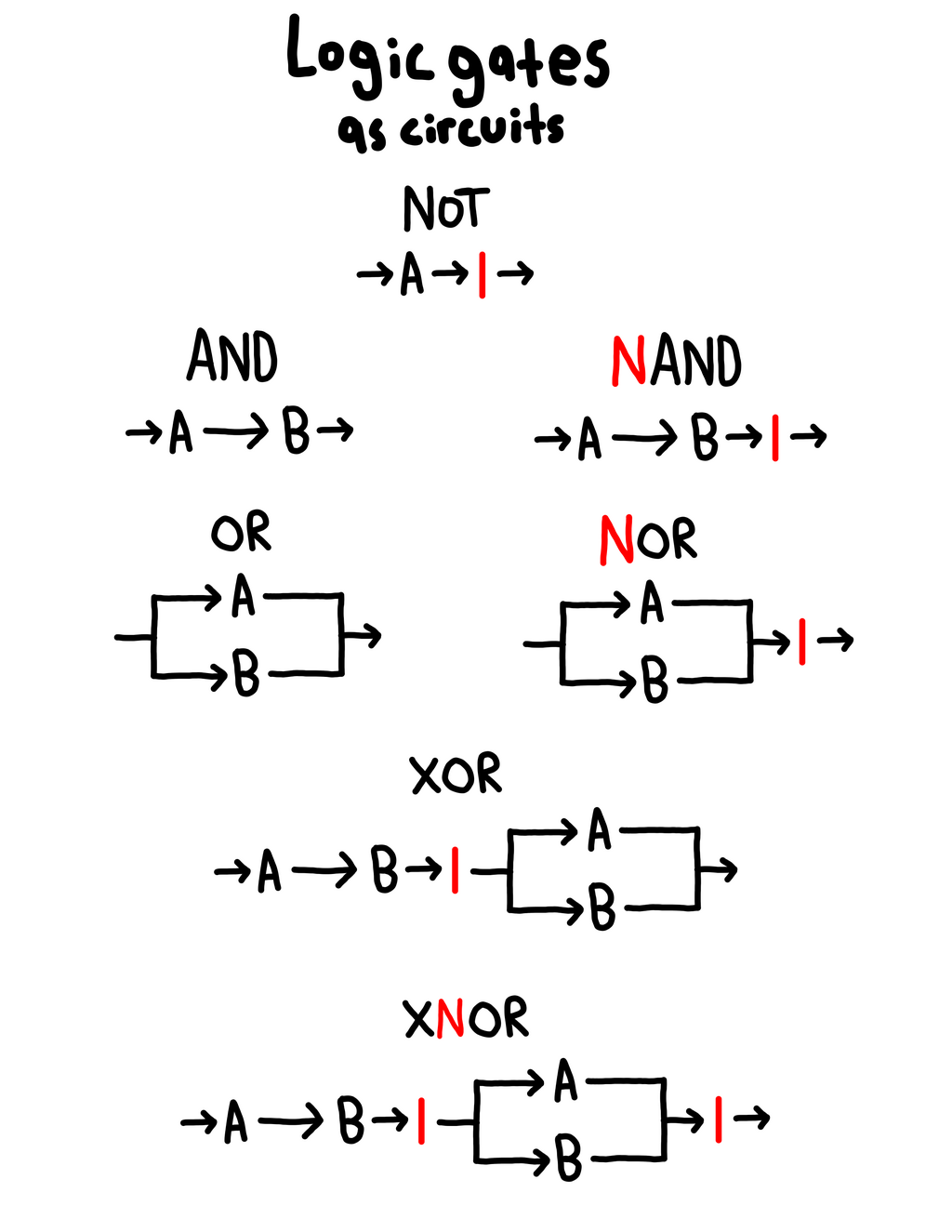
Inside every smartphone, laptop, and digital device, there are billions of tiny electronic switches called transistors. These switches can be either on or off, a state that corresponds perfectly to the 1s and 0s of Boolean algebra. By combining these switches into circuits called logic gates, which perform the AND, OR, and NOT operations, computers can perform complex calculations, process information, and make decisions.
What George Boole created as a way to formalize human reasoning turned out to be the perfect language for designing the electronic brains of the 21st century.
Let's check your understanding of these fundamental concepts.
Who is credited with developing Boolean algebra as a way to give mathematical structure to logic?
In Boolean algebra, what numerical values are used to represent 'true' and 'false'?