Blockchain Fundamentals Explained
Introduction to Blockchain
What Is a Blockchain?
Think of a simple notebook, or a ledger, where you keep track of transactions. Every time you spend or receive money, you write it down. This notebook is a central record. If you lose it, the record is gone. If someone changes an entry, it might be hard to prove what the original was.
At its most basic level, a blockchain is a digital ledger maintained by a decentralized network of computers.
A blockchain is like that notebook, but it’s digital and shared across many computers. Instead of one person holding the master copy, everyone in the network has an identical version. This setup makes it incredibly secure and reliable. Its main purpose is to record information, whether it's financial transactions or other types of data, in a way that is very difficult to change, cheat, or hack.
The Structure of a Chain
The name “blockchain” gives a big clue about how it works. It’s a chain of blocks. Let's break that down.
Blocks are like the pages of our digital notebook. Each block contains a list of recent transactions or data. Once a block is filled with information, it gets added to the chain.
Each block also contains two other important pieces of information: its own unique identifier, called a hash, and the hash of the block that came before it.
hash
noun
A unique, fixed-length string of characters that identifies a piece of data. It acts like a digital fingerprint.
This is how the chain is formed. Each new block points back to the previous one by including its hash. This creates a secure, interconnected line of blocks, starting from the very first one, often called the Genesis Block.
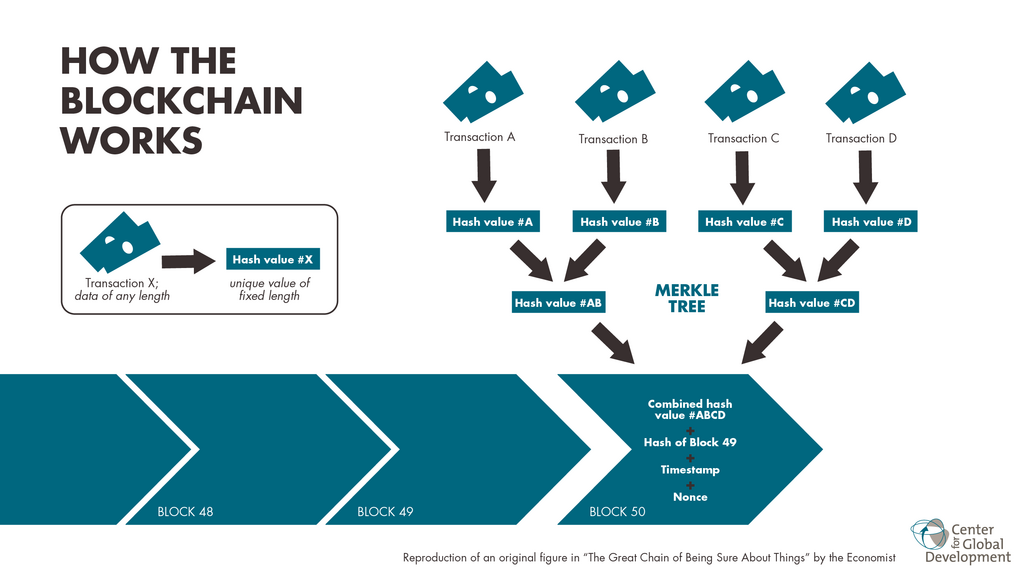
This structure is what makes a blockchain so secure. If someone wanted to alter the data in an old block, they would change that block's hash. Because the next block in the chain contains the original hash, the link would break. To successfully change a block, a person would have to alter that block and every single block that comes after it, all across the network, which is practically impossible.
Why It Matters
The structure of a blockchain gives it three powerful characteristics that set it apart from traditional databases.
Decentralization As we've covered, there's no central authority. The ledger is distributed across a peer-to-peer network. No single person or entity can control it, which prevents censorship and single points of failure.

Transparency While the identity of participants can be anonymous, the transactions themselves are often public. Anyone on the network can typically view the ledger and verify its contents. This creates a system where actions are open for all to see, fostering trust.
Immutability This means that once something is recorded on the blockchain, it cannot be altered or deleted. The linking of blocks through hashes makes the data tamper-proof. It's a permanent, unchangeable record.
Together, these features create a robust and trustworthy way to record and share information. Now that you understand the basic building blocks, you're ready to explore what this technology can do.
Let's review these core concepts.
What is the primary function of a blockchain?
How do individual blocks in a blockchain create a secure, interconnected chain?