Blockchain Explained
Introduction to Blockchain
A Shared Digital Notebook
Imagine a group of friends who want to keep track of money they lend each other. Instead of one person being the scorekeeper, everyone gets an identical notebook. When one person lends money to another, everyone writes it down in their own notebook. This way, the record is public to the group and can’t be easily disputed. If someone tries to change a past entry, their notebook won't match everyone else's, and the change will be rejected.
A blockchain works in a similar way. It's a digital ledger, or notebook, that is shared across a network of computers. Instead of being stored in one central place, copies of the ledger exist on many computers around the world. Its main purpose is to record transactions or any kind of digital information in a secure and verifiable way, without needing a central authority like a bank or government to oversee it.
At its most basic level, a blockchain is a digital ledger maintained by a decentralized network of computers.
This structure is what makes it so revolutionary. It allows for trust and agreement between people who might not know each other, all handled by the technology itself.
The Core Characteristics
Three key features give blockchain its power: decentralization, transparency, and immutability.
Decentralization: This is the opposite of a traditional, centralized system. In a centralized system, like a bank, all data is stored and managed by a single entity. If that central entity fails or is compromised, the entire system is at risk. In a decentralized system, the information is distributed across many participants in the network. There's no single point of failure.
Transparency: In most blockchains, anyone with access to the network can view the entire history of transactions. While the real-world identities of participants are often anonymous (represented by a string of characters), the transactions themselves are public. This transparency builds trust, as everyone can verify the records for themselves.
Immutability: This means that once a transaction is recorded on the blockchain, it cannot be altered or deleted. Transactions are grouped into 'blocks' of data. Each new block is cryptographically linked to the one before it, forming a chronological 'chain'. Changing a block would require changing every single block that comes after it across the entire network, which is practically impossible.
Immutability
noun
The quality of being unchangeable over time. In the context of blockchain, data recorded on the ledger cannot be altered or removed.
A Brief History
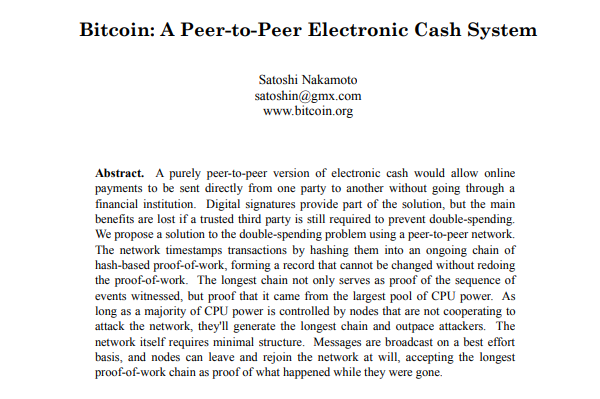
The ideas behind blockchain technology have been around since the early 1990s, but they came together in 2008 with the publication of a white paper titled "Bitcoin: A Peer-to-Peer Electronic Cash System." This paper, written by a person or group using the pseudonym Satoshi Nakamoto, outlined the first practical application of blockchain technology: a decentralized digital currency.
For its first few years, blockchain was almost exclusively associated with Bitcoin. It was the underlying engine that made the cryptocurrency possible. However, developers soon realized that the technology's potential went far beyond digital money.
The real turning point came with the development of platforms like Ethereum in the mid-2010s. Ethereum showed that a blockchain could be used to run programs and automate agreements, not just record transactions. This opened the door to countless new applications, from supply chain management and digital identity to voting systems and online gaming.
Today, blockchain is an evolving technology being explored by industries all over the world, promising to reshape how we interact with data and trust each other in a digital age.
Ready to check your understanding?
In the analogy of friends tracking loans in identical notebooks, what does the fact that everyone has their own copy of the notebook represent?
What does 'immutability' mean in the context of blockchain?
You now have a solid grasp of what a blockchain is, its core features, and where it came from. This foundation is key to understanding its more advanced capabilities.