Big Data and MongoDB
Introduction to Big Data
What Is Big Data?
Every time you stream a movie, post a photo, or use a map on your phone, you create data. Now multiply that by billions of people doing the same thing every second. The result is a digital flood of information unlike anything in human history.
This is the world of Big Data. It’s not just about having a lot of information; it’s about having datasets so large, fast-moving, and complex that traditional software and databases can't handle them. Think of trying to fit an ocean into a bucket. It just doesn't work.
Big Data refers to extremely large and complex sets of data that traditional data processing software struggles to manage and analyze effectively.
These massive datasets come from everywhere: social media feeds, website clicks, weather sensors, medical records, and countless other sources. To make sense of it all, we need a new way of thinking about data, starting with its core characteristics.
The Three Vs
To qualify as "big," data usually has three key traits, known as the Three Vs: Volume, Velocity, and Variety.
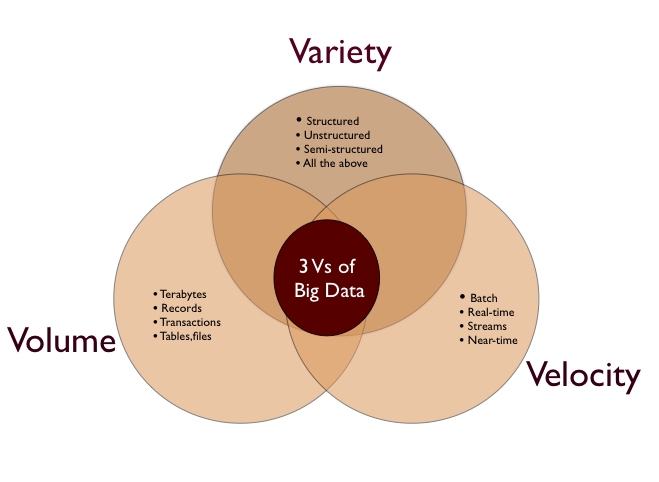
Volume refers to the sheer amount of data. We're no longer talking about megabytes or gigabytes, but terabytes, petabytes, and even exabytes. For perspective, a single petabyte could hold over 200,000 high-definition movies.
Velocity is the speed at which data is created and needs to be processed. Financial markets generate stock data in microseconds. A popular social media platform processes millions of posts every minute. This information is a constant, high-speed stream that needs to be captured and analyzed in near real-time.
Variety describes the different forms data can take. In the past, most data was structured—neatly organized in tables, like a spreadsheet. Big Data is mostly unstructured. It includes everything from emails and text documents to photos, videos, and audio files. This mix of formats makes it much harder to organize and analyze.
Challenges and Opportunities
The unique nature of Big Data presents significant challenges. How do you store an ever-expanding ocean of information? How do you process unstructured data from millions of sources at once? Traditional databases were designed for organized, predictable data, not the chaotic reality of the modern web.
Managing this scale, speed, and complexity requires new tools and technologies built from the ground up for Big Data.
But with these challenges come incredible opportunities. By analyzing Big Data, organizations can uncover patterns and insights that were previously invisible.
A retail company can analyze shopping habits to personalize recommendations and manage inventory. Scientists can sift through genomic data to find new treatments for diseases. Cities can analyze traffic patterns to reduce congestion and improve public transport.
The goal is to turn raw, messy data into valuable knowledge. This allows for smarter decisions, more efficient operations, and innovations that can change how we live and work.
Which of the following best describes why traditional software struggles with Big Data?
A social media platform analyzing millions of posts, photos, and videos every minute is primarily dealing with which two characteristics of Big Data?
Understanding these fundamentals is the first step. Next, we'll explore the technologies designed to tackle these very challenges.