Become an AI Engineer
Introduction to AI
What Is AI?
Artificial intelligence is the science of making machines smart. The goal is to create computer systems that can perform tasks that normally require human intelligence. This includes things like learning from experience, understanding language, recognizing objects, and making decisions.
Think of it like this: you don't program an AI with rigid, step-by-step instructions for every possible scenario. Instead, you create a system that can learn on its own. It's the difference between giving someone a fish and teaching them how to fish. Traditional software is given the fish. An AI learns how to catch it.
Artificial Intelligence
noun
A field of computer science dedicated to creating systems capable of performing tasks that typically require human intelligence, such as visual perception, speech recognition, decision-making, and translation between languages.
At its core, AI involves creating algorithms, which are sets of rules or instructions, that allow computers to process information and find patterns. By analyzing huge amounts of data, these systems can learn to make predictions or classifications. For example, by seeing millions of images of cats, an AI can learn to reliably identify a cat in a new photo it has never seen before.
A Quick History
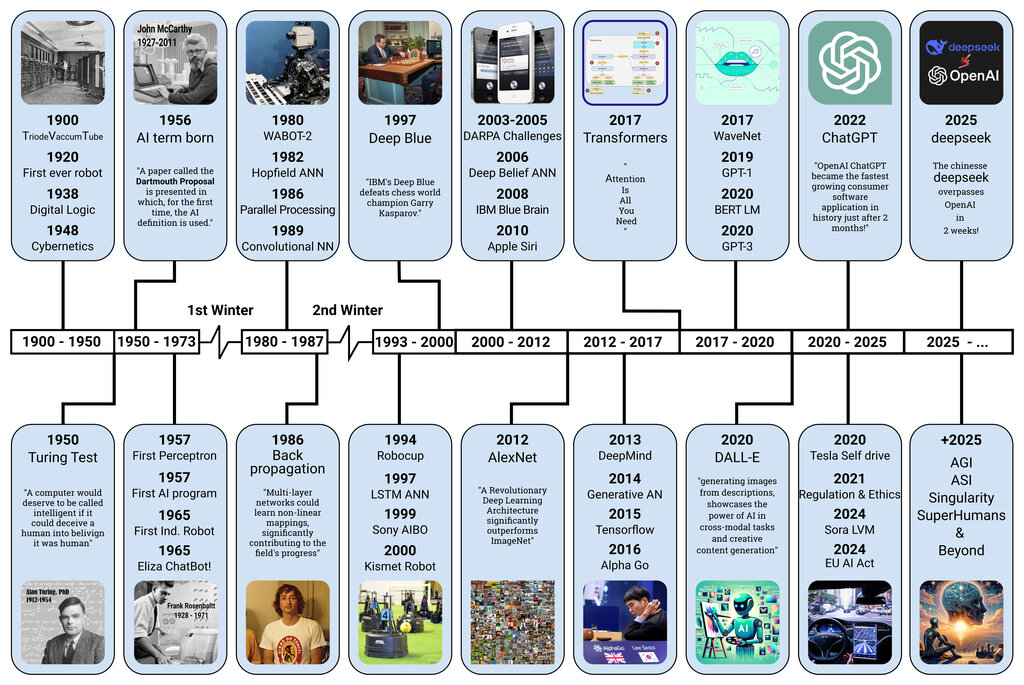
The idea of intelligent machines has been around for centuries, but the modern field of AI officially began in the summer of 1956. A group of researchers gathered for a workshop at Dartmouth College to explore the possibility of creating machines that could think. This is where the term "artificial intelligence" was first used.
The journey wasn't a straight line. The early years were full of optimism, but progress was slow. Limited computing power and data led to periods known as "AI winters," when funding and interest dried up. However, the last couple of decades have seen an explosion in AI development, driven by the internet's vast amount of data and powerful new computer hardware.
AI in the Wild
AI isn't just a futuristic concept; it's already a part of our daily lives. From the moment you unlock your phone with your face to the shows recommended to you on a streaming service, AI is working behind the scenes.
In healthcare, AI helps doctors analyze medical images like X-rays and MRIs to spot diseases earlier and more accurately. In finance, it constantly monitors transactions to detect and prevent fraud. Car manufacturers use AI to power self-driving features, making roads safer. Even industries like agriculture use AI to monitor crop health and optimize harvests.
Essentially, if a task involves finding patterns, making predictions, or optimizing a process, AI can likely play a role.
Ethics and Society
The rise of AI brings incredible opportunities, but it also raises important questions. As we build systems that make decisions affecting people's lives, we must consider the ethical implications.
One major concern is bias. If an AI is trained on data that reflects historical biases, it can learn to make unfair decisions. For example, an AI hiring tool trained on past hiring data from a male-dominated industry might unfairly favor male candidates. Ensuring fairness and transparency in AI systems is a critical challenge.
Privacy is another key issue. Many AI applications rely on vast amounts of personal data. How do we use this data to build helpful tools without compromising individual privacy? Finally, there's the societal impact on jobs. While AI will create new roles, it will also automate some existing ones, requiring a shift in the workforce and a focus on new skills.
Use of artificial intelligence (AI) in human contexts calls for ethical considerations for the design and development of AI-based systems.
Navigating these challenges requires careful thought from developers, policymakers, and the public. Building trustworthy AI is just as important as building powerful AI.
Ready to check your understanding of these core concepts?
What is the core difference between an AI system and traditional software?
The term "artificial intelligence" was officially coined at a 1956 workshop held at which institution?