
Barley beta-glucan (also optional, but highly recommended!) is a soluble, fermentable prebiotic fiber. I add it because beta-glucans have good evidence for lowering LDL cholesterol, and may help increase elimination of some PFAS “forever chemicals.” Trying to under what barley fiber is vs oat fiber or oat bran
It's great that you're incorporating beta-glucans into your routine! Before we break down the difference between barley fiber, oat fiber, and oat bran, could you let me know if you're primarily focused on their functional cooking and baking properties, or mostly on their health benefits like cholesterol management?
Mostly cooking & functional texture properties

Focusing on cooking and functional texture makes this distinction critical! Even though these three ingredients all come from oats and barley, they act completely differently in the kitchen.
Oat Fiber vs Oat Bran
Cross-section of an oat grain showing the outer hull and the inner groat's bran layer.
Why doesn't oat fiber have beta-glucan?
Here is a quick summary of how these three oat and barley ingredients stack up in structure and behavior:
| Ingredient | Source | Primary Fiber Type | Key Kitchen Effect |
|---|---|---|---|
| Oat Fiber | Outer Hull | Insoluble (Cellulose) | Adds structure, bulk, and crispness without gelling |
| Oat Bran | Groat Outer Layer | Soluble (Beta-Glucan) | Creates thick, moist, gel-like viscosity |
| Barley | Whole Groat/Bran | Soluble (Beta-Glucan) | Adds chewy texture and viscous thickening |
Continue to compare beta-glucan content in barley vs oat bran
Now that we know why oat fiber lacks , let's compare how barley and oat bran stack up when it comes to their soluble fiber content.
Beta-Glucan Content: Barley vs Oat Bran

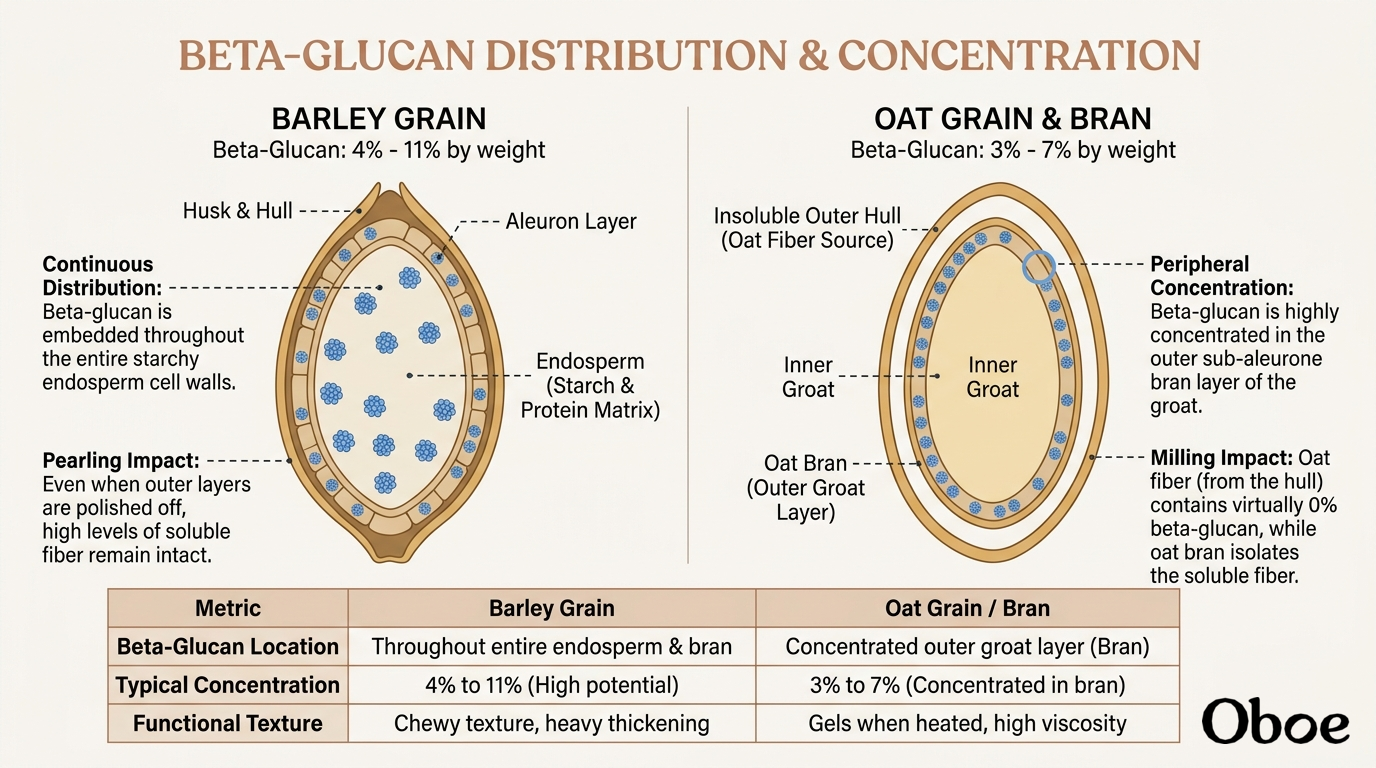
I've started generating a quick visual diagram above to help picture how these concentrations compare across the grains.
Why does barley have a higher beta-glucan potential?
Barley gets its edge over oats because of how the grain's genetics distribute that soluble fiber.
In oats, is produced mainly near the outer surface of the edible groat—creating that concentrated we isolate during milling. In contrast, barley genetic programming embeds beta-glucan continuously throughout the entire endosperm (the starchy body of the seed), as well as in the outer walls.
Because the fiber is built directly into the inner cell walls of the entire barley kernel, even processing methods like pearling (which polishes off the outer skin) leave plenty of soluble beta-glucan intact across the whole grain.