B-Tree Data Structures Explained
Introduction to B-Trees
Beyond Binary Trees
Binary search trees are great for organizing data in main memory. They're fast and efficient, but they have a weakness: they can grow very tall and unbalanced. When you're dealing with massive amounts of data, like the kind stored on a hard drive, a tall tree becomes a problem.
Every time you access a new node, you might have to read from the disk. Disk reads are incredibly slow compared to accessing RAM. A tall, skinny tree means many disk reads to find what you're looking for. We need a tree that is short and wide, minimizing the number of levels we have to traverse.
This is where B-Trees come in. They are self-balancing search trees designed to be wide and shallow, which is perfect for systems that read and write large blocks of data.
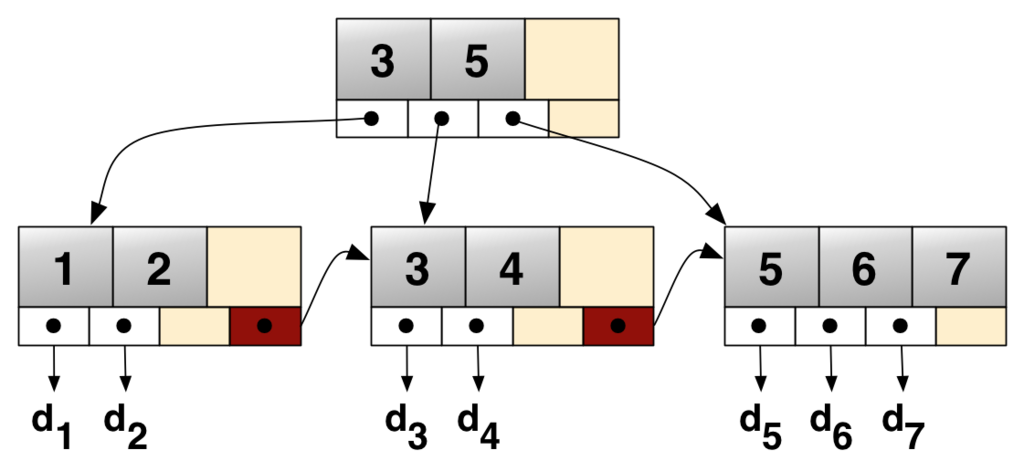
The Rules of a B-Tree
B-Trees work their magic by following a specific set of rules that keep them balanced and efficient. Unlike binary trees, where each node has at most two children, B-Tree nodes can have many children.
This is governed by a parameter called the minimum degree, usually written as . The value of (where ) determines the shape of the tree.
Every node in a B-Tree, except the root, must have at least keys and at most keys. This rule ensures the tree doesn't get too sparse or too crowded.
Here are the other core properties:
- Keys and Children: An internal node with keys has children. The keys in the node act as separation points for the subtrees pointed to by the children.
- Sorted Keys: All keys within a node are stored in sorted order.
- Balanced Leaves: All leaf nodes appear at the same level. This is a crucial property that guarantees the tree remains balanced, ensuring that the time to access any element is consistent.
- Root Node Rules: The root is a special case. It can have as few as one key. If it's not a leaf, it must have at least two children.
The B-Tree Advantage
So why go through the trouble of these complex rules? The main advantage is keeping the tree height extremely low. A B-Tree can store a massive number of items with only a few levels.
For example, a B-Tree of height 3 with a minimum degree of 500 can store over 250 million keys. Finding any single key would require, at most, 3 disk reads—one for the root and two more to get to the correct leaf. A binary search tree holding the same data could be millions of levels deep in the worst case.
Fewer levels mean fewer slow disk accesses, which leads to dramatically faster searches, insertions, and deletions for large datasets.
This structure makes B-Trees incredibly useful. While we won't dive into the details here, they form the backbone of most modern database and filesystem indexing systems. They provide a reliable way to keep huge amounts of data sorted and accessible in logarithmic time, no matter how much data you add or remove.