Atomic Structure Unveiled
Introduction to Atomic Structure
The Building Blocks of Everything
Everything you see around you—the chair you're sitting on, the air you're breathing, the device you're reading this on—is made of matter. But what is matter made of? If you could zoom in, past what any microscope can see, you would find the fundamental units that make up all substances. These are called atoms.
Atom
noun
The smallest unit of an element that maintains the chemical identity of that element.
The idea of atoms is ancient, first proposed by Greek philosophers like Democritus, who imagined that all matter was composed of tiny, indivisible particles called atomos. For centuries, this was just a philosophical idea. It wasn't until the early 1800s that science began to catch up.
From Billiard Balls to Blueberries
An English chemist named John Dalton was the first to propose a scientific theory of the atom. Based on his experiments with gases, he imagined atoms as tiny, solid, indestructible spheres, much like miniature billiard balls. His theory had a few key points:
- All matter is made of atoms.
- Atoms cannot be created, divided, or destroyed.
- Atoms of the same element are identical.
- Atoms combine in simple whole-number ratios to form compounds.
Dalton's model was a huge step forward. It explained many chemical observations and laid the groundwork for modern chemistry. For nearly a century, the atom was thought to be the smallest thing in the universe—a solid, fundamental particle.
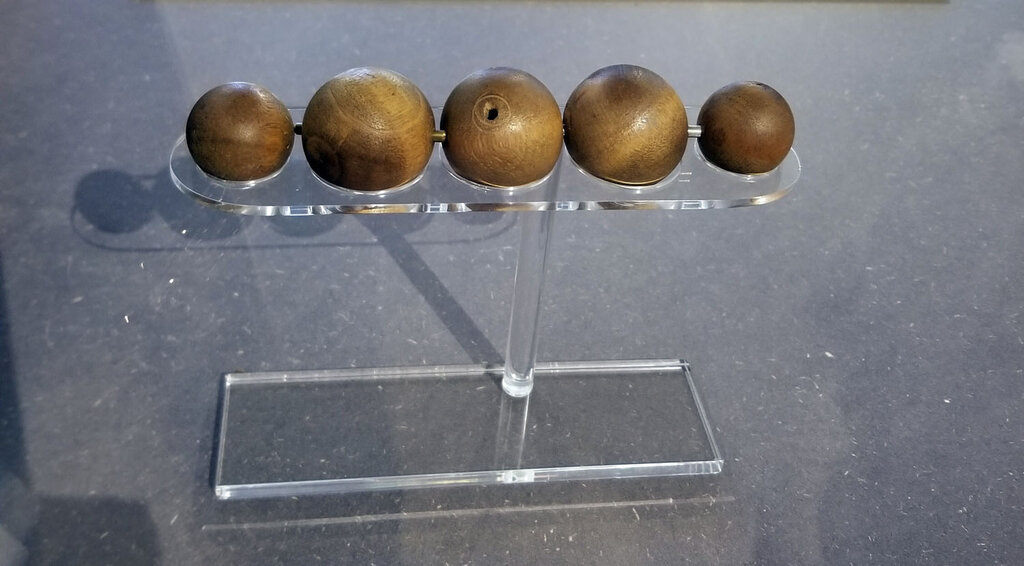
Then, in 1897, a discovery by physicist J.J. Thomson changed everything. While studying electric currents, he found evidence of a particle much, much smaller than an atom: the electron. Since atoms themselves are electrically neutral, he reasoned they must contain these negatively charged electrons, and also some form of positive charge to balance them out.
This led to a new model of the atom. Thomson proposed what's often called the "plum pudding" model. He pictured the atom as a sphere of uniform positive charge with negatively charged electrons scattered throughout it, like raisins or blueberries in a muffin. The atom was no longer an indivisible sphere; it had an internal structure.

The Empty Atom
The plum pudding model didn't last long. A physicist named Ernest Rutherford, who had been a student of Thomson's, decided to test it. His famous gold foil experiment, conducted in 1909, involved shooting a beam of tiny, positively charged particles (called alpha particles) at a very thin sheet of gold foil.
According to the plum pudding model, the positive charge in the gold atoms was spread out. Rutherford expected the alpha particles to pass straight through the foil with only minor deflections.
Most of the particles did exactly that. But to his astonishment, a very small number—about 1 in 8,000—bounced back as if they had hit a solid wall. Rutherford later described his surprise: "It was almost as incredible as if you fired a 15-inch shell at a piece of tissue paper and it came back and hit you."
This result could only mean one thing: the positive charge in an atom wasn't spread out. It was concentrated in a tiny, dense center, which he called the nucleus. The electrons, he proposed, must orbit this nucleus, much like planets orbiting the sun. This meant that the atom was mostly empty space!
Rutherford's nuclear model was a revolutionary insight. It gave us the basic picture of the atom we still use today: a tiny, massive nucleus containing positive charge, surrounded by a cloud of orbiting electrons. However, it had its own problems. Classical physics predicted that an orbiting electron should constantly lose energy and spiral into the nucleus, causing the atom to collapse. But atoms are stable.
This puzzle was tackled by Niels Bohr in 1913. He proposed a new model that incorporated ideas from the emerging field of quantum mechanics. Bohr suggested that electrons could only exist in specific, fixed orbits, or energy levels, around the nucleus. They could jump between these levels by absorbing or emitting energy, but they couldn't exist in the spaces in between. This prevented them from spiraling into the nucleus.
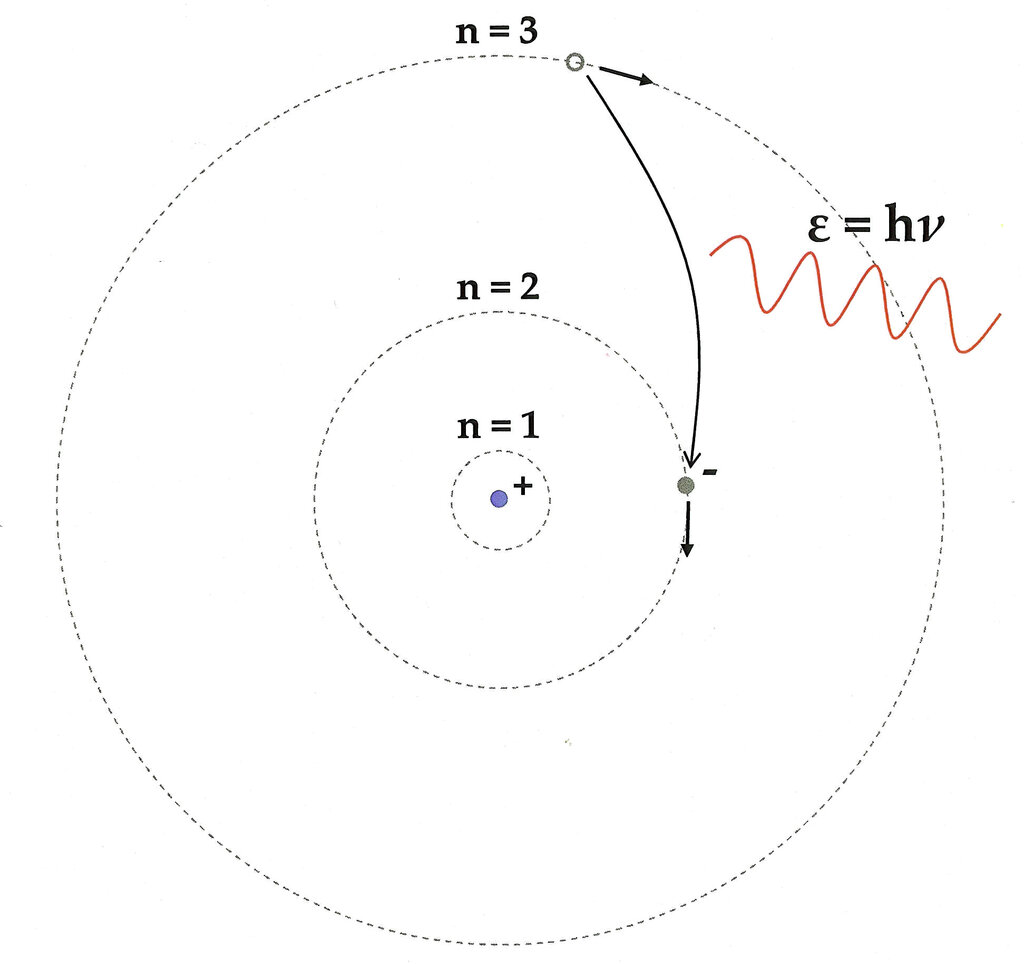
Bohr's planetary model successfully explained the stability of atoms and accurately predicted the light spectrum of the hydrogen atom. While our understanding has evolved even further since Bohr's time, these early models were crucial stepping stones. They show how science works: a process of proposing ideas, testing them with experiments, and refining them based on new evidence. Each model built upon the last, taking us from a simple solid sphere to the complex and fascinating structure of the atom.