Atomic Charge and Electrostatic Dynamics
Coulomb Forces
The Force Within the Atom
Atoms are stable because of a powerful, invisible glue. Protons in the nucleus are positively charged, while electrons are negatively charged. This difference in charge creates an attractive force that holds them together, much like the north and south poles of two magnets pulling towards each other. This is known as electrostatic attraction.
Like charges repel, and opposite charges attract. This is the fundamental rule of electrostatics.
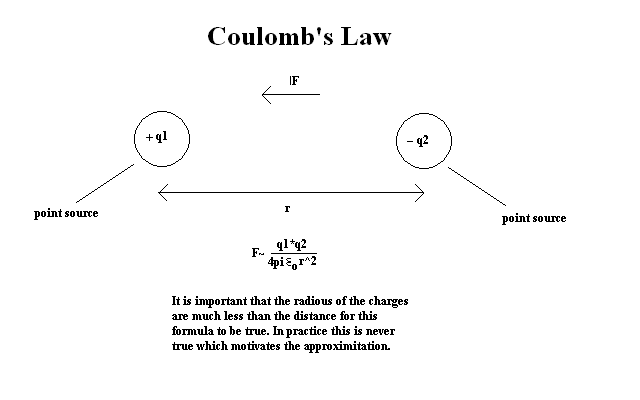
But how strong is this force? How do we measure it? In the 18th century, French physicist Charles-Augustin de Coulomb investigated this question. He discovered a precise mathematical relationship that describes the electrostatic force between two charged particles. This relationship is now called Coulomb's Law.
This formula tells us two crucial things. First, the force is directly proportional to the product of the charges. More charge means more force. Second, and most importantly for atomic structure, the force is inversely proportional to the square of the distance between the charges. This is an inverse-square law., annotations: [ { "highlightText": "inverse-square law", "annotationText": "## A Universal Pattern\n\nNature loves inverse-square laws. The intensity of light from a candle, the pull of gravity between planets, and the strength of a magnetic field all follow this same mathematical pattern.\n\nIt arises from geometry. As a force or energy radiates outwards from a point source in three-dimensional space, it spreads over the surface of an ever-expanding sphere. Since the surface area of a sphere is , the energy per unit area must decrease in proportion to ." } ] }, { "type": "asymptoteGraphicPlaceholder", "description": "A graph illustrating the inverse-square law for electrostatic force. The x-axis is labeled 'Distance (r)' and the y-axis is labeled 'Force (F)'. The curve starts high on the y-axis when r is small and rapidly decreases as r increases, approaching the x-axis but never touching it. Key points should be labeled to show the relationship. For example, label a point (r, F). Then label the point (2r, F/4) and (3r, F/9) to visually demonstrate the 'square' part of the law. The curve should be smooth and clearly show a steep drop-off followed by a flattening curve.\n\nSize: The graph should be wider than it is tall, perhaps a 4:3 aspect ratio, to allow for clear labeling on the x-axis without cramping.\n\nText Placement: The axis labels 'Distance (r)' and 'Force (F)' should be at the bottom and left, respectively. The point labels like '(r, F)' should be placed near the points with a small line pointing to them if necessary to avoid overlapping the curve.\n\nFIRST DRAFT:\nunitsize(1.5cm);\n\nreal f(real r) {return 1/r^2;}\npath g = graph(f, 0.5, 4);\n\ndraw(g, blue+1.2pt);\n\nxaxis(" (Distance)", RightTicks, EndArrow);\nyaxis(" (Force)", LeftTicks, EndArrow);\n\nlabel("O", (0,0), SW);\n\nreal r1 = 1;\nreal r2 = 2;\nreal r3 = 3;\n\ndot("()", (r1, f(r1)), NE);\ndot("()", (r2, f(r2)), E);\ndot("()", (r3, f(r3)), E);\n\ndraw((r1,0) -- (r1,f(r1)) -- (0,f(r1)), dashed);\ndraw((r2,0) -- (r2,f(r2)), dashed);\ndraw((r3,0) -- (r3,f(r3)), dashed);\n\ntick(x=r1, Label="");\ntick(x=r2, Label="");\ntick(x=r3, Label="");\n\ntick(y=f(r1), Label="");\n" }, { "type": "text", "text": "Inside an atom, this means that if you were to double the distance between an electron and the nucleus, the attractive force holding it would drop to just one-quarter of its original strength. If you tripled the distance, the force would plummet to one-ninth. This rapid decrease in force with distance is the key to why atoms have a specific size and structure. Electrons settle into orbits where the electrostatic pull is balanced." }, { "type": "header", "text": "Calculating the Atomic Glue" }, { "type":
Let's refine the formula. The constant is often written as , where is a fundamental physical constant called the permittivity of free space.. This constant essentially describes how easily an electric field can establish itself in a vacuum.
To apply this to an atom, we need the values for the charges. Both protons and electrons have the same magnitude of charge, known as the elementary charge, denoted by . Protons have a charge of , and electrons have a charge of .
Elementary Charge
noun
The smallest possible unit of electric charge that can exist freely. It is the magnitude of the electric charge carried by a single proton or electron.
The value of is tiny: approximately Coulombs. Let's consider a simple hydrogen atom, which has one proton in its nucleus and one electron. The average distance between them is about meters.
Using these values in Coulomb's Law gives us the force holding the hydrogen atom together. Even though the charges are minuscule and the distance is incredibly small, the resulting force is immense on an atomic scale. It is this force that prevents the electron from simply flying away.
This same law also explains the repulsion that protons feel for one another inside the nucleus. Since they are all positively charged, they are constantly trying to push each other apart. This repulsive electrostatic force is overcome by an even stronger, but much shorter-ranged, force called the strong nuclear force. That's a story for another time, but it highlights the constant push and pull of forces that give atoms their structure and stability.
Now, test your understanding of these atomic forces.
What is the primary force responsible for binding electrons to the nucleus of an atom?
According to Coulomb's Law, if the distance between an electron and the nucleus is tripled, what happens to the electrostatic force between them?
Understanding Coulomb's Law is the first step in seeing the atom not as a static picture, but as a dynamic system governed by powerful forces.