Atomic Architecture and Chemical Dynamics
Subatomic Particle Dynamics
The Atom's Inner World
At the heart of every element is a dense nucleus, orbited by a cloud of electrons. The nucleus contains two types of particles: positively charged protons and neutral neutrons. The electrons carry a negative charge. It's the interplay between these three particles that dictates an atom's identity and behavior.
| Particle | Location | Relative Charge | Relative Mass |
|---|---|---|---|
| Proton | Nucleus | +1 | ~1 amu |
| Neutron | Nucleus | 0 | ~1 amu |
| Electron | Orbitals | -1 | ~1/1836 amu |
The mass of an electron is so small compared to protons and neutrons that it's often considered negligible when calculating the total mass of an atom. The real heavy lifting is done in the nucleus.
Identity and Weight
An element's identity is defined by a single, unchangeable number: its atomic number. This number represents the count of protons in the nucleus. Change the number of protons, and you change the element entirely. A carbon atom always has 6 protons. An atom with 7 protons is, by definition, nitrogen.
The mass number, on the other hand, tells us the total count of particles in the nucleus. It's the sum of the protons and neutrons. Because atoms of the same element can have different numbers of neutrons, they can also have different mass numbers.
Atoms of the same element that have different numbers of neutrons are called s. For example, all carbon atoms have 6 protons, but they can have 6, 7, or even 8 neutrons. These are known as carbon-12, carbon-13, and carbon-14, respectively. While they are all chemically carbon, their different masses give them slightly different physical properties.
We represent isotopes using a standard notation. The mass number (A) is written as a superscript and the atomic number (Z) as a subscript, both to the left of the element's symbol (X). For carbon-14, this would be written as .
Forces in the Nucleus
A big question arises when you think about the nucleus. If it's packed with positively charged protons, and like charges repel each other, why doesn't the nucleus fly apart? The answer is the s, a fundamental force of nature that is far more powerful than electromagnetic repulsion, but only over extremely short distances. This force binds protons and protons, neutrons and neutrons, and protons and neutrons together, creating a stable nucleus. Neutrons play a key role as a sort of nuclear glue, helping to overcome the repulsive forces between protons without adding any extra repulsion themselves.
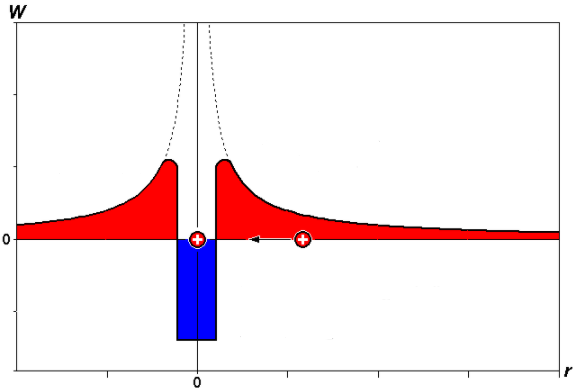
The balance between the repulsive electromagnetic force and the attractive strong nuclear force determines whether a nucleus is stable or radioactive. If the ratio of neutrons to protons is too high or too low, the nucleus can become unstable and decay, a topic we'll explore later.
Let's review the key terms we've covered.
Now, test your understanding of these atomic building blocks.
What uniquely defines an element?
An atom has a mass number of 35 and an atomic number of 17. How many neutrons does it have?
Understanding these subatomic dynamics is the first step toward understanding chemical reactions, bonding, and the structure of the periodic table.