Asynchronous and Multithreaded Programming in C# and C++
Introduction to Concurrency
What is Concurrency?
Concurrency is the ability of a system to run multiple tasks in overlapping time periods. It doesn't necessarily mean things are happening at the exact same instant. Instead, it means the system is making progress on more than one task at a time.
Think of a chef in a kitchen. The chef might start boiling water for pasta, and while the water heats up, they begin chopping vegetables for the sauce. Then, they might put the sauce on to simmer and turn back to put the pasta in the now-boiling water. The chef is handling multiple tasks—heating water, chopping vegetables, simmering sauce, and boiling pasta—by switching between them. Progress is being made on all fronts, even though the chef is only doing one specific action at any given moment. This is concurrency.
Concurrency is about dealing with lots of things at once. Parallelism is about doing lots of things at once.
This is an important distinction. True parallelism requires multiple processors (or cores) to execute tasks simultaneously. Concurrency is a more general concept where a single processor can switch between tasks so quickly that it appears they are running at the same time. Modern computers have multiple cores, so they can achieve both concurrency and parallelism.
Processes and Threads
In computing, concurrent tasks are managed as either processes or threads. Understanding the difference is key.
A process is an instance of a running program. When you open a web browser, a word processor, and a music player on your computer, you're running three separate processes. Each process has its own dedicated memory space, which is protected from other processes. If your web browser crashes, it usually doesn't take down your word processor with it. This isolation makes processes robust, but it also means that sharing information between them is slower and more complex.
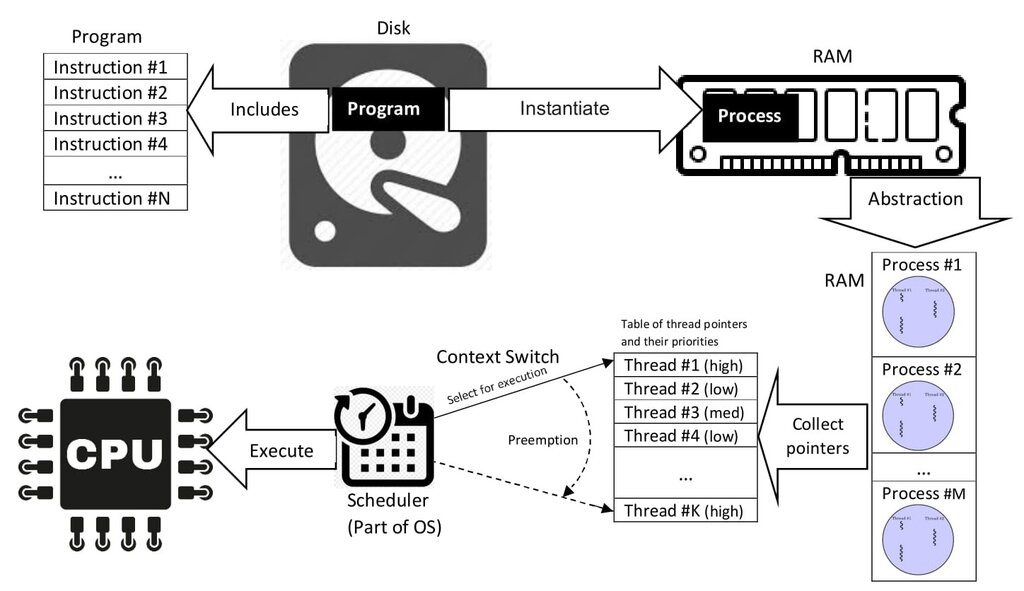
A thread, on the other hand, is the smallest unit of execution within a process. A single process can have multiple threads running concurrently. Think of a word processor: one thread might be checking your spelling and grammar in the background while another thread is responding to your typing.
All threads within the same process share the same memory space. This makes communication between them very fast and efficient. However, it also introduces a risk: if one thread corrupts the shared data, it can crash the entire application.
| Feature | Process | Thread |
|---|---|---|
| Isolation | High. Processes have separate memory. | Low. Threads share memory within a process. |
| Creation Time | Slower, more resource-intensive. | Faster, less resource-intensive. |
| Communication | Slower (requires inter-process communication). | Faster (can directly access shared memory). |
| Fault Tolerance | High. One process crashing won't affect others. | Low. A fault in one thread can crash the whole process. |
Why Use Concurrency?
So why bother with the complexity of managing multiple tasks? The benefits are significant, especially in modern software.
Improved Responsiveness: The most noticeable benefit is in user interfaces. If you click a button to download a large file, a concurrent application can start the download in a background thread. The main thread remains free to respond to other user actions, so the application doesn't freeze. You can keep working while the download progresses.
Better Resource Utilization: Processors are often idle, waiting for slower operations like reading a file from a disk or fetching data from a network. Concurrency allows the CPU to switch to another task during these waiting periods. This keeps the processor busy and makes the overall system more efficient.
Leveraging Multi-Core Processors: Nearly all modern CPUs have multiple cores. Concurrent programming is the key to unlocking their full potential. By splitting a large task into smaller pieces that can run on different cores simultaneously (parallelism), you can dramatically reduce the total time it takes to complete the job.
Despite these advantages, concurrent programming isn't a silver bullet. It introduces its own set of challenges. When multiple threads access and modify shared data at the same time, they can interfere with each other, leading to corrupted data. This is called a race condition.
Another common issue is deadlock, where two or more threads are stuck waiting for each other to release a resource, and neither can proceed. These challenges require careful design and specific synchronization techniques to manage access to shared resources safely.
Synchronization and concurrency are critical for managing processes that execute simultaneously in a multitasking environment.
By understanding these fundamental concepts—what concurrency is, the roles of processes and threads, and the trade-offs involved—you're ready to explore how to implement these ideas in practice.