Artificial Intelligence with CEFRO
Introduction to Artificial Intelligence
What Is AI Anyway?
Artificial intelligence is about creating machines that can think, learn, and solve problems like a human. It's a broad field in computer science focused on building systems that can perform tasks that typically require human intelligence. This could be anything from understanding spoken language to recognizing a face in a photo.
The idea isn't new. While AI seems like a recent buzzword, its roots go back to the 1950s when computer scientists first started exploring the concept of machine intelligence. They dreamed of creating machines that could reason and learn, laying the groundwork for the technology we see today.

The Two Main Flavors of AI
Not all AI is created equal. The AI that recommends movies on your streaming service is very different from the sentient robots you see in movies. We can generally sort AI into two main categories: Narrow AI and General AI.
Artificial Narrow Intelligence (ANI)
noun
Also known as Weak AI, this is AI that is trained to perform a single, specific task. It operates within a limited, pre-defined range.
You interact with Narrow AI every day. It's the technology behind Apple's Siri, the recommendation engine on Amazon, and the software that helps fly a commercial airplane. These systems are incredibly good at what they do, but they can't step outside their designated function. A chess-playing AI can beat a grandmaster, but it can't tell you the weather or recommend a good book.
Artificial General Intelligence (AGI), on the other hand, is the stuff of science fiction—for now. This is a type of AI that would possess the ability to understand, learn, and apply its intelligence to solve any problem, much like a human being. AGI could write a symphony, discover a new scientific principle, and have a meaningful conversation. It doesn't exist yet, but it remains the ultimate goal for many AI researchers.
| Feature | Narrow AI (ANI) | General AI (AGI) |
|---|---|---|
| Scope | Performs specific, dedicated tasks | Can handle any intellectual task a human can |
| Learning | Learns from data for its specific task | Learns and adapts across different domains |
| Awareness | Not conscious or self-aware | Potentially conscious (hypothetical) |
| Examples | Voice assistants, spam filters, self-driving cars | None currently exist; seen in fiction (e.g., The Terminator) |
The Building Blocks of AI
So how do we build AI? The magic behind modern AI comes from a few key technologies that allow machines to learn from data. Think of AI as the big, overarching goal. Machine learning, deep learning, and neural networks are the powerful tools we use to get there.
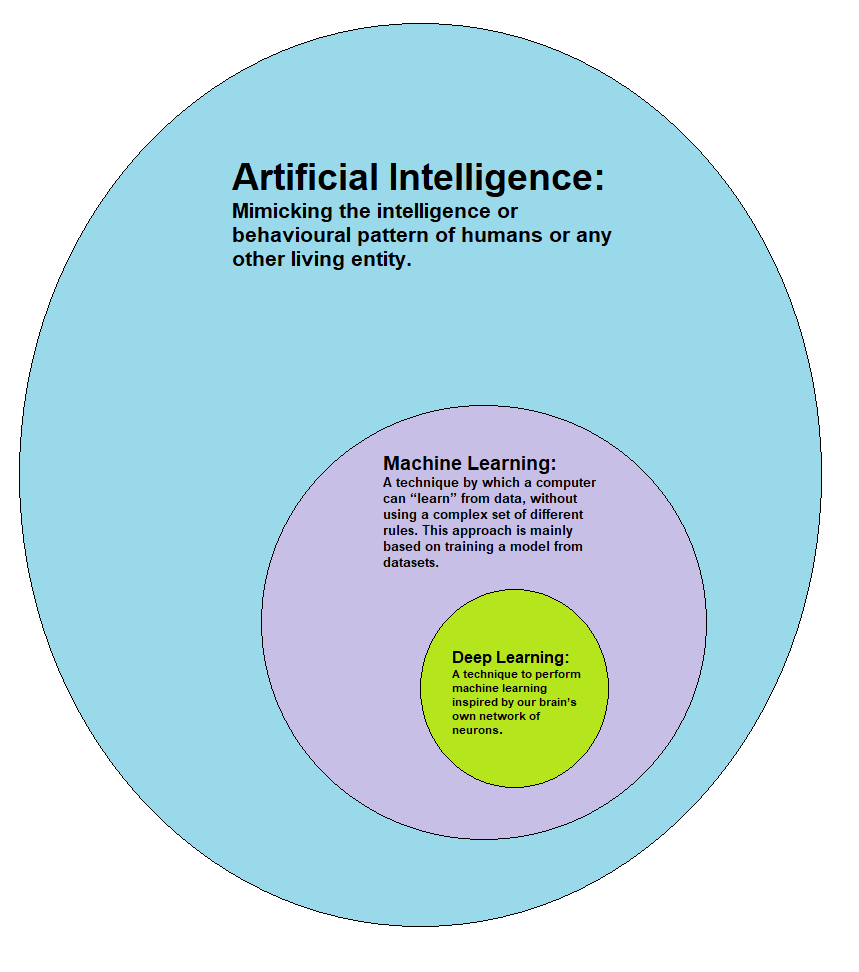
Machine Learning (ML) is a subset of AI. Instead of programming a computer with explicit, step-by-step instructions, machine learning allows it to learn on its own. You feed it large amounts of data, and the ML algorithm uses that data to identify patterns and make predictions. For example, you can train a machine learning model to recognize pictures of cats by showing it thousands of cat photos. It learns the features of a cat—pointy ears, whiskers, fur—without you ever having to describe them in code.
Deep Learning (DL) is a specialized type of machine learning. It's inspired by the structure of the human brain and uses something called a neural network. These networks have multiple layers that process information, allowing them to learn very complex patterns from vast amounts of data. This is the technology that powers many of the most impressive AI advancements, like language translation and image recognition.
Neural Networks are the core of deep learning. They consist of layers of interconnected nodes, or "neurons." Each neuron receives input, processes it, and passes an output to the next layer. A simple network might have just a few layers, but a "deep" network can have hundreds. This layered structure allows the network to learn progressively more complex features from the data.
In short: AI is the goal of creating intelligent machines. Machine learning is a way to achieve AI by learning from data. Deep learning is a powerful type of machine learning that uses multi-layered neural networks.
These foundational concepts are the starting point for understanding the complex and rapidly evolving world of artificial intelligence.