Architecting Secure IoT Systems
Hardware Selection Criteria
The Core Decision: MCU vs. SBC
Choosing the brain for an IoT project boils down to a fundamental choice: a microcontroller (MCU) or a single-board computer (SBC). Think of it as hiring a specialist versus a generalist. An MCU is a specialist. It’s a single chip designed to do one set of tasks repeatedly and efficiently, like reading a sensor and sending the data. An SBC, on the other hand, is a generalist. It’s a complete computer on a single circuit board, capable of running a full operating system and multiple programs at once.
The core trade-off is between focused efficiency and versatile power. Your project's specific needs will dictate which path is right.
The Specialist: ESP32-S3
The ESP32-S3 is a powerhouse MCU, tailored for connected devices. Its primary strengths are power efficiency and built-in connectivity. It includes integrated Wi-Fi and Bluetooth, which dramatically simplifies the design and reduces the final product size. For battery-powered devices, this is a game-changer. The ESP32-S3 has multiple deep sleep modes that allow it to consume microamps of power, waking only when needed to perform a task. This can extend battery life from hours to months or even years.
Furthermore, MCUs like the ESP32 excel at This means they can execute tasks with precise, predictable timing. If you're building a system where a delay of a few milliseconds could cause failure, like a high-speed motor controller or a medical device, an MCU is the only reliable choice. It's not about raw speed, but about predictable consistency.
The Generalist: Raspberry Pi 5
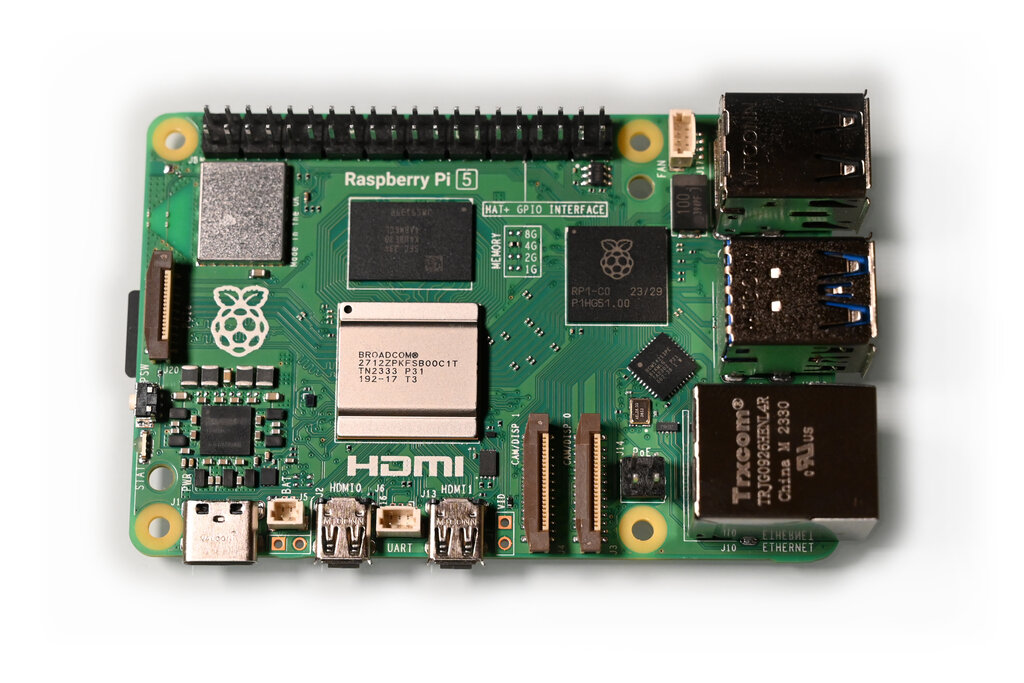
The Raspberry Pi 5 is a full-fledged computer shrunk down to the size of a credit card. Its main advantage is raw processing power and flexibility. Running a complete Linux operating system means you can use familiar programming languages, libraries, and tools. You can run a web server, a database, or even a machine learning model directly on the device.
This capability is perfect for complex applications that require significant local processing or a local file system. Instead of just collecting data, a Pi can perform , processing raw sensor information on-site to identify trends, filter out noise, or trigger complex actions without needing to constantly communicate with the cloud. It’s the ideal choice for a smart home hub, a network video recorder, or an industrial gateway that aggregates data from multiple simpler sensors.
A Practical Framework
Choosing your hardware requires a clear-eyed assessment of your project's goals, both for the prototype and for a potential production run. Key factors include the power source, the type and number of inputs/outputs (I/O), and the cost at scale, often summarized in a . An MCU might cost only a couple of dollars per unit in bulk, while an SBC will be significantly more. This difference is negligible for a one-off project but becomes a deciding factor for a product meant for mass market.
| Feature | ESP32-S3 (MCU) | Raspberry Pi 5 (SBC) |
|---|---|---|
| Power Profile | Very Low (μA in deep sleep) | High (Requires stable power supply) |
| Processing | Dual-core, up to 240 MHz | Quad-core, up to 2.4 GHz |
| Operating System | Real-Time OS (e.g., FreeRTOS) | Full Linux OS (e.g., Raspberry Pi OS) |
| I/O | Excellent for analog (ADC/DAC), digital (I2C, SPI) | Excellent for high-speed digital (USB, Ethernet, PCIe) |
| Connectivity | Integrated Wi-Fi & Bluetooth | External via USB or built-in module |
| Prototype Cost | ~$10 (Dev board) | ~$60-$80 |
| Mass Production Cost | Low (~$2-$4 per module) | High (~$60+ per unit) |
| Best For | Battery-powered sensors, simple controllers | Complex gateways, local data processing, media servers |
Use the table above as a starting point. If your device needs to run on a battery for a year and just report the temperature once an hour, the ESP32-S3 is the obvious winner. If you need to stream and analyze multiple high-definition video feeds, the Raspberry Pi 5 is the only viable option.
Based on the provided text, which statement best describes the core difference between a microcontroller (MCU) and a single-board computer (SBC)?
You are designing a device where a delay of even a few milliseconds in processing sensor data could cause a critical failure, such as in a high-speed motor controller. Which type of processor is the most suitable choice?
Ultimately, the right choice aligns with the core function of your device, its power budget, and your long-term production costs.