Architecting Autonomous AI Agents
Agentic Architecture
From Thinking to Doing
A standard large language model works in a straight line. You give it a prompt, and it generates a response. The process is linear: input leads to output, and the interaction ends. This is powerful for tasks like summarizing text or answering a question based on its training data, but it's fundamentally passive.
Agentic AI breaks this linear chain. Instead of a one-time response, an agent operates in a continuous cycle. It takes an action, observes the result, and then decides what to do next. This feedback mechanism transforms the LLM from a simple text generator into a system that can interact with its environment to achieve a goal.
An agent doesn't just answer questions. It takes steps to find the answer, even if that means using tools or asking for more information.
The Agentic Loop
The core of an agent is a simple but powerful loop: Perception, Reasoning, and Action. This cycle repeats until the agent has accomplished its task.
-
Perception: The agent takes in new information from its environment. This could be the initial user prompt, the output from a piece of code it just ran, data from a web search API, or an error message.
-
Reasoning: This is where the LLM shines. It acts as the agent's brain, analyzing the information gathered during the perception phase. Based on the overall goal and the latest data, it decides on the next best step.
-
Action: The agent executes the step decided upon during reasoning. This involves using a specific tool, like calling a function, querying a database, or even asking the user a clarifying question. The outcome of this action then becomes the new input for the next perception phase, and the loop continues.
This loop distinguishes an agent from a simple chatbot. A chatbot's state is often just the history of the conversation. An agent’s state includes the full history of its perceptions, reasoning steps, and actions. It constantly updates its understanding of the world based on the results of its own interventions.
This process is guided by a pattern known as , which stands for "Reason and Act." It’s a powerful evolution from the earlier "Chain of Thought" prompting. While Chain of Thought showed an LLM's reasoning steps, ReAct prompts the model to interleave its thoughts with actions. The model first thinks about what it needs to do, then it takes an action using a tool, observes the result, and thinks again.
The LLM as Conductor
In an agentic architecture, it's helpful to think of the LLM as an orchestration engine rather than a simple knowledge base. The LLM itself doesn't browse the web or execute code. Instead, its core function is to act as a smart router or a conductor of an orchestra.
It receives a goal and perceives the current state. Based on this, it
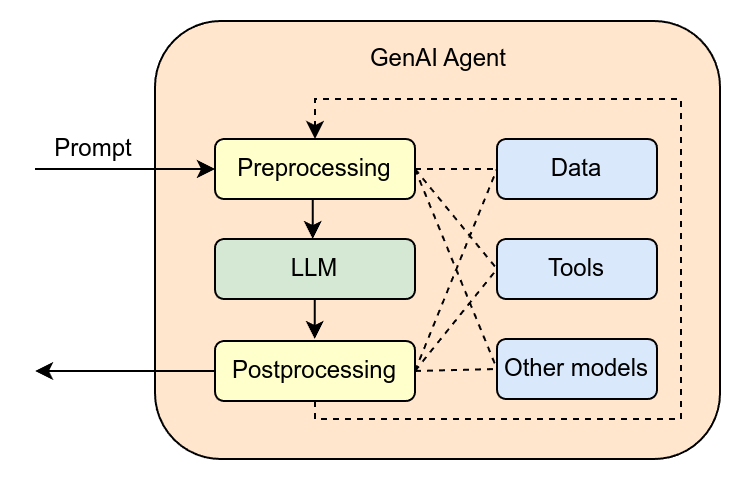
chooses the right tool from its toolkit, formulates the correct input for that tool, and calls it. When the tool returns a result, the LLM interprets that output and decides the next move.
This ability to manage state and tools is what enables autonomy. The agent isn’t just following a rigid script; it's dynamically creating a plan based on a live feedback loop. It decides when the task is complete not because it ran out of instructions, but because its reasoning module concludes that the goal has been successfully met based on the information it has perceived from its actions.
Now, let's test your understanding of these core agentic concepts.
What is the primary difference between how a standard LLM operates and how an agentic AI system operates?
What are the three core, repeating steps in an agent's operational cycle?
Building agents is about creating systems that do things, not just say things. The agentic loop is the engine that drives this capability.