Applied Machine Learning Engineering
Introduction to MLOps
From Lab to Real World
A machine learning model can feel like magic. It can predict customer churn, identify diseases in medical scans, or power a recommendation engine. Data scientists spend weeks, sometimes months, building and perfecting these models on their computers. But a model that only works on a laptop is just an experiment. To have a real impact, it needs to be part of a live application, serving predictions to thousands or even millions of users.
This is where things get tricky. Getting a model from a data scientist's 'lab' into the real world—a process called deployment—is a major hurdle. The environment is different, the data is constantly changing, and the model needs to be reliable and fast. It’s not a one-time handoff; it's a continuous process.
Many models that perform brilliantly in development never make it into production. The gap between creating a model and using it effectively is often called the 'last mile' problem of AI.
This challenge led to the creation of MLOps.
What is MLOps?
MLOps stands for Machine Learning Operations. It’s a set of practices that aims to deploy and maintain machine learning models in production reliably and efficiently. If you've heard of DevOps, which bridges the gap between software development (Dev) and IT operations (Ops), the concept is very similar. MLOps applies those same principles to the world of machine learning.
MLOps (Machine Learning Operations) bridges the gap between data science and IT operations, enabling seamless development, deployment, monitoring, and scaling of machine learning models.
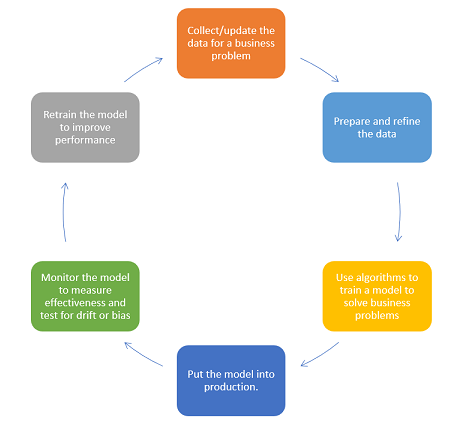
The goal is to unify the ML system development (the 'ML' part) with the ML system operations (the 'Ops' part). Instead of data scientists just building a model and 'throwing it over the wall' to an engineering team to deploy, MLOps creates a collaborative, automated workflow. This ensures that the path from building a model to using it in a product is smooth, fast, and repeatable.
Key Principles
MLOps is built on a few core ideas borrowed from DevOps and adapted for the unique needs of machine learning.
| Principle | Description |
|---|---|
| Automation | Automate every step possible, from data processing and model training to testing and deployment. This reduces manual errors and speeds up the entire process. |
| CI/CD | Continuous Integration/Continuous Deployment pipelines automatically build, test, and deploy new model versions, just like with traditional software. |
| Versioning | Keep track of everything: the data used for training, the code that built the model, and the model itself. This ensures reproducibility and makes it easy to roll back to a previous version if something goes wrong. |
| Monitoring | Once a model is live, continuously monitor its performance. Is it still accurate? Is the incoming data changing in unexpected ways? Monitoring helps catch problems before they affect users. |
| Collaboration | MLOps fosters teamwork between data scientists, software engineers, and operations teams. Everyone shares responsibility for the entire lifecycle of the model. |
Imagine a team building a product recommendation engine for an e-commerce site. Without MLOps, a data scientist might manually retrain the model with new sales data every month, then hand it off to an engineer to deploy. This process is slow, prone to errors, and makes it hard to track why a model's performance suddenly drops.
With MLOps, the team builds an automated pipeline. New data triggers the pipeline, which automatically retrains, tests, and deploys the new model if it meets performance standards. Everything is versioned, so they know exactly which data and code produced which model. The live model's accuracy is monitored in real-time, and alerts are sent if performance degrades. This system is faster, more reliable, and much easier to manage.
Tools of the Trade
A wide range of tools has emerged to support MLOps practices. You don't need to know them all, but it's helpful to understand the categories they fall into.
- Cloud Platforms: Major providers like Amazon Web Services (AWS), Google Cloud Platform (GCP), and Microsoft Azure offer comprehensive MLOps services (e.g., SageMaker, Vertex AI, Azure Machine Learning). These platforms integrate everything from data storage to model deployment and monitoring.
- Orchestration: Tools like Kubeflow and Apache Airflow help you define, schedule, and run complex ML workflows as a series of steps.
- Experiment Tracking & Versioning: Tools like MLflow and Weights & Biases log your experiments, track model parameters, and version your data and models. This is crucial for reproducibility.
- Model Serving: Once a model is trained, it needs to be served so applications can get predictions from it. Tools like Seldon Core, KServe, and TorchServe are designed to deploy models at scale, ensuring high availability and low latency.
These tools form the building blocks for creating robust, automated MLOps pipelines.
Now, let's test your understanding of these core concepts.
What is the primary goal of MLOps?
MLOps principles are heavily inspired by the practices established in which other field?
MLOps transforms machine learning from a research-oriented, manual process into a reliable, engineering discipline. It's the key to unlocking the full potential of AI by making sure great models can become great products.