Antigravity Explained
Introduction to Gravity
The Pull of the Universe
Drop a ball, and it falls to the ground. Jump, and you come back down. This invisible pull is gravity, one of the four fundamental forces of nature. It’s what keeps your feet on the ground, the Moon orbiting the Earth, and the Earth orbiting the Sun.
Gravity is the force of attraction between any two objects that have mass. The more mass an object has, the stronger its gravitational pull.
For centuries, people understood that things fall, but it was Isaac Newton who first described gravity as a universal law. He realized the same force that makes an apple fall from a tree also keeps the planets in their orbits. His idea was revolutionary because it applied everywhere in the universe, not just on Earth.
Newton's Universal Law
In 1687, Newton published his law of universal gravitation. It states that the gravitational force between two objects depends on two things: their masses and the distance between them.
Simply put, the more massive the objects, the stronger the pull. And the farther apart they are, the weaker the pull becomes. This relationship isn't linear, though. If you double the distance between two objects, the gravitational force between them drops to one-quarter of its original strength. This is known as an inverse-square law.
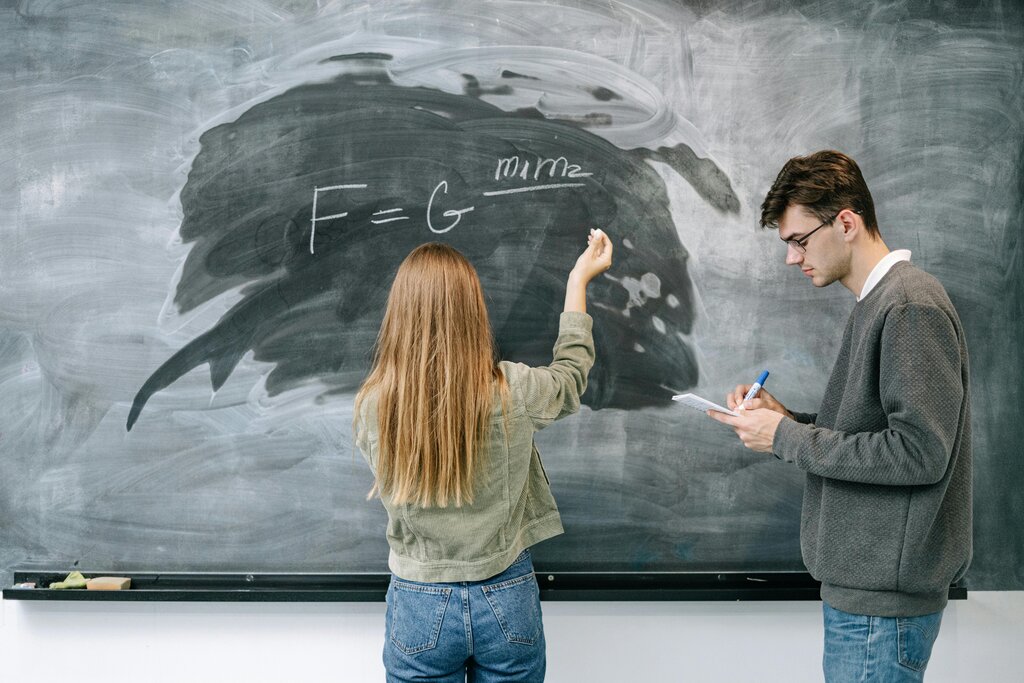
This powerful idea can be captured in a single, elegant equation:
Let's break that down:
• is the gravitational force. • and are the masses of the two objects. • is the distance between the centers of the objects. • is the gravitational constant, a number that makes the units work out correctly.
This formula allows us to calculate the force of gravity between any two objects, whether they're apples and the Earth or distant galaxies.
A Field of Influence
Newton’s law describes a force acting at a distance, which can be hard to picture. Physicists use the concept of a gravitational field to help visualize this. Imagine that any object with mass, like a planet, creates a field of influence around itself in space.
This field is what exerts a force on any other mass that enters it. The field is strongest near the object and gets weaker farther away. It's a way of mapping out how gravity would affect an object at any point in space.
Einstein's Revolution
For over 200 years, Newton's law was the final word on gravity. It worked almost perfectly, explaining the motions of planets with incredible accuracy. But in the early 20th century, Albert Einstein offered a completely new perspective with his theory of general relativity.
In this view, gravity is not a force, as described by Newton, but a curvature in the fabric of space, and objects respond to gravity by following the curvature of space in the vicinity of a massive object.
Einstein proposed that space and time are woven together into a single, four-dimensional fabric called spacetime. Massive objects, like stars and planets, don't pull on other objects with a mysterious force. Instead, they warp or curve the spacetime around them.
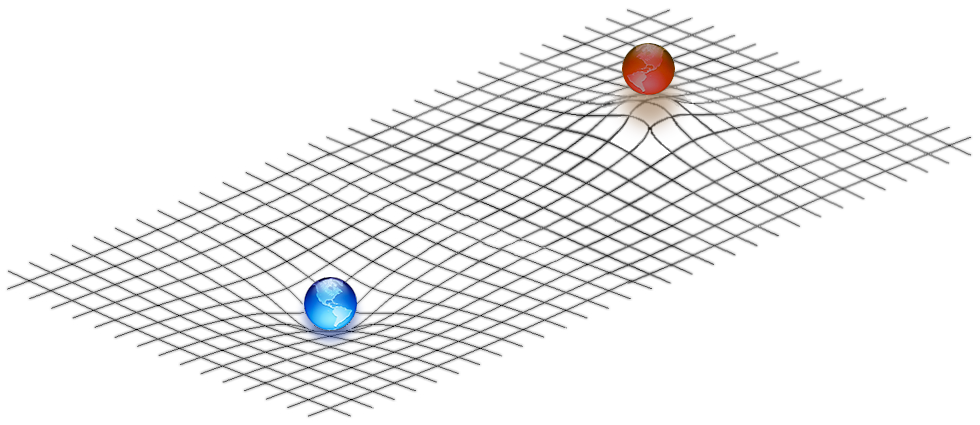
Imagine placing a bowling ball on a stretched-out rubber sheet. The ball creates a dip in the sheet. Now, if you roll a marble nearby, it won't travel in a straight line. It will follow the curve in the sheet created by the bowling ball. That's how general relativity explains orbits. Planets aren't being pulled by the Sun; they are simply following the straightest possible path through the curved spacetime that the Sun creates.
Einstein's theory doesn't make Newton's law wrong. For most situations we encounter, like launching satellites or calculating the orbits of planets, Newton’s equations are an excellent approximation. But for extreme situations—like near a black hole or for incredibly precise measurements—general relativity is necessary to get the right answer. It explains observations that Newton's law can't, like the bending of starlight by gravity.
Now, let's test your understanding of these foundational ideas about gravity.
Who first formulated the law of universal gravitation, proposing that the same force that pulls an apple to the ground also keeps planets in orbit?
According to Newton's law of universal gravitation, if the distance between two objects is tripled, what happens to the gravitational force between them?
From Newton's force to Einstein's curved spacetime, our understanding of gravity has shaped how we see the entire universe.