AI Network Architectures
Architectural Mechanics
How Neural Networks Process Information
Different problems require different tools. In machine learning, the architecture of a neural network is the tool, and its design dictates how it 'thinks' about data. While all neural networks are built from layers of neurons, their arrangement determines whether they excel at understanding images, text, or time-series data. Let's explore how three cornerstone architectures—CNNs, RNNs, and Transformers—handle data at a fundamental level.
CNNs and Spatial Hierarchies
Convolutional Neural Networks (CNNs) are the masters of spatial data, like images. Their strategy is inspired by the human visual cortex. Instead of looking at an entire image at once, a CNN scans it with a small window called a filter or kernel. This filter is a small matrix of weights trained to detect a specific feature, like a vertical edge, a patch of color, or a curve.
The filter slides across the entire image, a process called convolution, creating a 'feature map.' This map highlights where in the image its target feature was found. Early layers in a CNN learn to detect simple features like edges and corners. The feature maps from these layers are then passed to subsequent layers, which use them as input. These deeper layers learn to combine the simple features into more complex ones, like eyes, noses, or wheels. This creates a spatial hierarchy of knowledge: from pixels to edges, to shapes, to objects.
To manage the computational load and make the network less sensitive to the exact location of features, CNNs use pooling layers. A pooling layer also slides a window across the feature map, but instead of applying learned weights, it performs a fixed operation. Max pooling, the most common type, simply takes the maximum value from the window. This shrinks the feature map's size, retaining the most prominent features while discarding less important information and reducing complexity.
RNNs and Temporal Memory
Recurrent Neural Networks (RNNs) are designed for sequences, where order matters. Think of text, speech, or stock market data. Unlike a CNN that processes a whole grid at once, an RNN processes data one step at a time.
The magic of an RNN is its hidden state, which acts as a form of memory. At each step in the sequence (e.g., for each word in a sentence), the RNN takes two inputs: the current data point (the word) and the hidden state from the previous step. It combines them to produce an output for the current step and a new hidden state to pass to the next step. This new state contains information about all the preceding elements in the sequence.
This recurrent loop allows the network to maintain context. When processing the word 'it' in the sentence "The cat sat on the mat, and it was happy," the hidden state would ideally carry the information that 'cat' was the subject, helping the model understand what 'it' refers to. However, this memory is imperfect. In long sequences, information from early steps can fade, a problem known as the vanishing gradient problem
Transformers and Global Context
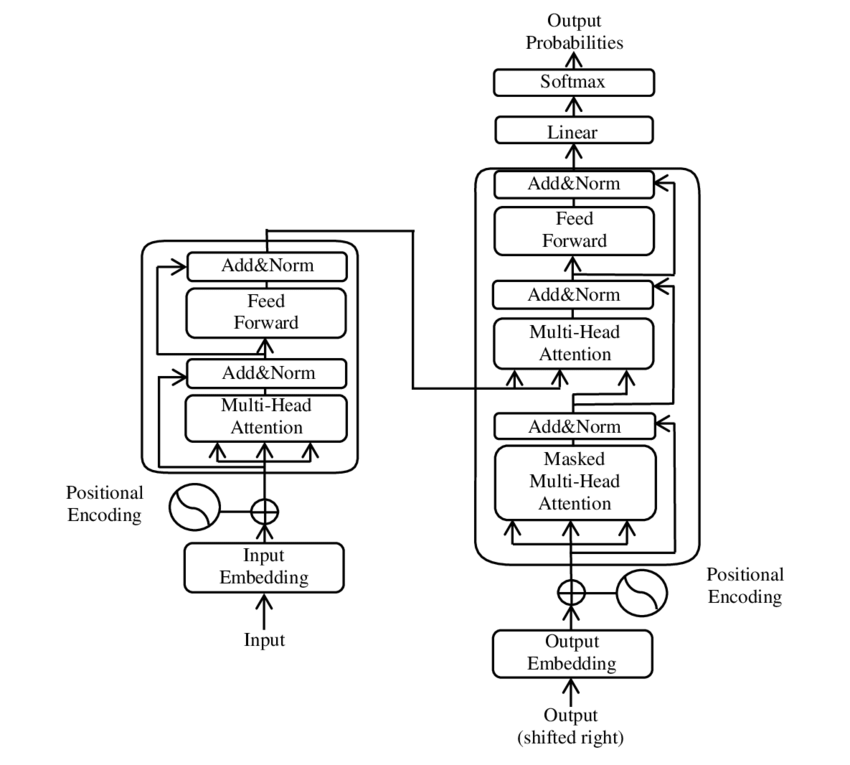
Transformers revolutionized natural language processing by overcoming the sequential nature of RNNs. Instead of processing a sentence word by word, a Transformer processes the entire sequence at once. This massive parallelization is made possible by its core mechanism: This mechanism allows the model, when processing a single word, to look at all other words in the input sequence and weigh their importance. It directly calculates how relevant every other word is to the current word.
For example, in the sentence "The robot picked up the ball because it was heavy," self-attention can directly link "it" to "ball" by assigning a high attention score between them. An RNN would have to carry the information about "ball" through several intermediate steps, with the risk of it degrading. Transformers create direct paths between any two words, regardless of their distance. Because the model doesn't process data in order, it needs another way to understand word position. This is handled by , where a unique vector is added to each word's embedding to give it information about its place in the sequence.
Structural Trade-offs
Each architecture represents a different set of trade-offs between computational efficiency, memory, and the ability to capture context. There is no single 'best' architecture; the choice depends entirely on the nature of the data and the problem you want to solve.
| Architecture | Primary Data Type | Processing Method | Context Handling | Key Benefit |
|---|---|---|---|---|
| CNN | Grids (Images) | Parallel (Convolution) | Local (receptive field) | Efficient feature extraction for spatial data. |
| RNN | Sequences | Sequential (step-by-step) | Temporal (hidden state) | Simple model for ordered data. |
| Transformer | Sets / Sequences | Parallel (Attention) | Global (self-attention) | Captures long-range dependencies; highly parallelizable. |
CNNs excel at finding localized patterns in fixed-size grids, making them dominant in computer vision. RNNs, with their step-by-step processing, are a natural fit for time-series data but are slow to train and struggle with long-term dependencies. Transformers provide a powerful, parallelizable solution for understanding global context in sequences, but their computational cost grows quadratically with sequence length, making them resource-intensive. Understanding these core mechanics is the first step toward building and adapting models for any task.