AI Inference Explained
Introduction to AI Inference
Putting AI to Work
Think about how you learn a new skill, like identifying different types of trees. First, you study. You look at pictures, read descriptions, and maybe even take a quiz. This is the learning phase. Once you feel confident, you go out into a forest. You see a tree you've never encountered before and, based on your studies, you identify it as an oak.
That moment of identification—applying your knowledge to new information—is exactly like AI inference.
Inference is the process where a trained AI model uses its knowledge to make predictions or decisions about new, unseen data.
After an AI model has been built and trained on a massive dataset, it needs to be put to use. That's what inference is all about. It's the operational phase where the AI performs its designated task in the real world. Whether it's translating a sentence, diagnosing a medical image, or recommending your next song, the AI is performing inference.
AI inference is where capabilities learned during AI training are put to work.
Training vs. Inference
The distinction between training and inference is fundamental to understanding AI. Training is the intensive, upfront process of teaching the model. It involves feeding the model vast amounts of labeled data so it can learn patterns, relationships, and features. Think of it as creating the textbook and making the student study it for months.
Inference, on the other hand, is the live performance. It's when the trained model is given a new, single piece of data and asked to make a quick decision. This is the open-book test where the student has to find the answer quickly.
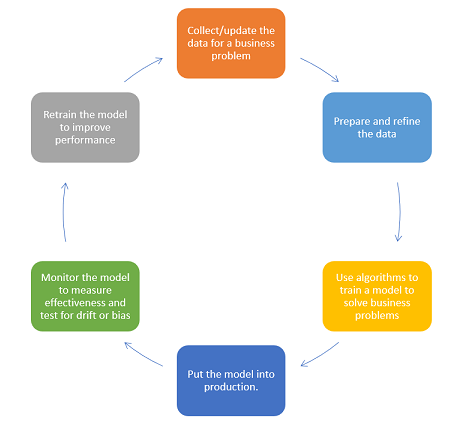
Training is computationally expensive and can take days or even weeks on powerful computers. Inference needs to be fast and efficient, often delivering results in milliseconds. Here's a quick breakdown of the differences:
| Feature | Training | Inference |
|---|---|---|
| Goal | Learn patterns from data | Apply knowledge to new data |
| Data | Large, historical datasets | Single, live data points |
| Process | Slow, iterative, and offline | Fast, real-time, and online |
| Cost | High computational cost (one-time) | Low cost per prediction (ongoing) |
Why Inference Matters
While training gets a lot of attention, inference is where the magic happens for users. It's the point where an AI system becomes useful. All the complex training is worthless if the model can't make fast, accurate predictions in a real-world application.
Instead, what’s most useful to companies is the inference stage — taking a pretrained AI model and then inputting their own data or prompts to help them perform business tasks more efficiently.
Every time you use an AI-powered service, you're kicking off an inference task. Here are a few examples:
- Your email service uses a model to infer whether an incoming message is spam.
- A navigation app infers your estimated time of arrival based on current traffic.
- Your phone's camera infers the presence of a face to focus on it.
In each case, a pre-trained model is taking in new data and outputting a useful prediction. This is the core of how we interact with AI every day.
Now that you understand the difference between teaching an AI and putting it to work, let's test your knowledge.
What is the primary role of AI inference?
Compared to the training phase, the inference phase of an AI model needs to be:
Understanding inference is key to seeing how AI moves from a complex research project to a practical tool that shapes our world.